
How to choose a cat tree: height, access and stability
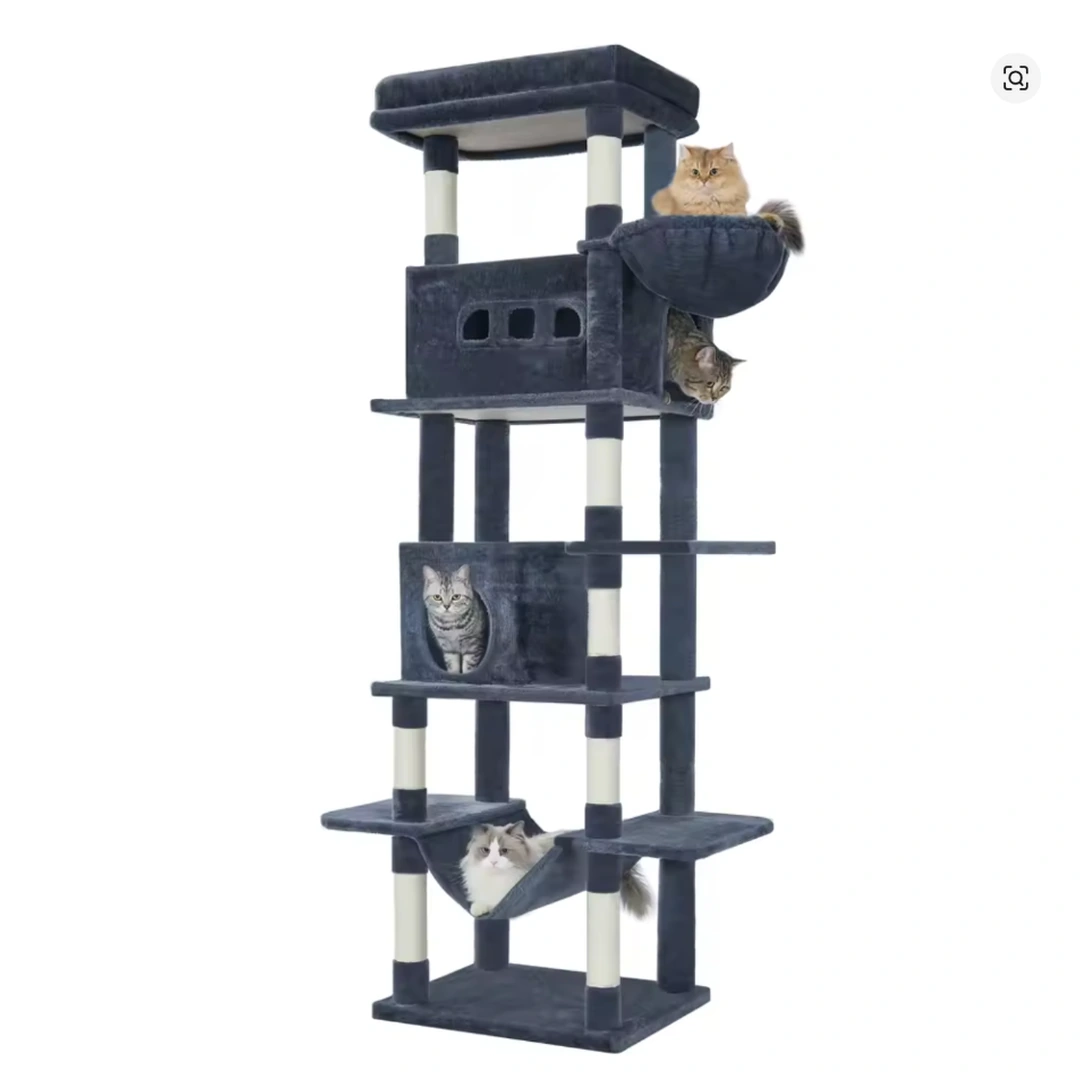
A cat tree can provide places to watch, rest and scratch. Yet its height or number of platforms alone cannot tell you whether it will suit your companion. The right choice depends on how your cat moves, what they prefer and how much room you actually have at home. AAFP and ISFM recommendations on feline environmental needs offer a useful framework: provide refuges, distribute resources and create opportunities for natural behaviours. This guide applies those principles to choosing a tall tower, without making unverified claims about any particular model.
Observe your cat’s habits before comparing models
Start by noticing where your cat chooses to settle. Do they prefer an armchair, an easily reached shelf or a hiding place at floor level? Some cats seek an open lookout point, while others rest somewhere away from passing feet. These observations help distinguish furniture you like from furniture your cat can actually use. Also note the surfaces they already scratch: the direction and position of a new scratching area can influence whether they take to it.
AAFP and ISFM guidelines describe a refuge as a private, secure space, often raised off the ground. They also recommend places where a cat can withdraw. That does not mean you need to choose the tallest tower. An accessible, quiet platform may be more useful than a summit that is hard to reach. If your cat hesitates to jump, changes how they get around or seems uncomfortable, seek veterinary advice rather than treating the change as simple disinterest in the furniture.
Check the platforms and routes between them
Look at the usable dimensions of the resting areas, not just the advertised outside measurements. Environmental recommendations say perches should be wide and long enough for a cat to stretch out fully. A photograph does not always show this: look for measurements of each platform, the size of openings and the gaps between levels. For a larger cat, a small hanging basket may look inviting in a picture without providing a suitable place to rest.
Next, trace the route your cat would take from the floor to a resting place. Are there manageable steps, room to turn around and more than one way back down? Do not assume every cat will manage the same gaps. A kitten, an agile adult and an animal with reduced mobility may use the structure differently. Choose access that suits your companion, rather than lifting them to the top to demonstrate the route.
Plan a stable position in the room
Before buying, measure the floor space, available height and clearance around the intended position. Consider doors, curtains and nearby furniture: the tower should not make a familiar route awkward. A position by a window may offer a lookout, but check that the window and its opening are safe. Having cat furniture nearby does not, by itself, prevent a fall or an accidental escape.
Assess stability using the design and instructions for the exact model. Check the assembly guidance, stated load limits and any fixings required by the manufacturer. Do not invent an anchoring method or assume that a large base automatically prevents a tip-over. Once assembled, check the components as directed and watch the first few uses. Any loose part, damaged surface or unusual movement should be investigated before you let your cat continue climbing.
Provide separate resources in a multi-cat home
A large tower with several beds does not necessarily replace separate resting places. AAFP and ISFM recommendations emphasise making resources available throughout the environment. Two cats in one household may not always want to share the same space. Notice whether one waits for the other to leave, stays on the floor or gives up a bed when the other approaches. Such behaviour can help you spot an arrangement that does not work for everyone.
Keep alternatives elsewhere in the room or home: a quiet refuge, an accessible bed and places to scratch should not all depend on one route. Food and water bowls and litter trays also need to be arranged as separate resources. Do not promise that a new tree will make conflict disappear. If tension continues, looking at the environment as a whole and seeking professional support is more appropriate than simply changing the furniture.
Introduce the tower gently and check the variant
Let your cat explore the structure at their own pace. Keep their usual resting places available while they get used to it, rather than replacing everything at once. Familiar company and interactions chosen by the cat may help with the introduction, but do not force them into a cubby. Environmental recommendations also highlight familiar scents and interactions that respect individual preferences. Watching use develop gradually is more useful than looking for a dramatic response on the first day.
Finally, compare the variant actually being offered with the available documentation. Colour, beds, accessories and dimensions can differ between listings. A supplier image can help identify a product, but it is not proof of a safe working load or a guarantee of what will be delivered. Ask for any missing information before deciding. For a tall tower, prioritise usable measurements, routes between levels and verifiable instructions; these are more helpful than a pile of sales claims.
Veyrulis is preparing a listing for a multi-level tall cat tree, with a height of 210 cm announced but still to be confirmed for the exact variant. The product is not yet for sale. Supplier images do not confirm the selected colour or what will be included; dimensions, safe working load and instructions still need checking. The button below opens this listing in preparation and does not allow an order to be placed.
Sources and further reading
This advice is for information only and does not replace your veterinarian's opinion.