
Changing cat litter entirely: when and how to organise it
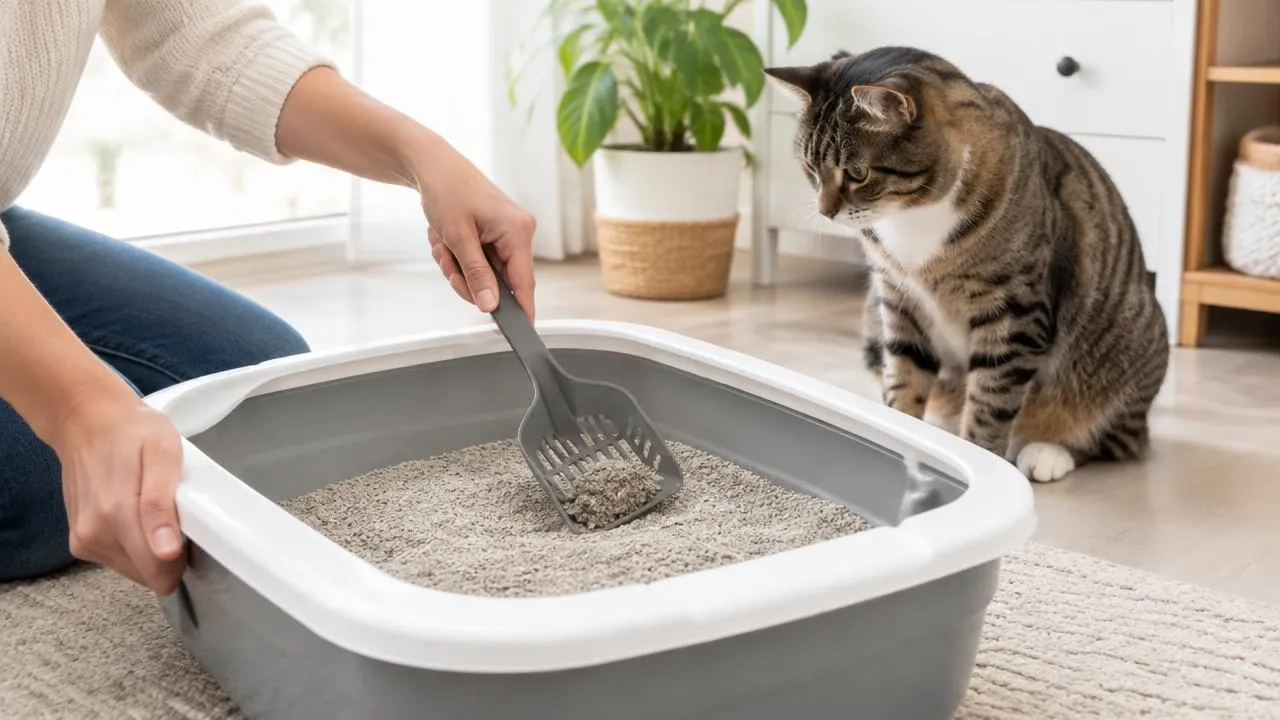
Changing cat litter entirely can mean two different decisions: renewing the tray contents or adopting a new material. The first is maintenance; the second involves the animal's preferences. Confusing them might lead to altering habits when you only wanted a clean container. AAFP/ISFM recommendations provide benchmarks for washing and replacement, while allowing for feline choice. Here is how to approach these decisions without attributing any specific medical properties to them.
Distinguishing renewal from product change
Emptying a tray for washing does not require choosing a different texture for refilling. In your thinking, start by identifying the need: maintaining the container or seeking a better-accepted substrate. This practical distinction helps in reading recommendations without attributing the effects of cleaning to a new material, nor interpreting every renewal as a change in feline habits. Clarifying this intent ensures you maintain consistency for your pet while achieving hygiene.
AAFP/ISFM guidelines advise, in most cases, a clumping, unscented, fine material comparable to sand. They highlight individual preferences, including depth. Putting back a litter that already suits and testing another proposal are two distinct steps. Nothing in the source texts justifies automatically renewing the product type during every major maintenance session. Consistency is often key for feline comfort, unless a specific aversion to the current substrate has been clearly observed.
Placing replacement within the washing range
The AAFP/ISFM document places tray washing every one to four weeks. It specifies that some behaviourists prefer washing and replacing litter weekly, while others suggest two to four weeks. This nuance must be preserved: the source describes several accepted practices rather than a single duration applying mechanically to every cat and installation. Your specific frequency should reflect the number of cats, the type of substrate used, and the observed levels of cleanliness.
Between these operations, waste must be removed at least daily and the level topped up when necessary. Pouring new material over soiled content is not the removal action described by the guide. To organise your maintenance, keep three separate actions in your routine: removing waste, adding as needed, and planning the wash with content renewal. This structured approach prevents the build-up of bacteria and odours while maintaining the comfort of the animal.
Using the empty container to return to basics
For washing, the authors recommend hot water and soap only. They advise against strong chemical substances and ammonia-based products. The moment the tray is empty does not have to become a session of multiple treatments: available sources provide neither a universal disinfection protocol nor a domestic recipe to substitute for this indication. Simple cleaning maintains the integrity of the plastic container while ensuring it remains safe and attractive for your cat's use.
Cleaning the tray should not be replaced by adding fragrance to fresh material. AAFP/ISFM explains that no product cancels the need for regular maintenance and that scented litters or deodorants may displease cats. Newly poured content is not a reason to further perfume the space; the objective is not to give it an olfactory signature intended for humans. Cats have a sensitive sense of smell, and artificial scents can cause litter box avoidance.
If you want another texture, propose rather than impose
To explore preferences, the guide suggests offering several trays with varied substrates and depths. This possibility is particularly useful when your question goes beyond simple content replacement. You can note the cat's choices between the proposals without labelling as a whim the fact that it does not use the one that seemed most practical or pleasant to you. This observational method respects the animal's natural inclinations and helps reduce stress.
The text also describes a progressive introduction of the desired material into the indoor tray when the cat prefers ground similar to that used outside, such as soil or sand. It does not, however, provide a specific numerical calendar valid for all transitions. Therefore, do not invent a mandatory daily proportion; keep the observed preference and individual circumstances at the centre of the process. Patience ensures the cat accepts the new substrate without discomfort.
Evaluating refusal without blaming renewal
After maintenance, a change in usage deserves to be described precisely. Guidelines remind us that elimination difficulties can involve several dimensions, notably medical, environmental, and social. A clean container does not guarantee that its location, access, or interactions with other cats are suitable. Conversely, the simple fact that a refusal follows a renewal does not prove its cause. Multiple factors must be considered to understand why a cat avoids its designated toilet area.
The MSD Veterinary Manual mentions bloody urine, frequent urges, straining, and urination outside the box among signs of lower urinary tract diseases. Faced with these manifestations, contact a veterinarian rather than multiplying replacements as the sole response. Litter management is part of the measures mentioned for idiopathic cystitis, but its diagnosis requires excluding other causes; domestic observation alone is not sufficient. Professional medical advice is essential whenever health symptoms appear during maintenance.
The project for a connected automatic round litter box from Accessoires Chat remains in preparation and is not yet marketed. Its price has not been validated. The visual is an illustrative image, not a confirmation of specifications. These will be confirmed on the manual of the delivered model; for details specific to the device, check the manual of the exact model. This product remains a draft not available for sale.
Sources and further reading
- AAFP and ISFM Guidelines for diagnosing and solving house-soiling behavior in cats (Journal of Feline Medicine and Surgery, 2014)
- Manuel vétérinaire MSD — Lower Urinary Tract Disease in Cats
This advice is for information only and does not replace your veterinarian's opinion.