
How often to clean cat litter? Benchmarks for the cat
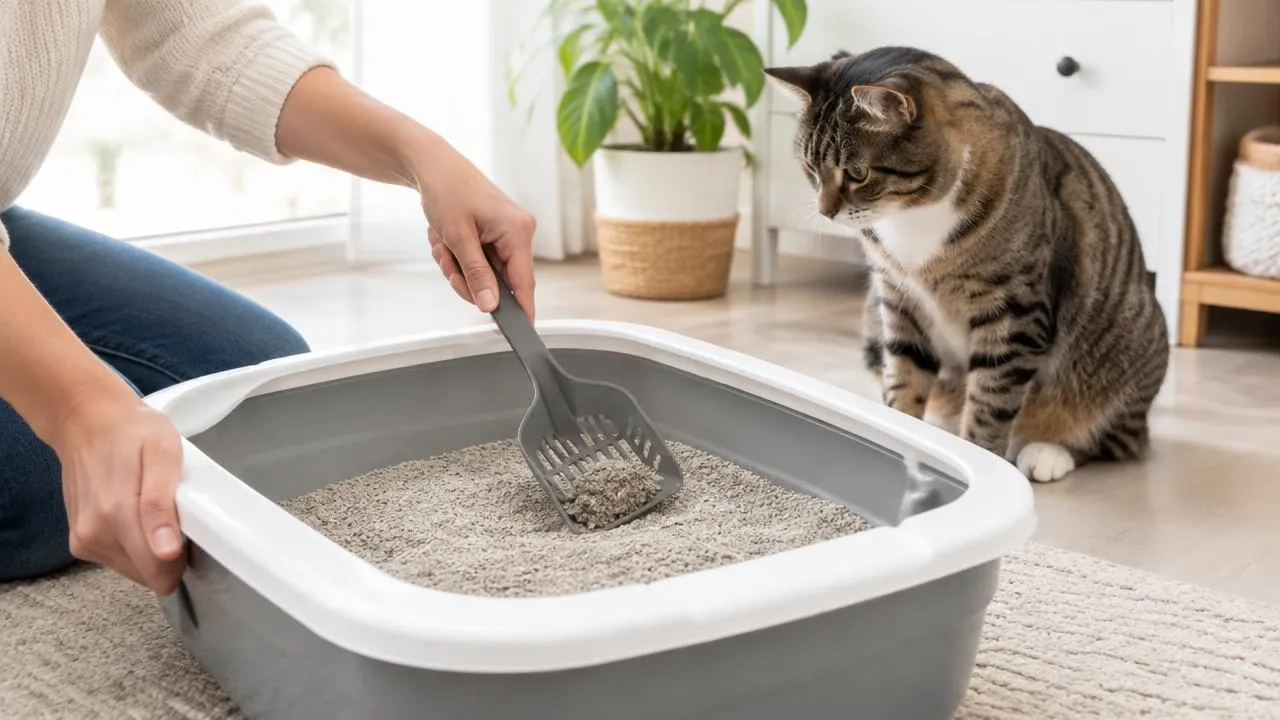
How often should you clean litter without confusing a quick daily check with a full wash? The answer becomes clearer when these tasks are separated. AAFP/ISFM guidelines provide a minimum for waste and a range for the container. They also recognise that practices proposed by professionals are not all identical. This guide aims to help you organise these actions without turning a calendar into a blind rule or missing an unusual sign.
The daily appointment concerns waste
According to AAFP/ISFM recommendations, waste must be removed at least once a day. Material should also be topped up as needed. This is the most direct answer for routine monitoring: a tray should not wait for the next major wash to be cleared of what the cat has deposited there. Following this minimum ensures the environment remains acceptable for the animal while preventing unpleasant odours from accumulating within the home environment.
This daily minimum does not describe a guaranteed duration of cleanliness for all installations. The document emphasises that a soiled tray can lead to aversion. Therefore, think of removal as a regular task rather than permission to leave waste until a specific hour. With multiple containers, ensure your organisation does not systematically leave the same one away from maintenance. Consistency across all available toilet areas is vital for maintaining the cat's established bathroom habits.
The full wash follows a different schedule
To wash the tray, the reference text indicates an interval of one to four weeks. Some cited behaviourists judge weekly washing and replacement as optimal; others estimate that a rhythm of two to four weeks remains compatible with cat acceptance and proves easier for owners to follow. The guide presents this diversity instead of imposing a single date. Ultimately, the choice depends on the type of substrate used and the individual cat's sensitivity.
These benchmarks do not allow for assigning an exact number of days to each commercial family of granules. The provided sources do not give such a table. For your organisation, distinguish between what you know about the container, what you observe when inspecting it, and any specific instructions. If you use an automatic device, check the manual for the exact model rather than applying an invented periodicity to its specific mechanical cleaning cycle.
Plan the actions, not just an alert
A clear routine can set aside a moment for scooping and separately identify the next wash. This way of organising does not add a veterinary prescription: it simply serves to make the two tasks planned by AAFP/ISFM visible. Record what has actually been done, especially if several people share the care of the trays, so as not to confuse an intention with completed maintenance. Documentation helps track changes in the cat’s frequency.
During washing, the authors advocate only soap and hot water; they request that strong chemicals and those containing ammonia be avoided. Respecting the frequency is therefore not enough if the method deviates from these indications. Conversely, choosing a product presented as very powerful does not dispense with regularly returning to the container and removing waste between washes. Proper hygiene requires both the correct frequency and the appropriate materials to ensure safety and comfort.
Make all toileting points accessible
The number of trays and their distribution contribute to the installation described by the guidelines. For a single cat, they recommend two trays in two distinct locations. In a multi-cat household, they mention the usual rule of the number of cats plus one, while specifying that social groups and relationships may lead to adapting this organisation. Each animal must feel secure and unhurried when using their designated litter facilities at home.
A clean but inaccessible tray does not meet the animal's needs. The guide specifically advises not to place food and water nearby and to allow cats to reach their toilets without having to encounter a housemate. When scheduling cleaning rounds, keep the issue of access in mind: the schedule and the location do not solve the same problem. An ignored tray might simply be poorly placed rather than being redundant for the feline users.
Spotting what a schedule cannot explain
The MSD Veterinary Manual describes frequent urination, straining to urinate, the presence of blood, and urinary elimination outside the tray as signs of lower urinary tract disease. An increase in visits should therefore not be interpreted solely as a need to scoop more often. Ask the veterinarian how to have these observations evaluated and report any changes noted in habits. Timely medical intervention is far more important than strictly following a cleaning schedule.
In rare situations of particularly difficult-to-control urinary infections, AAFP/ISFM mentions that daily washing of the container may be recommended. This exception does not turn daily full washing into a domestic norm for all cats. If a professional gives you specific instructions, have their implementation clarified; do not independently deduce a medical strategy from the general frequency presented here. Always prioritise direct veterinary advice over general guidelines when dealing with specific feline health issues.
A connected automatic litter box, in a round format, is in preparation at Accessoires Chat. It is not yet for sale; no price is validated. The associated image remains illustrative, without confirming characteristics. These must be verified in the manual of the delivered model. For any questions regarding the operation or maintenance of this equipment, check the manual of the exact model. Product remains a draft not for sale with illustrative imagery.
Sources and further reading
- AAFP and ISFM Guidelines for diagnosing and solving house-soiling behavior in cats (Journal of Feline Medicine and Surgery, 2014)
- Manuel vétérinaire MSD — Lower Urinary Tract Disease in Cats
This advice is for information only and does not replace your veterinarian's opinion.