
Cheap automatic litter boxes: what to compare before choosing
Searching for a “cheap automatic litter box” reflects an understandable aim: keeping spending under control. On its own, however, that search does not provide a reliable way to compare the options available. Without verified prices and detailed instructions, describing something as a bargain would be misleading. Instead, this guide helps you distinguish between what is documented, what remains unknown and what matters to your cat. Veterinary guidance does not establish prices or identify any particular model as the best choice.
Establish an honest basis for comparison
Start by writing down the exact model references you want to examine, keeping different versions separate rather than treating them as interchangeable. Beside each one, record only the specifications stated in its instructions. For questions about functions, accessories or conditions of use, consult the manual for that precise model. An empty box does not mean that a function is either present or absent: it simply means you do not yet have the answer.
You can then divide your questions into three columns: everyday use, maintenance and suitability for your animal. This table is a decision-making aid, not a performance test. Without documentation that makes comparison possible, avoid ranking the models against one another. Asking for clarification before choosing is better than attaching an implied value to a marketing phrase when you do not know the practical conditions behind it or the limitations that have been stated.
Compare toileting space, not just external shape
According to the AAFP/ISFM guidelines, litter box size plays an important role in whether a cat accepts it. For a rectangular tray, the suggested length is one and a half times the cat’s length, measured from the nose to the base of the tail. This advice helps you assess the space available; it does not make an appliance’s external dimensions equivalent to usable internal space. That space must be documented for the particular model being considered.
These recommendations also specify that the opening should allow easy access. Rather than assuming a compact shape is automatically an advantage, ask which measurements describe the entrance and which describe the inside area. If those details are unavailable, keep that uncertainty visible in your table. Comparing only the amount of room the appliance occupies for people would overlook the space your companion actually needs to adopt its toileting posture inside the litter box.
Weigh up the maintenance requirements
The AAFP/ISFM recommendations emphasise that no product removes the need for regular litter box care. They call for waste to be removed at least daily and litter to be topped up whenever necessary. For your comparison, therefore, ask which tasks are described, which parts need handling and how those tasks are carried out. Do not put a figure on time savings you have not measured, or assume every appliance requires the same maintenance schedule.
The veterinary document recommends periodically washing trays with soap and hot water, without harsh or ammonia-based products. For a device containing technical components, check its manual to establish which parts may be cleaned and which methods are permitted. Compare how clearly these instructions are explained, rather than relying on a general promise of simplicity. If you cannot explain how to maintain the model you are considering, you cannot yet judge whether it suits you.
Include your cat’s habits in the decision
Price tells you nothing about preferences for litter material. The AAFP/ISFM text describes a common preference for fine, unscented, clumping litter, while recognising individual differences. Before deciding, identify what your cat currently uses and look for explicitly stated compatibility information. A preference described in veterinary guidance does not amount to technical approval for a device. Equally, a material being permitted by a manufacturer does not demonstrate that your own animal will accept using it.
Also consider how litter boxes are distributed around your home. For a single cat, the authors recommend two trays in separate locations. Where cats live together, they stress the importance of resources being accessible to the different social groups. Do not assess your plans as though the proposed purchase must necessarily become the only toileting location. The number and positioning of trays should reflect feline needs, rather than a comparison of the electronic functions available.
Reject savings presented as medical benefits
The MSD Veterinary Manual includes litter box maintenance among several aspects of managing idiopathic cystitis, alongside the environment, stress and interactions between cats. It does not support claims that a particular model prevents disease or avoids the need for treatment. Supposed reductions in veterinary expenses should therefore never be used to justify your choice. Keep the budget for equipment separate from the medical assessment of any symptoms you have noticed in your own cat.
In practice, finish your comparison by listing the remaining unknowns, rather than producing an artificial ranking. You may have clearer information about one model’s access, permitted litter materials and maintenance requirements than another’s; that reflects the quality of the information available, not clinical superiority. If your companion urinates elsewhere or strains to urinate, the signs described by MSD call for a discussion with a vet, not simply a search for a different appliance or a cheaper offer.
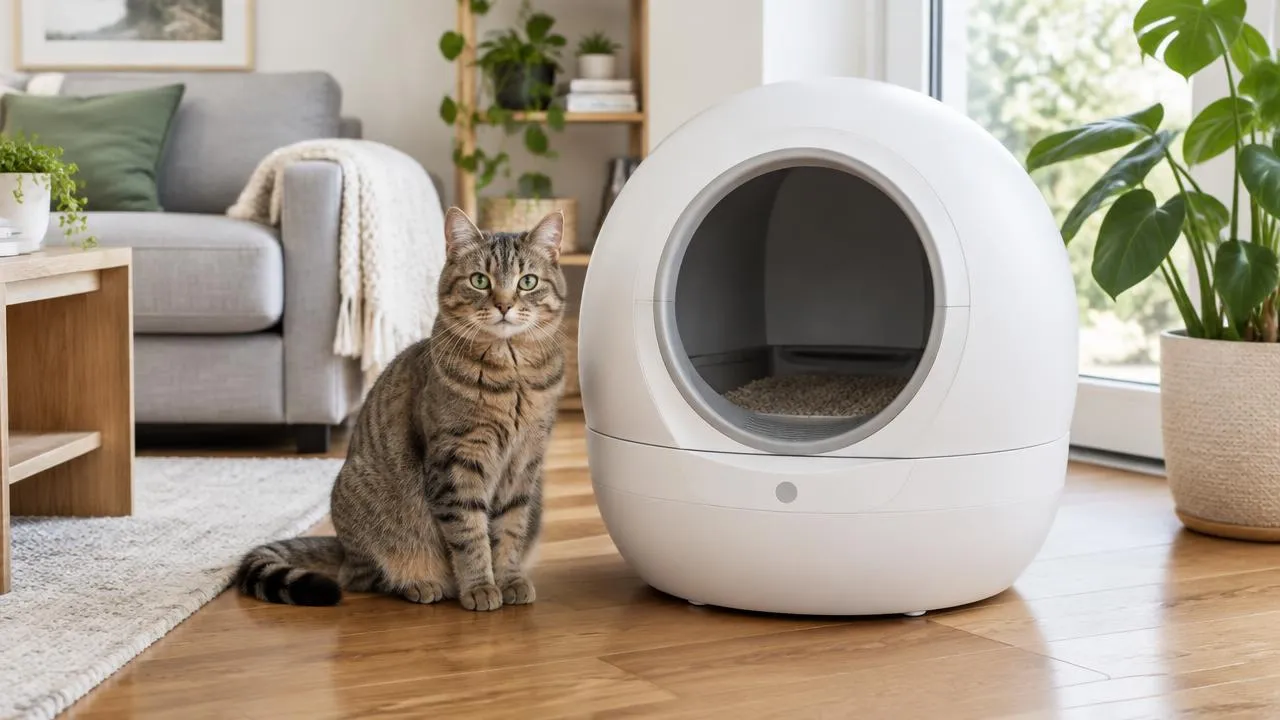
A round, connected automatic litter box is being prepared by Accessoires Chat; this project is not yet available for sale. Its price has not been confirmed, so a meaningful price comparison is not possible at this stage. The image is an illustration. Specifications will need to be checked against the instructions accompanying the model actually delivered, rather than inferring any particular functions from the appearance shown in the image.
Sources and further reading
- AAFP and ISFM Guidelines for diagnosing and solving house-soiling behavior in cats (Journal of Feline Medicine and Surgery, 2014)
- Manuel vétérinaire MSD — Lower Urinary Tract Disease in Cats
This advice is for information only and does not replace your veterinarian's opinion.