
Self-cleaning litter trays: how do they work and what should you check?
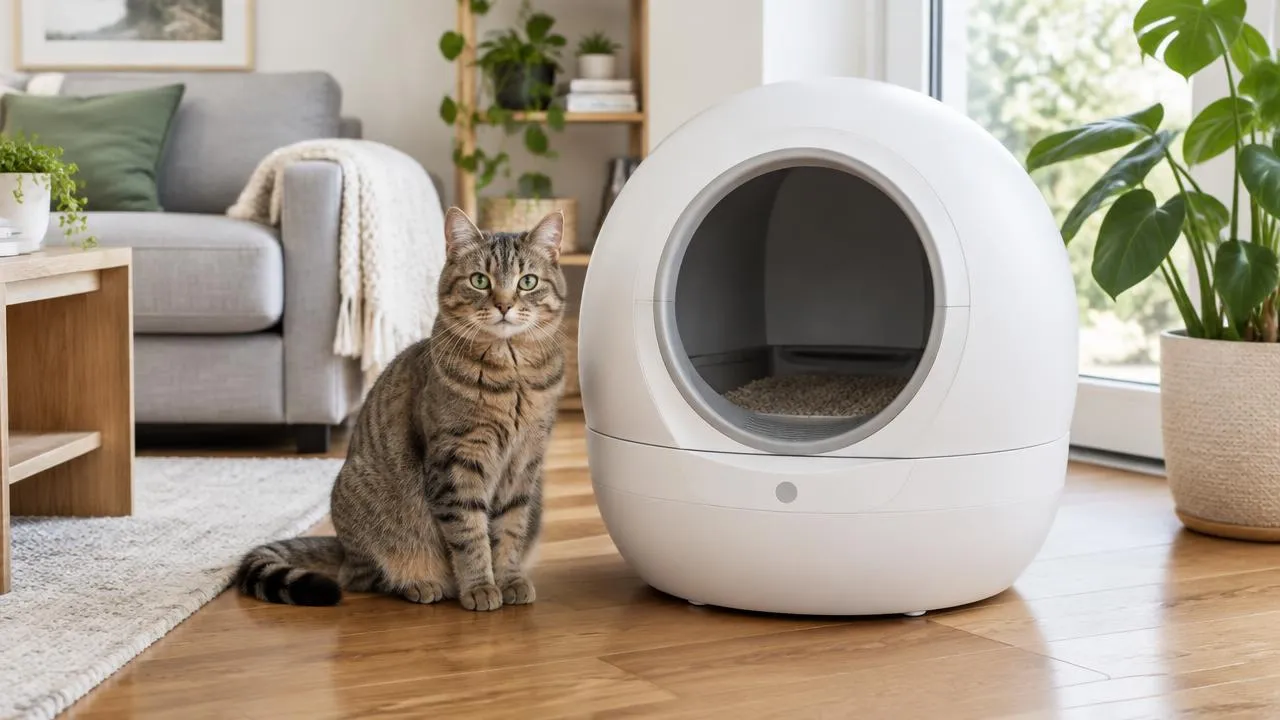
How does a self-cleaning litter tray work? Answering that question without assuming that every device has the same capabilities means distinguishing technical documentation from your cat’s needs. The veterinary sources used here discuss cleanliness, preferences and health; they do not describe the mechanisms of models available on the market. What follows is therefore a way of reading the information about a particular device, rather than treating its name as a guarantee of comfort or a promise of medical benefits.
Start with the manual, not the product name
What exactly does “self-cleaning” mean for the particular model you are considering? Look in its instruction manual to see which operations are provided, when they take place and which tasks still require your involvement. Do not assume how activation, waste movement or connected operation works. For each of these points, check the manual for that exact model: veterinary recommendations cannot supply the missing information in an incomplete commercial product description.
To make this reading exercise practical, write out a complete sequence of use: the cat entering, the stated operation, waste collection, maintenance and returning the device to use. Put a question mark beside every stage that is not documented. This approach does not describe a universal technology; it helps you formulate questions for the seller. Any function that the document makes difficult to explain must remain unconfirmed information, rather than becoming a reassuring assumption.
Separate technical functions from feline comfort
The AAFP/ISFM guidelines emphasise that the dimensions of litter trays matter just as much as their number. They generally recommend a rectangular tray measuring one and a half times the cat’s length, from the nose to the base of the tail. This reference concerns the space available for toileting; it is not a certification of automatic devices. For usable dimensions and access arrangements, consult the specific documentation for the model you are examining.
The same document notes that preferences are divided between covered and open trays. It recommends open trays where possible, to make monitoring and frequent waste removal easier. Do not conclude from this that your cat will necessarily accept a different shape simply because it is automated. Instead, compare the proposed device with your cat’s current habits, without allowing its external design to become the sole consideration on which you base your choice.
Understand what still needs maintenance
According to the AAFP/ISFM recommendations, no product removes the need to clean and maintain a cat’s toilet regularly. The document calls for waste to be removed at least daily and litter to be topped up as needed. This principle is separate from technical procedures: to find out how to check cleanliness, empty the designated parts or work on a device, consult the exact model’s manual rather than improvising a dismantling procedure.
For a litter tray, the authors also suggest washing every one to four weeks with soap and hot water, avoiding strong substances and ammonia-based products. This advice does not mean that every electrical or assembled part can undergo the same treatment. Ask which parts are washable and how they should be washed. When reading the documentation, distinguish the care of the toileting area itself from maintenance of the technical components.
Keep toileting facilities accessible and acceptable
Location is part of how the setup actually works in practice, in terms of the cat using it. The AAFP/ISFM document explains that a tray near noisy appliances, or associated with an unpleasant experience, may be avoided. It also advises keeping food and water away from toileting facilities. Before favouring a position that is convenient for you, therefore, consider how quiet the location is and the route your cat must take to reach it.
The litter material deserves the same careful consideration. In most situations, the authors favour a fine, unscented, clumping material, while recognising that individual preferences vary. This recommendation does not establish any mechanical compatibility. If your cat’s preferred material is not clearly listed among those permitted, seek confirmation in the manual for the model concerned. Your choice should neither conflict with the animal’s needs nor rely on compatibility that has simply been assumed.
Do not confuse use with a health assessment
The MSD Veterinary Manual lists blood in the urine, frequent urination, straining to urinate and urinating outside the tray among the signs of lower urinary tract disease. Changing the cat’s toilet cannot establish the cause of these signs. If you notice them, speak to your vet: explaining the behaviour solely in terms of the new device would mean leaving the medical question out of consideration rather than addressing it.
MSD includes litter tray management, stress reduction and relationships between cats in the management of idiopathic cystitis. It does not present automatic equipment as a treatment. Your practical conclusion can therefore remain modest: understand the documented functions, check the constraints and observe your companion. A machine’s stated ability to operate correctly is not, on its own, sufficient to demonstrate that the toileting facilities are suitable for the cat that uses them.
At Accessoires Chat, a round connected automatic litter tray is in preparation. It is not yet available for sale, and its price has not been approved. The image shown remains illustrative: it cannot be used to establish what the final specifications will be. Those specifications will need to be confirmed in the instruction manual for the model actually supplied, before drawing any conclusions about the functions it offers or the conditions under which it should be used.
Sources and further reading
- AAFP and ISFM Guidelines for diagnosing and solving house-soiling behavior in cats (Journal of Feline Medicine and Surgery, 2014)
- Manuel vétérinaire MSD — Lower Urinary Tract Disease in Cats
This advice is for information only and does not replace your veterinarian's opinion.