
Cleaning the litter box: which products are preferred?
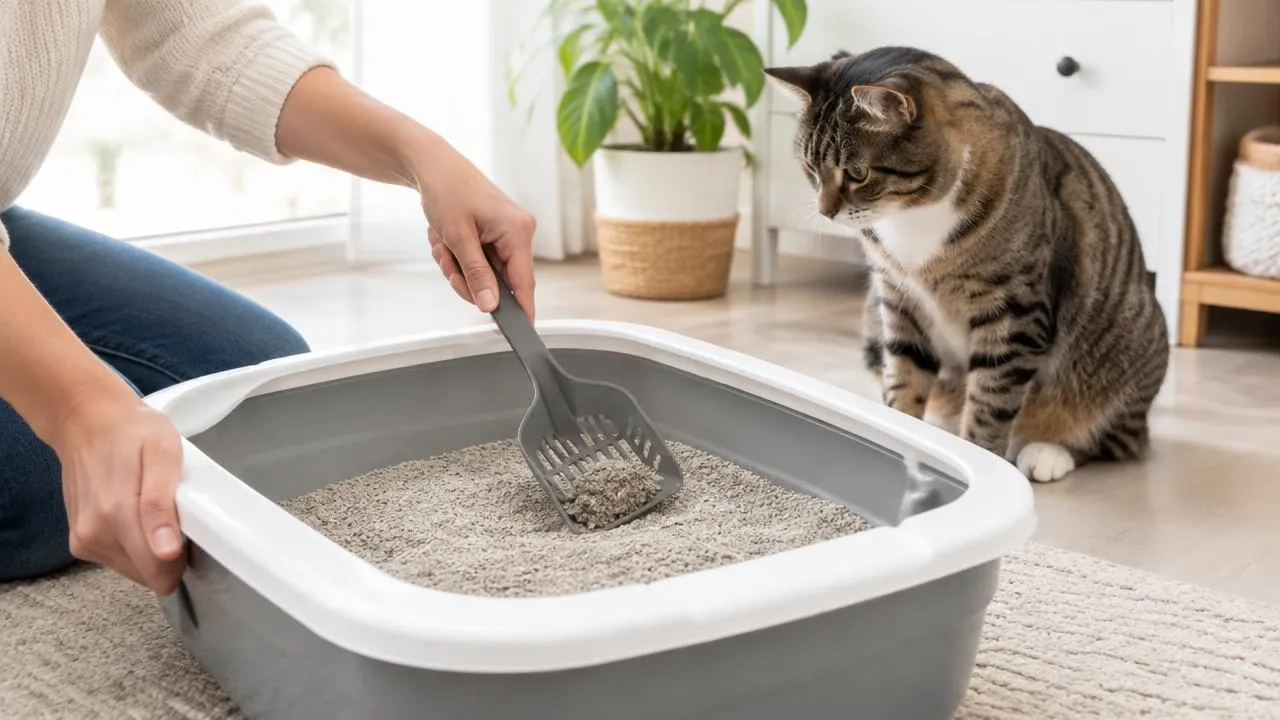
To clean the litter box, should you seek a specialised disinfectant or a homemade mixture? The AAFP/ISFM guidelines provide a sober response: soap and hot water, without harsh chemicals or ammonia-based products. This does not classify every commercial reference, but it provides a clear direction. This guide remains within the limits of the two available veterinary sources and distinguishes washing the container, removing waste, and health issues that require more than a product.
The basic choice relies on two elements
The section dedicated to box management in the AAFP/ISFM recommendations requires using only soap and hot water. This is the starting point to maintain when choosing how to wash the container. The authors do not provide a brand, specific commercial formula, or ranking of soaps; it would therefore be misleading to transform this indication into a detailed comparison. If you seek a specific brand, these guidelines do not list validated commercial products.
The same recommendations exclude strong chemical agents and products containing ammonia. This phrasing must remain faithful to the text: it does not provide an exhaustive list of authorised or prohibited ingredients, nor does it allow for announcing a disinfectant concentration. If your question concerns a specific formula, the sources presented here are not sufficient to confirm its relevance for this washing. Always prioritise the simple mixture of soap and hot water for safety.
Do not invent a recipe from general advice
Simple washing advice is not a disinfection protocol. The two consulted texts do not describe dosages for vinegar, bicarbonate, or a domestic mixture, nor contact times applicable to all containers. We cannot therefore recommend these recipes as if they had been validated in the available passages, even when they circulate widely. Sticking to the basic veterinary instructions ensures you do not inadvertently use substances that might be unpleasant or harmful to the cat.
This limit also applies to promises of urinary protection linked to a cleaner. The MSD Veterinary Manual presents lower urinary tract disorders as having various causes. It mentions litter box management in the care of idiopathic cystitis, without attributing to a washing product the capacity to prevent or cure diseases. A maintained container does not become a medical treatment. Therefore, do not expect a specific soap to resolve underlying health issues or clinical conditions.
Fragrance does not measure washing quality
The AAFP/ISFM guide warns that cats often find scented substrates and deodorisers unpleasant. It also advises avoiding deodorising powders. Consequently, seeking a strong clean smell is not the criterion proposed for judging feline comfort. Human preference for a fragrance cannot be taken as a sign of acceptance by the box user. A neutral-smelling environment is often preferred by cats to avoid sensory aversion that might lead to inappropriate elimination outside the box.
The authors notably explain that a cat may abandon a covered box containing an odour and return to it after cleaning, once the odour has become neutral again. This observation supports the importance of not confusing masking with maintaining. However, it does not demonstrate that all box refusal is olfactory: dimensions, substrate, location, and relationships between animals remain other elements of the installation to examine. Multiple factors influence the cat's use of its sanitary space.
Associate the method with the right maintenance rhythm
Washing is recommended at an interval of one to four weeks by AAFP/ISFM. The document reports a weekly preference among some behaviourists and a two-to-four-week preference among others. Choosing the soap therefore does not mean waiting indefinitely before using it; the product and regularity respond to two complementary aspects of container maintenance. Establishing a routine helps maintain a hygienic environment that meets the ethological needs of the feline while ensuring the container remains clean.
Daily, the guide requires removing waste at least once per day and topping up the substrate as needed. This task remains necessary between washings, even if the last full maintenance is recent. To avoid misunderstandings in the household, you can distinguish the actions in your organisation: removing is not washing, and adding material is not removing soil. Both daily scooping and periodic deep cleaning are essential components of proper feline hygiene and environment management.
Recognising the limits of domestic cleaning
A urinary change requires particular attention. MSD cites straining to urinate, more frequent urination, blood in the urine, and urinary deposits outside the litter box as manifestations of lower urinary tract diseases. If you notice these signs, describe them to the vet. Changing the cleaner does not allow determining if it involves stones, an infection, or another condition. Professional diagnosis is vital when clinical signs appear, regardless of the cleaning products you currently use.
A specific washing instruction may sometimes come from the professional: AAFP/ISFM rarely mentions daily washing during urinary infections that are particularly difficult to control. This is not an invitation to generalise this rhythm nor to choose a disinfectant alone. Finally, for a container belonging to an automatic device, check the manual of the exact model for specificities to respect; the sources do not detail every equipment. Adhere to the manufacturer instructions for electronic components.
At Accessoires Chat, the round model of connected automatic litter box is in preparation and not currently available for sale. The price remains to be validated. The image shown is illustrative; no specifications should be inferred from it. Characteristics must be confirmed in the manual of the delivered model. For technical indications specific to this device, check the manual of the exact model. It is currently a draft product and not for sale.
Sources and further reading
- AAFP and ISFM Guidelines for diagnosing and solving house-soiling behavior in cats (Journal of Feline Medicine and Surgery, 2014)
- Manuel vétérinaire MSD — Lower Urinary Tract Disease in Cats
This advice is for information only and does not replace your veterinarian's opinion.