
Cat litter odour: focus on maintenance rather than masking
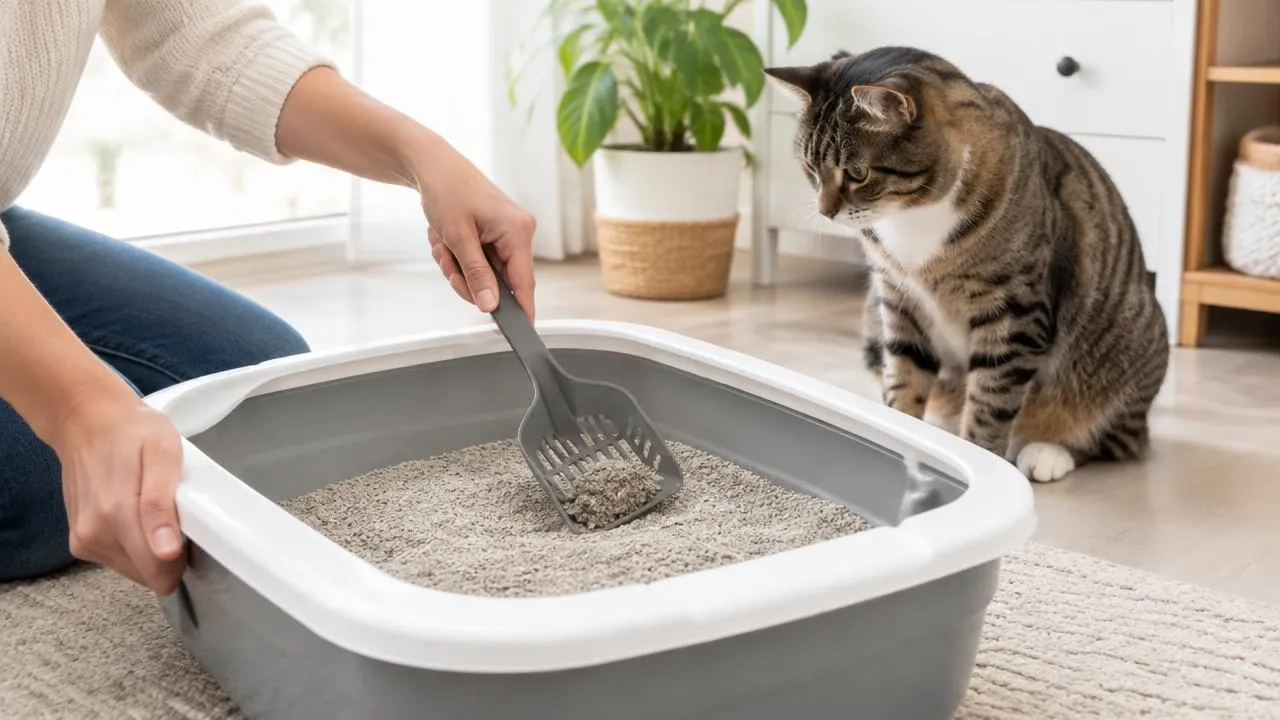
When a cat litter odour becomes unpleasant, the temptation is to seek a product that hides it. However, the owner's comfort and the cat's needs do not always align. AAFP/ISFM guidelines on elimination outside the box favour a well-maintained setup and an unscented substrate. To decide what to modify, it is better to distinguish between waste to remove, the container to wash and the habits of its user. This approach avoids replacing a cleanliness issue with a new scent. It allows for examining each step separately: what remains in the tray, how it is maintained and the reactions of your companion when using it.
Start with what remains in the tray
AAFP/ISFM recommendations require removing waste at least once a day and topping up the substrate whenever it becomes necessary. This daily routine therefore constitutes the first benchmark to examine. Before changing products, ask yourself if the waste is actually being removed and if all the trays in the house benefit from this attention. Regularity is the foundation of management, as it prevents the accumulation of bacteria and chemical compounds that cause strong smells.
The same document specifies that no product dispenses with regular cleaning and maintenance. A commercial argument mentioning freshness must therefore not lead to spacing out these actions. To organise the routine, mentally separate the removal of waste from the washing of the container: the former does not replace the latter, even when the surface appears acceptable. A clean-looking tray can still harbour bacteria on its walls, making thorough disinfection essential for a healthy home.
Wash the container with simple means
For the tray itself, experts give a washing range of between one and four weeks. They report different approaches: some behaviourists prefer washing with weekly replacement, while others suggest two to four weeks. These are management benchmarks, not a promise that a container will remain pleasant throughout this entire duration. The frequency depends on the number of cats, the type of litter used and the environmental temperature which affects how quickly organic matter degrades.
The cited protocol relies on soap and hot water. Strong chemicals and those containing ammonia should be avoided. If you are looking for a solution to a persistent odour, return to this recommendation rather than stacking different products. The texts used here do not allow for recommending a homemade recipe, a specific disinfectant concentration or a particular brand. Simple cleaning remains the gold standard to ensure the material does not absorb lasting smells over time.
Understand what a lid changes
The guidelines explain that an open tray does not trap odours inside as a covered installation can. They also point out that some cats avoid a closed box when an odour is present, then start using it again after cleaning and returning to a neutral smell. Hiding the content from human eyes therefore does not guarantee its acceptance by the animal. The concentration of vapours inside a hood can be overwhelming for a sensitive feline.
This does not mean that every cat refuses a lid. The reported preferences are shared between large covered and open trays. The document nevertheless recommends open models when possible, notably to facilitate monitoring and frequent scooping. Therefore, examine the actual usage of the tray before choosing a closure as a response solely to olfactory discomfort. Observing your pet's entry and exit can provide clues about whether they feel trapped or comfortable inside a hood.
Do not replace an odour with a perfume
Scented granules and deodorisers can displease cats, the AAFP/ISFM recommendations emphasise. Their general orientation is towards a fine, sand-like, unscented and clumping material. This choice targets the feline preferences described in the text; it does not constitute a guarantee that all odour will disappear nor that every animal will choose exactly the same texture. Respecting the animal's natural olfactory environment is crucial to avoid stress and potential house-soiling issues in the future.
If your companion stands on the edges with only one or two paws in the tray, the guide sees this as a possible sign of aversion to the substrate or its dirtiness. This behaviour invites a re-examination of the setup, without automatically concluding it is a perfume problem. Several containers offering different materials or depths also allow for exploring their preferences, as suggested by this source. Providing choices helps determine if the issue is the scent or the feel.
Distinguish domestic discomfort and urinary signs
A concern about odour must not overshadow what the cat is doing. The MSD Veterinary Manual lists among the manifestations of lower urinary tract diseases blood in the urine, frequent urination, straining to urinate and urine deposited outside the litter box. If you observe these changes, seek veterinary advice rather than limiting your response to replacing the granules. Medical issues require clinical intervention, whereas hygiene issues simply require a change in your daily cleaning routine.
MSD describes several possible causes for these manifestations and reminds us that idiopathic cystitis is diagnosed after excluding other conditions. A perceived odour in the house does not therefore allow for making this diagnosis. Cleaning remains useful, but it serves neither to identify a disease nor to treat it; above all, pass on to the veterinarian the concrete changes you have noticed. Early detection of physical distress is vital for the long-term health and comfort of your pet.
At Accessoires Chat, a connected automatic litter box in a round format is in development. It is not yet offered for sale and its price is not confirmed. The image is for illustrative purposes only. Specifications remain to be confirmed on the manual of the delivered model: please check the instructions of the exact model before relying on any technical information for your choice.
Sources and further reading
- AAFP and ISFM Guidelines for diagnosing and solving house-soiling behavior in cats (Journal of Feline Medicine and Surgery, 2014)
- Manuel vétérinaire MSD — Lower Urinary Tract Disease in Cats
This advice is for information only and does not replace your veterinarian's opinion.