
Cat tree spare parts: checking compatibility
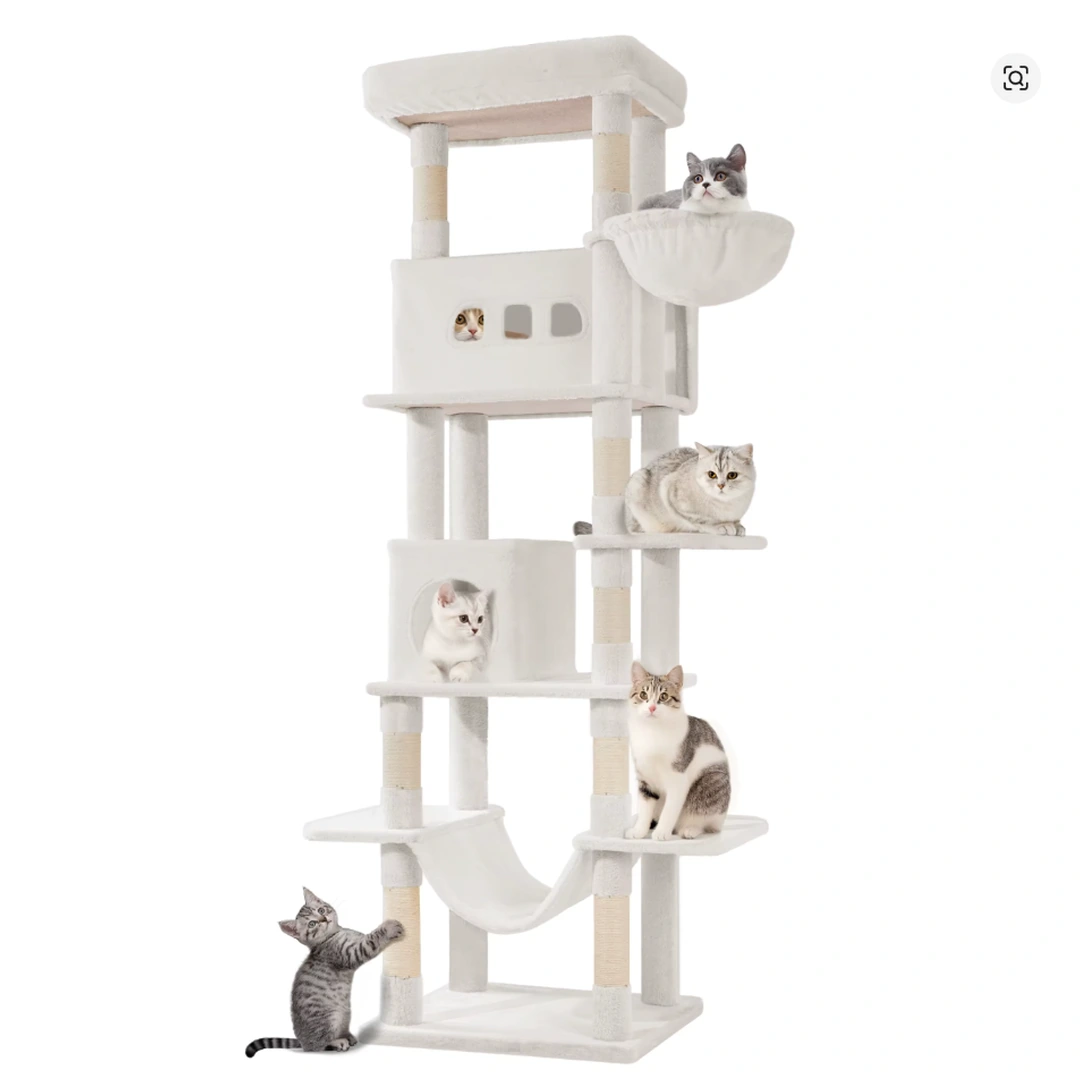
A post may look like the one on your cat tree, yet have a different connector. A platform may seem identical without sharing the same fixing points. When looking for cat tree spare parts, it is therefore better to prepare an accurate record than to order from a photograph alone. The aim is to identify the correct part reference and have its compatibility with the existing structure confirmed, using the manufacturer's instructions as your guide.
Cat tree spare parts: finding the references
Start by finding the brand, exact model name and reference on the invoice, any packaging you have kept or the product label. Record any version details too. The same commercial name can cover different configurations: a visual resemblance is not enough to establish that their components are interchangeable.
Find the parts list and diagram in the instructions. Record the code of the part you need, together with its position: a lower post, intermediate component or upper platform, for example. Similar-looking components may have different functions or connectors. Photograph the part in place and both ends, where accessible.
If the instructions are missing, ask the seller or manufacturer for those matching your exact model. Send your photographs with the available references. Keep original markings, even if unclear: they may help identify an older version. Without reliable identification, present your measurements as clues, not proof of compatibility.
Identify the thread, not just its apparent diameter
Examine every connection: a projecting threaded rod, threaded socket or through-fixing. A single post may have different connectors at either end. Record the top and bottom separately, with a close-up photograph. Any technical identification must be checked against the manufacturer's instructions or confirmed by its customer service team.
Diameter alone does not fully describe a thread. Its pitch, meaning the spacing between the threads, matters too. Callipers can help measure an accessible diameter, but cannot identify every characteristic of the connector on their own. Do not infer a technical designation from a rough measurement.
Also record the length of the projecting rod and the socket depth, if accessible without a risky intervention. These observations still need checking against the manufacturer's specifications. Never test a match by forcing the parts to screw together: difficult engagement may indicate incompatibility. An adaptor is not a solution to improvise.
Measure fixing centres and record their orientation
The centre-to-centre distance is the distance between the centres of two fixing points. On a platform with several holes, measure the relevant distances in each direction. Do not confuse this with the gap between hole edges. If the centres are hard to locate, state the uncertainty rather than silently rounding.
Next, draw a sketch viewed from above, clearly marking the front, back and side being viewed. Mark the holes and their distances from the edges. This orientation helps distinguish parts with similar but mirrored hole layouts. Add a photograph showing the ruler used to take the measurements.
It is also worth recording the diameter of the holes, any recess for a screw head and the thickness around the fixings. Their suitability must be checked against the manufacturer's instructions. Do not drill new holes to accommodate different fixing centres: you would be altering the part without knowing whether that modification is intended.
Compare relevant dimensions, not just overall size
For each component, distinguish external dimensions from those determining how it fits together. On a post, measure the body length separately from projecting threaded sections. For a platform, record length, width and thickness. Always explain your method: measurements bearing the same name can mean different things on different specification sheets.
Then examine the contact surfaces. Thick covering can hide a support's edge or make a measurement less clear. Do not tear anything away to obtain a dimension: instead, explain what remains hidden. Ask the manufacturer whether the stated dimension includes the covering and which supporting contacts are intended between components.
A difference in length may also affect connections with neighbouring parts. Compare the component within its immediate surroundings, not in isolation. Opening positions and clearance around connectors matter as much as the overall outline. If a listing only says ‘universal’, ask which models and configurations it explicitly covers.
Get confirmation before ordering
Put your request into one message: model, version, part code, photographs, dimensions, fixing centres and known connector details. Separate information taken from the instructions from your own measurements. Request written confirmation of compatibility with your exact reference, plus a list of fixings supplied or to retain according to the instructions.
On delivery, compare the part with your order and the instructions before installing anything. An unexplained discrepancy is reason to pause the replacement and contact the seller. Keep labels and packaging throughout this check. Do not allow access to a partially dismantled structure or one whose correct assembly remains uncertain.
The AAFP and ISFM guidelines on feline environmental needs (2013) highlight the importance of hiding places, raised perches, scratching and familiar scents. Keeping compatible components your cat already knows can accompany the replacement. Consult a vet for any sign of pain, limping, a fall, parasites or a change in behaviour.
VEYRULIS is preparing a 210 cm tall, multi-level tower cat tree, still at the draft stage and not yet for sale. Its price has not been approved, and its colour variant remains to be confirmed. To prepare for future replacements, keep its reference: specifications and any spare-part compatibility must be checked against the instructions for the model delivered.
Sources and further reading
This advice is for information only and does not replace your veterinarian's opinion.