
Connected cat litter applications and data: questions to ask
A connected litter application and its data easily raise expectations: understanding habits, keeping records or knowing what happens in your absence. None of this should be assumed for an undocumented reference. The veterinary sources used here describe neither software nor privacy policies. They serve mainly to recall what must remain observed in the cat. For everything regarding digital service, check the specific model instructions and request applicable documents.
Starting from documents rather than a digital promise
Create a list of questions without writing down presumed answers: is an account necessary, what information is displayed and what does it correspond to? Does the announced operation require a network? What remains possible otherwise? Search for the elements described for the exact version. A word like connected does not, on its own, provide information on the actual scope of a service or its settings.
Also ask where data recipients, retention periods and deletion options are explained. These points do not appear in the AAFP/ISFM or MSD texts and cannot be established from them. The objective is to obtain information from the provider, not to claim that all applications share the same practices or offer the same choices. Always consult the official documentation for the specific device purchased.
Understanding each piece of information before giving it meaning
For each potentially announced value, look for its definition in the documentation: what is measured, calculated or simply recorded? What limits are described? If you cannot find these explanations, note the question rather than inventing an interpretation. This preliminary work helps distinguish a documented function from a personal reading, without claiming a precision that has not been established. Technical specifications are the only valid source.
The MSD Veterinary Manual presents lower urinary tract signs as clinical manifestations: frequent urination, straining, blood in the urine and urinating outside the box. It does not validate an application as a means of recognising their cause. Any displayed information must therefore not be reformulated into a diagnosis of stones, infection or cystitis without veterinary evaluation. Data output remains raw information requiring expert medical assessment.
The same manual explains that several origins can produce urinary signs. A resemblance between a display and an observed change does not settle this question. If you wish to transmit a record, accompany it with what you have actually observed in the animal and the definition provided by the manufacturer. Separately present the observed facts and your understanding of the screen to ensure clinical clarity.
Maintaining a concrete description of behaviour
AAFP/ISFM guidelines place significant importance on the cat's history and environmental analysis. When a problem appears, describing elimination sites, recent changes and interactions helps reconstruct the context. A note written in simple words can supplement any available information without confusing it with a medical examination or laboratory result. Observations remain the primary tool for veterinary professionals to assess feline health and environmental well-being.
Do not summarise your observation to an indicator declared as reassuring. The MSD text notably cites straining to urinate and elimination outside the box; these manifestations deserve to be reported when seen. If a screen and your observation seem to tell different stories, report both to the vet, clearly indicating their origin. Do not erase actual behaviour behind a digital synthesis. Direct observation is irreplaceable for diagnosis.
Avoiding shortcuts in a multi-cat household
Before any collective use, ask how the model documents the potential attribution of information to an animal. Do not assume individual identification or reliable distinction between occupants. This point depends on the system specifications, not the veterinary recommendations cited here. If the answer is not clear, keep this limit explicit in the records you might share with a professional. Unverified data can lead to misinterpretation.
For their part, AAFP/ISFM recommendations insist on social relationships around litter boxes. Cats can limit the access of their peers, and non-affiliated groups need separate stations. These relationships are observed within the home. A digital view, regardless of its presentation, does not dispense with examining who approaches the toilets and who can actually use them. Physical monitoring of cat interactions remains essential for group harmony.
Keeping maintenance and medical follow-up at the forefront
AAFP/ISFM authors recall that no product replaces regular cleaning. Their recommendation to remove waste at least daily remains a benchmark for box management. For any maintenance reminders from an application, check what is actually planned and how it relates to the manual. Do not turn the absence of a message into proof that nothing needs to be checked. Hygiene requires consistent human verification and manual intervention.
Finally, a new episode of urinating outside the box justifies exploring health and context, according to the AAFP/ISFM approach. Do not attempt to resolve it solely by modifying a software option. Prepare your observations and available documents for the consultation. The interest of a connected setup must be discussed based on its confirmed functions, without attributing to it an unproven medical promise or data protection.
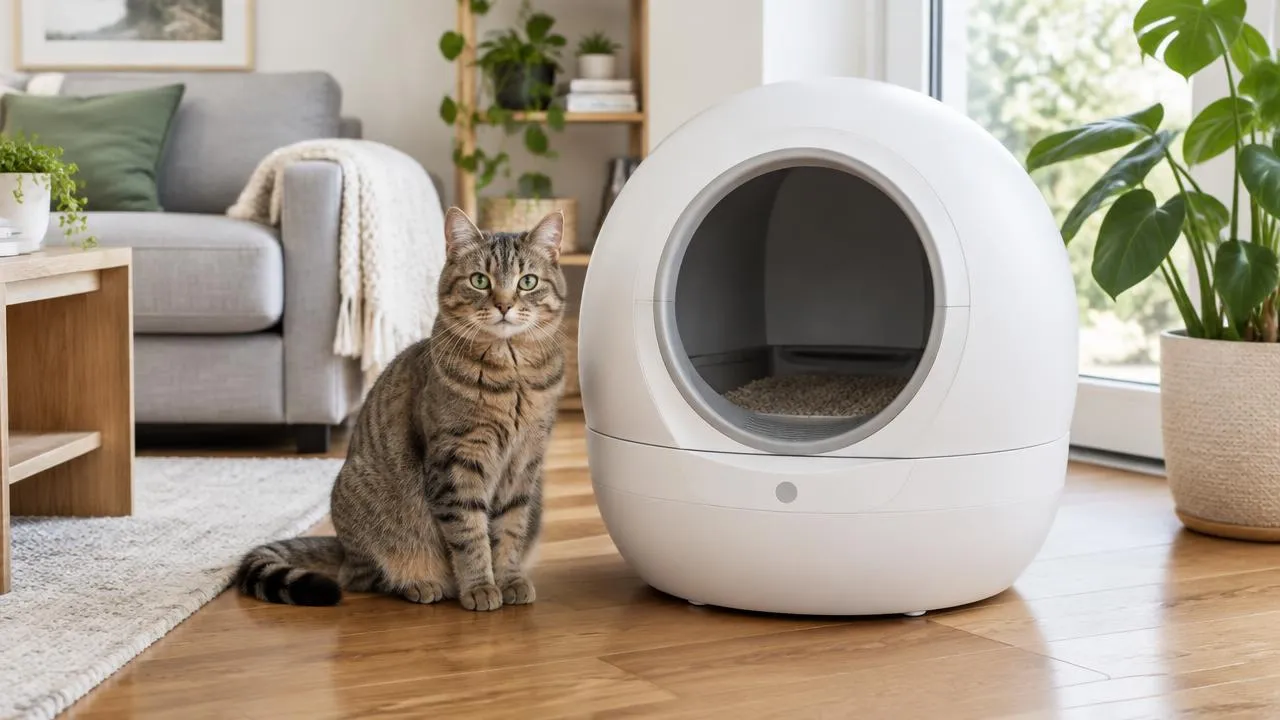
At Accessoires Chat, preparation concerns a connected automatic litter box with a round format. Sales have not started, the price remains unvalidated and the image is for illustrative purposes only. Specifications must be confirmed in the manual of the delivered model. This includes any digital functions: no list of data, application capacity or account modalities can be promised here. The product remains a draft not for sale.
Sources and further reading
- AAFP and ISFM Guidelines for diagnosing and solving house-soiling behavior in cats (Journal of Feline Medicine and Surgery, 2014)
- Manuel vétérinaire MSD — Lower Urinary Tract Disease in Cats
This advice is for information only and does not replace your veterinarian's opinion.