
Which cat tree lets a large cat stretch out without hanging over the edge?
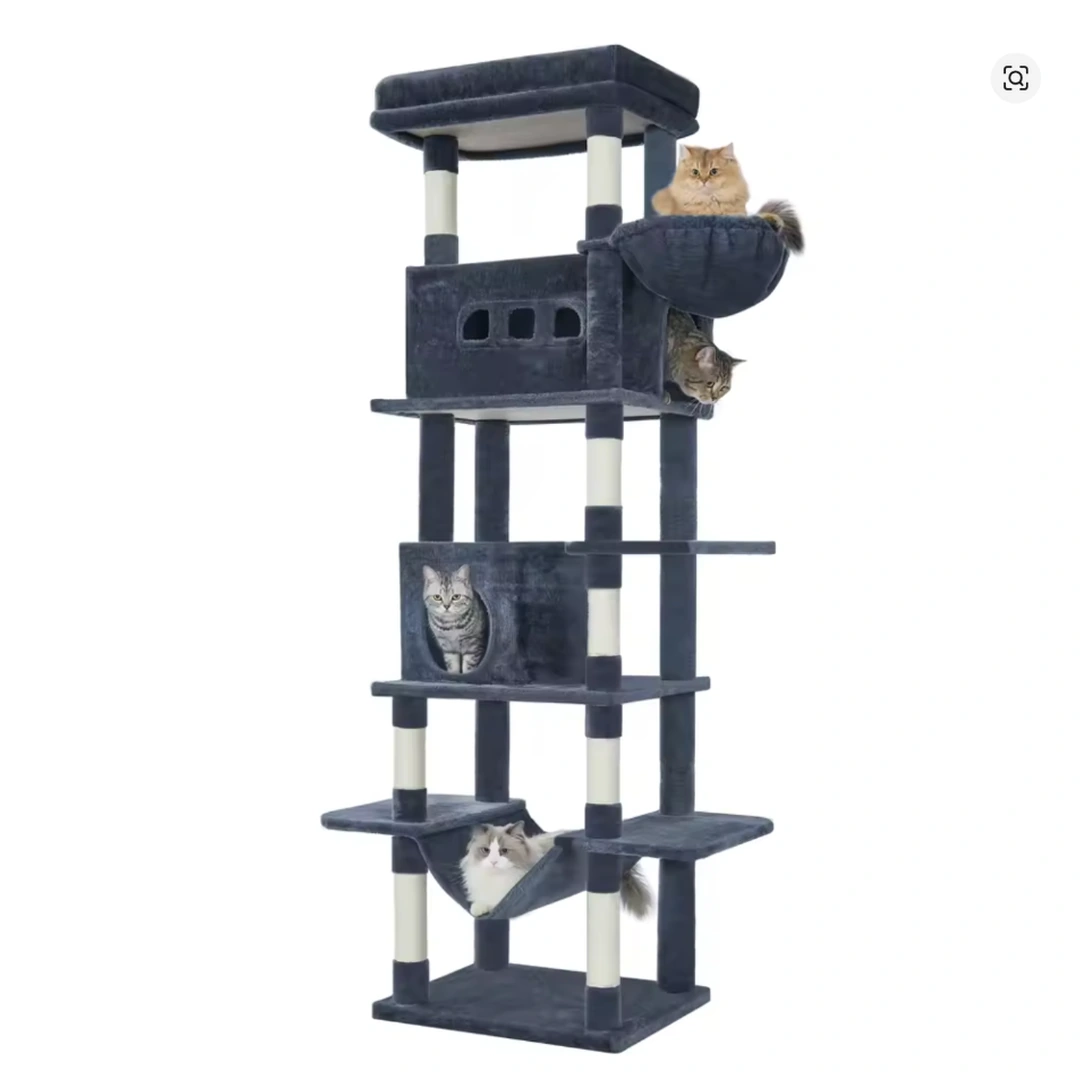
A large cat may fit on a platform when sitting, yet run out of room when sleeping on its side. Photos and overall measurements therefore cannot tell you whether a model's beds are suitable. When choosing a cat tree for a large cat, look at the surface that can actually support its body. Internal length, available width, edges and obstructions matter more than an impression of size. Here is how to compare those details with your companion's habits, without confusing the furniture's overall footprint with its resting space.
Cat trees for large cats: start with the sleeper
Before comparing models, watch your cat during its usual naps. Does it mainly sleep curled up, on its side, or with its front legs stretched out? Pay particular attention to the position that takes up the most room and that it willingly adopts. A suitable bed should not force it to stay tightly curled. Breed or weight alone cannot describe this footprint: two cats of a similar build may settle down in very different ways.
When your cat sleeps on a flat surface, roughly measure the length and width it occupies, without moving it or stretching its limbs. A photograph taken directly from above can help identify the outline, but cannot replace a measurement. Then reproduce that footprint on paper or cardboard on the floor. Allow room for movement, without assigning a universal figure: the allowance depends on its posture and the bed being considered.
Distinguish advertised dimensions from usable space
A product listing may give the outside measurements of a basket, its supporting board, or the entire piece of furniture. These figures are not interchangeable. Look for the bed's internal length and width, measured between the features that actually restrict your cat's position. A thick rim, domed cushion or post passing through the area can reduce the available surface. If the description is ambiguous, ask the seller exactly what the measurement includes.
To compare several cat trees, make a simple chart showing each bed's name, shape, internal measurements and any obstructions. Write ‘not specified’ rather than estimating a measurement from a photograph: perspective can be misleading. If possible, request a dimensioned drawing or a photograph with a measuring reference. All technical information must be checked against the manufacturer's instructions; a description such as ‘large size’ never replaces these specific details.
Compare shapes with your cat's lying position
A rectangular platform may offer useful length for sleeping on one side, provided its width also accommodates the body and legs. A square platform may suit a cat that frequently changes direction, but its diagonal measurement should not disguise sides that are too short. Compare the footprint observed at home with the whole shape of the support, not just its longest dimension. Rounded corners can also take away some of the advertised space.
For a round bed, look for the internal diameter actually available at the bottom. A generous opening at the top does not guarantee an equally wide base if the sides taper inwards. Oval beds require both internal length and width measurements. Flexible surfaces may change shape when occupied: do not assume they will provide the same resting area as a flat platform. Their design and conditions of use still need confirmation in the instructions.
Spot obstructions even on a large platform
A large board is not necessarily a large bed. Check the positions of posts, openings and attachments at bed level. A support in the middle may prevent your cat from stretching lengthways, even when the external measurements seem sufficient. Check the space above, too: another platform very close overhead can restrict certain positions. Ask for missing measurements rather than assuming your cat will inevitably find a way to squeeze into the space.
Edges need a balanced assessment. They can offer support, but sometimes occupy the space a cat needs for its shoulders or pelvis. A relaxed paw hanging over the edge does not, by itself, prove that the bed is too small. The practical question is whether your cat can choose to keep its whole body supported. If its hindquarters always have to hang over the edge to lie down, reassess the available surface.
Choose a proper bed rather than a collection of platforms
Compare each resting space individually: several small platforms do not replace one sufficiently spacious bed. A surface that only allows sitting may be a lookout point without being a suitable bed. The AAFP and ISFM guidelines on feline environmental needs (2013) highlight, among other things, the value of hiding places and elevated perches. They do not provide universal bed measurements for large cats: your comparison must remain specific to your animal.
Before buying, shortlist models with documented usable measurements that match your cat's footprint. After installation in accordance with the instructions, observe its positions without forcing it to try a bed. This observation does not replace the manufacturer's technical checks. If you notice any sign of pain, limping, a fall, parasites or a change in behaviour, consult a vet rather than automatically putting the situation down to a lack of space.
VEYRULIS is preparing a 210 cm tall, multi-level tower cat tree, which is not yet for sale. The price has not been approved, and the colour variant remains to be confirmed. Its suitability for a large cat will depend particularly on the usable dimensions of its beds. These specifications must be checked in the instructions for the model supplied, rather than judging by height alone.
Sources and further reading
This advice is for information only and does not replace your veterinarian's opinion.