
Maine Coon cat tree: posts suited to scratching
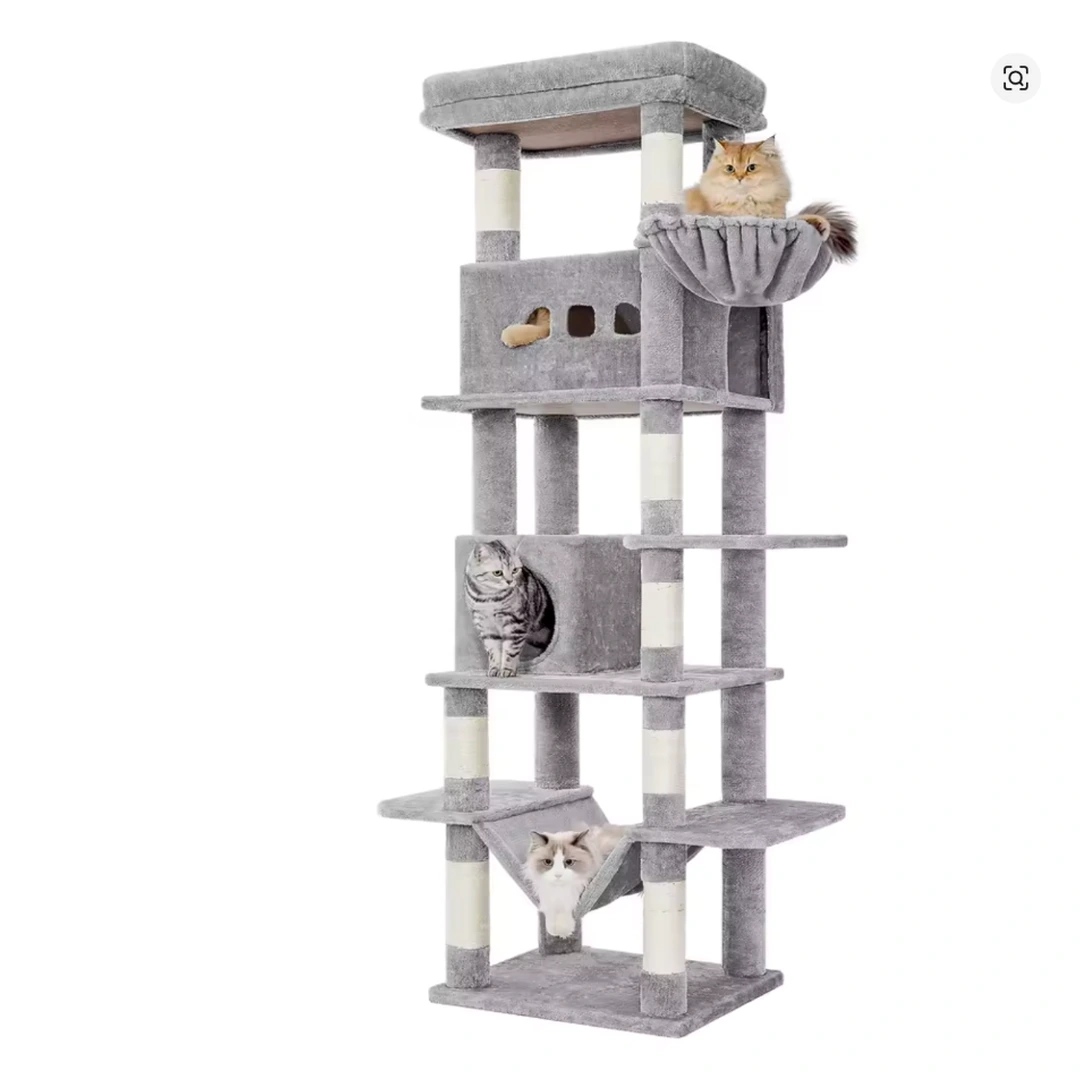
A Maine Coon scratching does more than work its claws against a rough surface: it reaches forwards with its paws, stretches its body and pulls on the support. When choosing a Maine Coon cat tree, looking only at the overall height can therefore obscure what really matters. A tall structure may have posts with too many interruptions for this movement. Instead, examine the section that is actually accessible, the purchase available to the paws and the stated strength, then check the technical information in the manufacturer’s instructions.
Maine Coon cat tree: measure the unobstructed length
The usable length is the surface the cat can scratch in one continuous movement, from its supporting position to its usual stretch. It is neither the tower’s height nor the combined length of several sections stacked above one another. An intermediate platform can interrupt a post that looks very long in a photograph.
Watch your cat stretch spontaneously against a permitted support, without lifting its paws or trying to encourage the greatest possible extension. Note the height it reaches and the space its body occupies. This gives you an individual reference point, more useful than a measurement presented as universally suitable for the entire breed.
Then compare this reference with the unobstructed length specified for each post. If the listing gives only overall dimensions, ask the seller for a dimensioned drawing. Also check the instructions to see where the scratching areas begin and end: decorative end pieces may reduce the section that is actually usable.
Check clearance for the body and paws
A post that is long enough on paper may still be awkward to use if a hideaway, step or edge obstructs the approach. Picture the cat standing in front of it, supported on its hind paws with its front paws higher up. Its belly, shoulders and head must follow the movement without negotiating an obstacle.
Examine front and side views rather than relying on the main image alone. A post behind a platform may have a visible surface but partly obstructed access. In particular, check whether the cat has somewhere to stand in front of the column, not just beside it. A photograph alone cannot settle this.
The path of the movement matters as much as the highest point reached. The paws need to travel back down the surface without immediately meeting a protruding joint. Have the clearances and model configuration confirmed in its instructions, especially when several different variants appear together within the same product listing.
Assess diameter without looking for a magic number
Diameter affects how the paws are positioned across the post. A narrow column has a more pronounced curve, while a wider one provides a less rounded contact surface. This does not establish an ideal diameter for every Maine Coon: their body sizes and scratching habits differ from one cat to another.
Observe whether your cat scratches with its paws close together, spread apart or placed on either side of the support. During a freely chosen trial, see whether its paws settle naturally into position. The aim is not to impose a posture, but to choose a shape suited to movements your cat already makes willingly.
When comparing two models, ask whether the stated diameter includes the covering and applies to every post. Perspective in a photograph can give a misleading impression of thickness. Refer to the measurements in the instructions: a substantial appearance alone tells you nothing about the internal construction or the post’s actual strength.
Distinguish apparent thickness from actual strength
When scratching, a cat pulls on the surface and puts the post under different stresses from simply passing nearby. Strength therefore depends on several elements: the post body, its ends, its connections and how securely the covering stays in place. Thick cladding can conceal a structure whose specifications remain unknown.
Look in the instructions for descriptions of load-bearing components, conditions of use and checks required by the manufacturer. Do not infer suitability for vigorous scratching from a single marketing term such as ‘giant’ or ‘reinforced’. If the information is ambiguous, ask the seller before choosing that model for your cat.
During the first uses, observe without holding or restraining the animal. Unexpected post rotation, visible deformation or a covering that shifts are reasons to stop access and seek advice from the manufacturer. Do not improvise a pulling test: the procedures for technical checks must remain those set out in the instructions.
Confirm your choice against your cat’s habits
The AAFP and ISFM guidelines on feline environmental needs (2013) recognise scratching as a behaviour that an appropriate environment should accommodate. They do not provide specific dimensions for Maine Coon scratching posts. Their relevance here is the reminder that equipment should allow the behaviour to be expressed, rather than simply serve as decoration.
Once you have checked the technical details, let your cat use the post at its own pace. Watch whether it can extend its body, place its paws and continue scratching along an uninterrupted section. Using it differently from what you imagined does not automatically indicate a fault: it may simply reveal an individual preference.
Keep your comparison checklist simple: confirmed unobstructed length, clear approach, documented diameter and strength described by the manufacturer. Do not try to correct an unusual posture yourself. For any signs of pain, limping, a fall, parasites or a change in behaviour, consult a vet rather than automatically attributing the problem to the post.
VEYRULIS is preparing a 210 cm tall, multi-level cat tree, still a draft and not yet for sale. The price has not been approved and the colour variant remains to be confirmed. For a Maine Coon scratching at full stretch, overall height is not enough: the unobstructed length, diameter and strength of the posts will need checking in the instructions for the model supplied.
Sources and further reading
This advice is for information only and does not replace your veterinarian's opinion.