
Cat tree for a small space: save floor space
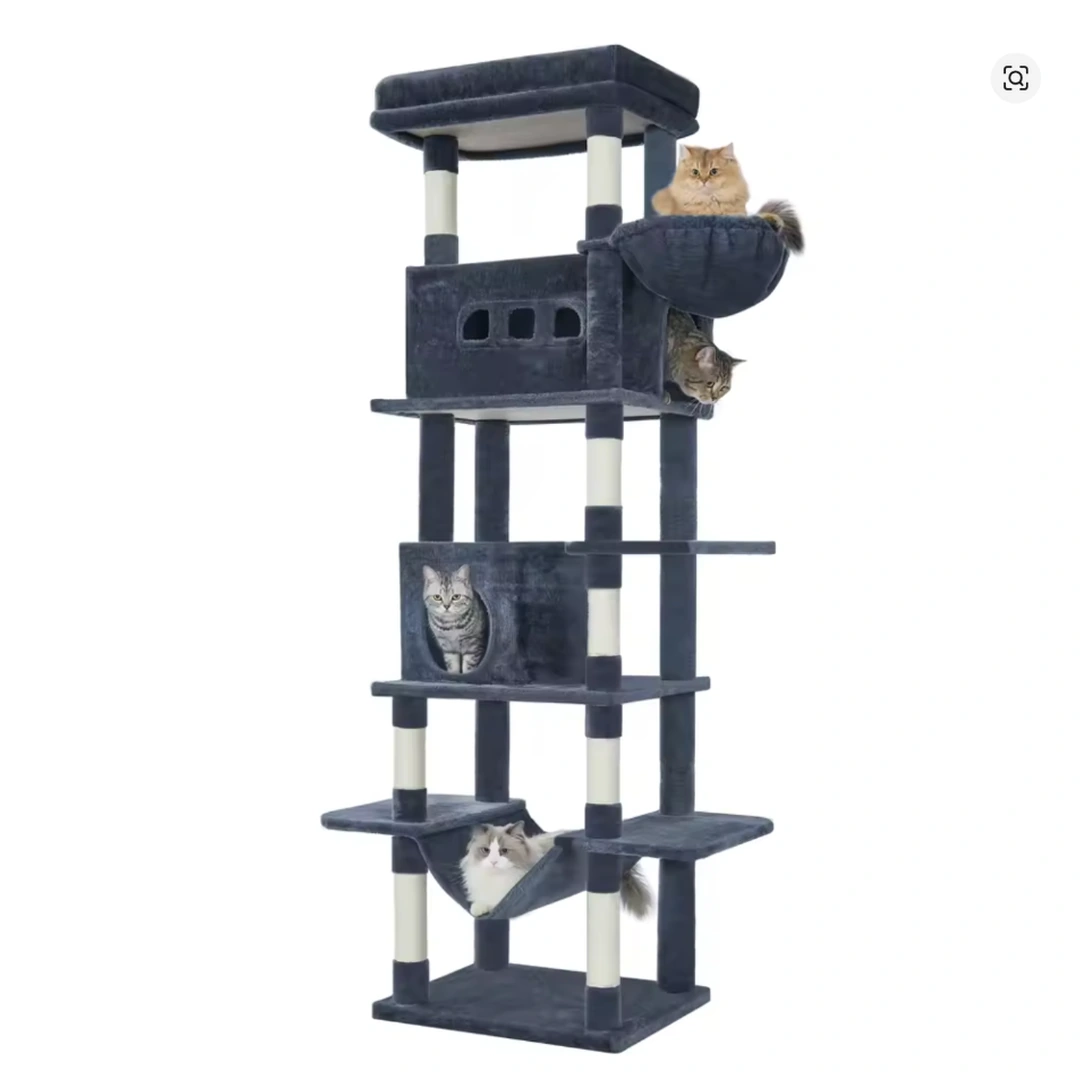
In a small home, a cat tree can look compact in a photograph but become an obstruction once installed. The base does not tell the whole story: overhanging beds, access for your cat and doors that need to open also take up space. Choosing a cat tree for a small space therefore means comparing complete shapes in their intended setting, rather than silhouettes alone. The aim is simple: preserve everyday movement while giving your cat usable territory, not equipment wedged between two pieces of furniture.
Cat tree for a small space: measure the actual footprint
Start by distinguishing between the base footprint and the floor area covered by the whole structure. An offset platform or side bed can extend well beyond the base. Look for overall dimensions on the product sheet and check how they correspond to the diagram. If they are missing, ask for clarification before assuming the model fits.
Then mark out this outline at home using paper placed temporarily on the floor, with your cat elsewhere. Include the upper overhangs too: their position could obstruct a handle, a drawer or your shoulder. This test does not confirm the technical suitability of the installation, but reveals clashes that a simple measurement against a wall can miss.
Finally, allow for the space needed to approach, climb up and come back down. This is not about applying a universal clearance: observe your cat's movements and check the manufacturer's guidance. A tree that fits precisely into a gap may still be impractical if its entrance faces directly towards an obstacle.
Compact design or vertical tower: compare the compromises
A low, compact model may suit a spot with visually clear space above it, but its functions are often arranged horizontally. Several beds side by side take up width. Compare the area actually occupied rather than assuming that a shorter cat tree will necessarily leave more floor space free.
A vertical tower stacks activities above one another. With comparable functions, it can reduce their spread across the room, provided its platforms stay within a reasonable overall volume. A narrow base with large side elements does not automatically save space. Also check which side the access points are on.
Wall-mounted or tension-mounted solutions may seem appealing for reducing floor occupation, but they involve requirements specific to your home. Compare their complete volume without treating them as interchangeable with a freestanding tower. Any supporting-surface compatibility, installation conditions or fixing requirements must be checked in the manufacturer's instructions.
Test everyday routes before setting aside a spot
A successful position proves itself during ordinary activities. Walk from the entrance to the living room, open cupboards, pull out a chair and carry your laundry basket through. If you always need to turn sideways or walk around a platform, the chosen structure is already encroaching on useful circulation space.
Compare several orientations of the same model, rather than just several locations. An overhang pointing into an unused corner may be less obstructive than the same overhang facing a walkway. However, moving the tree closer to furniture must not block your cat's access or create a gap where they could become trapped.
Think about occasional activities too: unfolding a sofa bed, getting out the vacuum cleaner or reaching storage. An apparently free spot becomes less useful if it means regularly moving the equipment. Keep openings and exits clear; the space saved must never depend on keeping a door closed or sacrificing a route through.
Keep your cat's activities accessible in a smaller space
The AAFP and ISFM guidelines on feline environmental needs (2013) highlight, among other things, hiding places, elevated perches, separate resources, scratching, familiar scents and respectful interactions. They help keep the right objective in view: reducing the space occupied does not mean removing the opportunities available to your cat.
Avoid turning the foot of the tower into a station combining litter tray, food and water to make every corner work harder. This concentration goes against the principle of separate resources. The tree can bring together certain activities, but it does not replace thoughtful organisation of the rest of the home, even when space is limited.
Between two similar shapes, favour the one whose features remain accessible after installation: an unobstructed scratching surface, a bed your cat can reach and an opportunity to retreat. Let your cat explore at their own pace. For any signs of pain, limping, falls, parasites or behavioural changes, consult a vet rather than automatically blaming limited space.
Choose between models with a simple comparison sheet
For each candidate, record the base dimensions, overall dimensions, overhangs and direction of access on the same sheet. Add the constraints stated in the instructions. Clearly distinguish confirmed information from details you still need to request: a photograph does not allow you to work out every measurement.
Then compare this record with your floor-layout test. Rule out models that force an awkward detour or prevent something from opening fully. Among the others, look for the best balance between occupied space and usable functions. The right choice is not necessarily the smallest: it is the one that lets the room remain liveable.
VEYRULIS is preparing a 210 cm tall, multi-level cat tree, an option to consider for making use of height in a small space. It remains a draft product and is not yet for sale; its price has not been approved and the colour variant still needs confirmation. The overall footprint and specifications will need checking in the instructions for the model supplied.
Sources and further reading
This advice is for information only and does not replace your veterinarian's opinion.