
Cats Eating Alone or with Company: Respecting Their Preferences
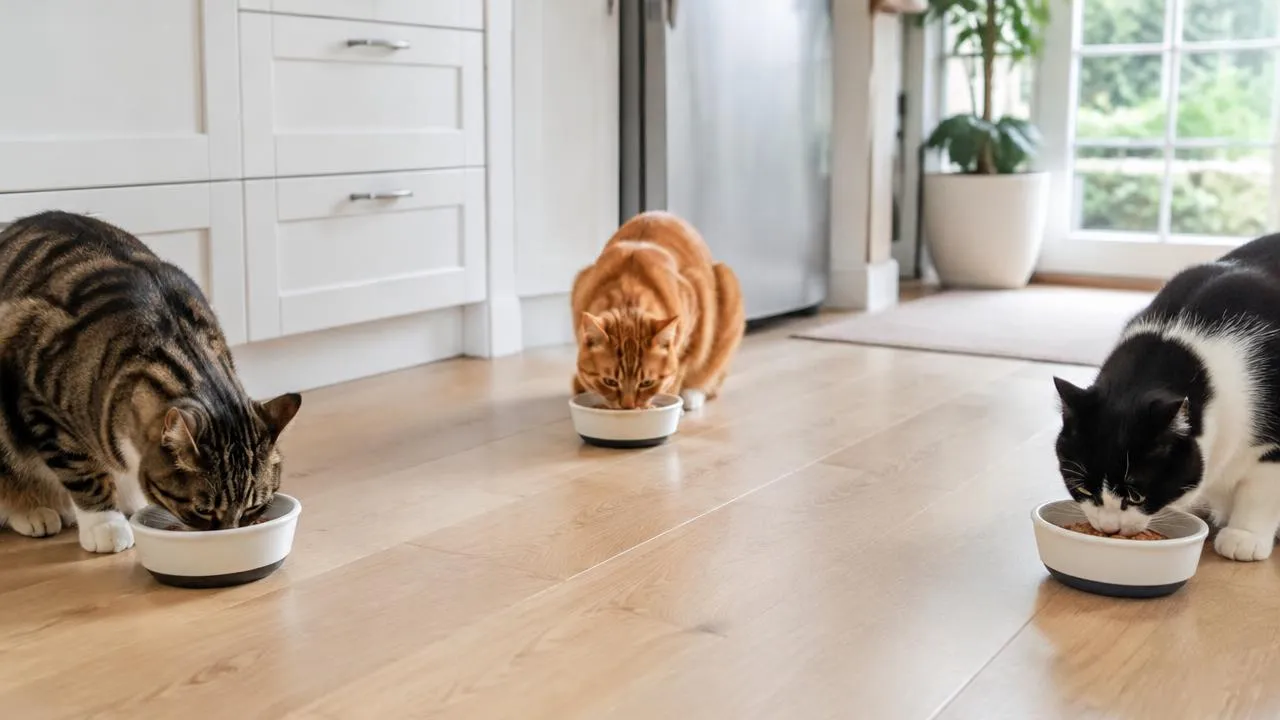
Some cats appear completely at ease near a companion during meals, whilst others firmly prefer to isolate themselves. The AAFP consensus statement describes the domestic cat as a solitary predator that naturally prefers to eat frequent, small meals alone. However, this general evolutionary tendency does not allow us to predict with complete certainty the exact preferences of each individual pet. Taking time to observe your animal's everyday behaviour helps you make an informed choice between setting up a shared feeding station and establishing separate dining spaces.
Observing what happens during mealtime
Begin by watching several meals carefully without immediately modifying your entire household routine. Which cat approaches the food first? Does the other wait patiently, change rooms, or eat rapidly? Calm, repeated observation over time provides far more reliable information than a single isolated incident. Take careful note of feeding schedules and the quantities offered, without interpreting every single movement as a definite sign of conflict.
Cats living in the same household do not necessarily use the rooms in an identical way. Some individuals deliberately avoid a companion or restrict their movements to one specific part of the home. The AAFP consensus statement reminds us that tension can exist between animals without obvious outward signs. A cat who does not actively protest is not necessarily comfortable if the other animal monopolises access to the food.
In daily practice, a brief period of supervision following each adjustment helps confirm that the chosen solution works for everyone. Check whether each cat reaches their feeding station without detours, eats at their own natural pace, and leaves without being pursued. If multiple resources are required, distribute them across the areas genuinely used by the cats, rather than grouping them together simply to make serving easier. These practical benchmarks allow you to adjust the overall setup to suit your living space and individual animals.
Creating distinct and easily accessible feeding areas
In a multi-cat household, the AAFP recommends establishing multiple feeding stations that are visually separated from one another. These stations can be located in completely different rooms, provided each animal can reach them easily and without difficulty. Avoid forcing any cat to eat in close proximity to a companion they typically seek to avoid throughout the day.
Carefully consider the agility, physical condition, and daily habits of each pet. Using an elevated surface can be considered when a cat’s mobility and physical fitness allow, but it is not automatically suitable for all animals. Stations should always remain situated well away from litter trays and be readily accessible to the intended animal. If a pet barrier is used, ensure it does not inadvertently block a cat who needs to reach their meal.
Monitoring daily portions and actual food intake
The AAFP advises dividing the total daily intake into multiple small meals spread throughout the day. The exact quantity to provide should be discussed with your veterinary surgeon, who can help determine the specific caloric needs of each cat. Measuring portions accurately using kitchen scales or a calibrated measuring scoop makes it much easier to track what is being offered.
In a home where cats tend to swap bowls, individual tracking becomes especially important. Keep a clear record of the quantity served to each animal alongside what remains untouched. The recommendations also mention comparing the food placed down with what is left after twenty-four hours. This record can be useful, but it replaces neither a professional evaluation nor direct observation of actual food intake.
Evaluating bowls and adjusting the feeding environment
When assessing a food bowl, ensure primarily that it is stable, clean, and positioned to allow the cat comfortable access to their meal. Official AAFP recommendations do not prescribe a universal shape, depth, or width. If you consider trying a different container, make a single observable change and verify that your cat continues to feed normally and without reluctance.
When cats have differing nutritional requirements, separating their feeding stations can make daily monitoring far clearer. Separate rooms or suitable pet barriers can be considered depending on your home layout and the animals' physical capabilities. Devices with individual access control exist, but features vary considerably from product to product: always check the manufacturer's manual carefully.
Establishing a realistic and sustainable daily routine
An effective arrangement is one that cats actively use and human caregivers can reliably maintain over time. Choose feeding schedules and station locations that are compatible with household life, then verify regularly that no pet is left without access. If relationships evolve or a cat changes their habits, review the layout rather than treating the plan as permanent.
You can also enrich daily meals with suitable foraging opportunities. The AAFP mentions food puzzles and scattering dry kibble in new locations to encourage natural exploratory activity. Introduce simple puzzles first and select an option well suited to the food type and the cat’s individual abilities. Automatic dispensers can divide meals, but they do not always replace genuine foraging and predatory behaviour.
At Accessoires Chat, a black automatic kibble dispenser with Wi-Fi is currently in preparation and is not yet available for sale. Its retail price has not been confirmed, and the accompanying image is purely illustrative. Technical specifications must be confirmed directly from the instruction manual of the model actually delivered. Please do not assume any specific functions exist before this verification, and seek professional advice to integrate any automated device into your cat's dietary regime.
Sources and further reading
This advice is for information only and does not replace your veterinarian's opinion.