
Cat blocking access to the litter box: organising resources in multi-cat households
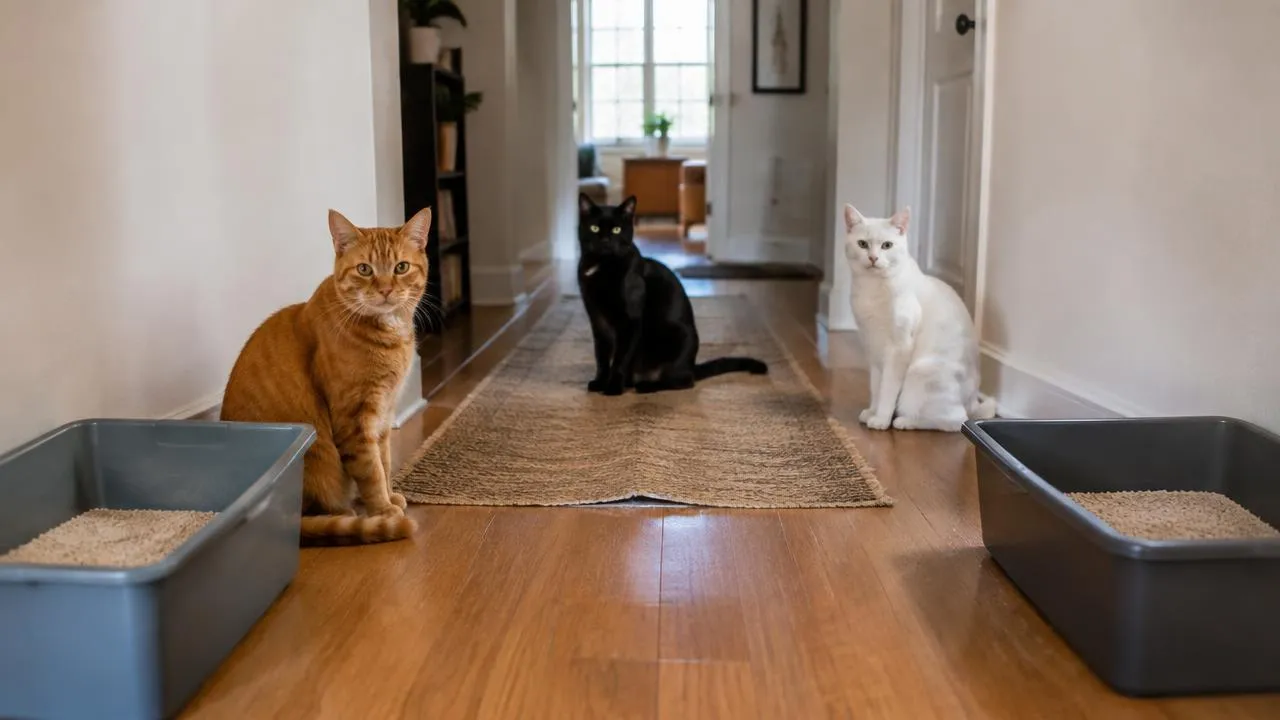
Every cat in the home theoretically has a toilet, yet one urinates elsewhere. Before concluding they reject the box, observe who can actually access it. A cat blocking access to the litter box is an issue of resource distribution, not just apparent cohabitation. AAFP/ISFM guidelines explicitly describe toilet monopolisation and the difficulties it causes for less confident animals in multi-cat homes. Evaluating environmental layout is essential to resolve these subtle social barriers.
Watch paths and exits, not just fights
According to the AAFP/ISFM, a housemate may prevent a timid cat from entering or leaving a tray. The absence of observed fighting is not enough to prove the resource is freely accessible. Examine where everyone positions themselves and which paths are necessary to reach the toilets. The text recommends that cats should reach their boxes without being forced to encounter others: this criterion helps in concretely analysing the housing and the flow of movement.
Prepare a sketch showing toilets, doors, resources, and incident locations. Recommendations use this type of plan to research relationships between inappropriate urination, circulation, and conflicts. Note which animal uses which site whenever you can identify them. This record is not intended to find a culprit, but to understand if a toilet that is available on paper becomes difficult to reach for a specific individual due to the physical layout or social pressure.
Count independent sites rather than containers
The historical benchmark presented by the guidelines is to have at least one box more than the number of cats. The document specifies, however, that this is not an absolute rule: social affinities and the number of groups matter. Animals that are not socially close must have separate stations. The total may therefore require an adjustment beyond a simple addition performed based on the number of residents to ensure everyone feels secure using them.
The same text considers adjacent trays as a single large box from the cat's perspective. A row of toilets in one room does not necessarily solve the monopolisation of its access. Look for several truly usable locations. In a multi-level home, provide at least one toilet per level, then examine if this distribution is sufficient for the different social groups and the paths they take. Strategic placement is more effective than simply increasing the numbers.
Choose a layout that does not trap the user
The recommendations advise against placing the openings of neighbouring boxes face to face. They suggest orienting them at right angles or around a corner to allow the exiting cat to avoid an approaching animal. This detail highlights the importance of the exit, often forgotten when checking only the entrance. The practical question is twofold: can the cat reach the resource, and then leave it without a forced confrontation? Strategic orientation reduces stress during vulnerable moments.
Easy opening and sufficient volume also remain necessary. The AAFP/ISFM indicates that a small covered container can hinder a large cat's posture, while an open tray facilitates monitoring and cleaning. Do not choose closed equipment solely to hide toilets from view. Compare the physical needs of each user with the possibilities for circulation around the site, without assuming a lid provides guaranteed social protection. Visibility can actually help a cat feel safer from ambush.
Extend the examination to other household resources
Water and food should not be installed near the toilets, the guidelines remind us, as this proximity can discourage their use. Multiplying boxes in a corner that already concentrates all the bowls is not a sufficient response. The resource map helps verify these proximities. Seek a coherent organisation across the home, rather than several local solutions that bring all animals to the same passage. Effective distribution respects the cat's natural hygiene and safety instincts.
The MSD Veterinary Manual specifically includes attention to cat interactions in the management of idiopathic cystitis. This mention gives weight to social observation, without proving that a conflict explains every accident. Present your findings to the vet and discuss adaptations. Punishment does not reorganise access; AAFP/ISFM recommendations indicate, on the contrary, that punitive interventions can worsen inappropriate urination difficulties and the cat's reactions. Positive environmental changes are preferred over any form of reprimand.
Do not miss an illness behind access difficulties
MSD cites blood in urine, straining to urinate, frequent urination, and urinating outside the litter box as signs of lower urinary tract diseases. Even if a social blockage seems obvious, a cat showing these manifestations must be evaluated. Medical explanations and life circumstances are not interchangeable. A conflict observation is useful to convey, but it does not alone allow for the exclusion of a urinary condition. Professional diagnosis remains the priority for physical health.
To track changes, distinguish observations by animal as much as possible: frequented toilets, incidents, and interactions around sites. The AAFP/ISFM emphasises chronology and the monitoring of proposed measures. A new distribution must be judged according to each individual's usage, not just the apparent cleanliness of the boxes. If a cat remains excluded or if accidents persist, return with this information to re-evaluate the plan rather than increasing constraints or using ineffective deterrents.
The project for a round connected automatic litter box by Accessoires Chat is currently in preparation and is not yet for sale. Its price is not confirmed and the image remains illustrative. Specifications must not be presumed: they are to be confirmed on the manual of the delivered model. Therefore, this presentation does not allow for any conclusion regarding its suitability for your group of cats or their specific social dynamic.
Sources and further reading
- AAFP and ISFM Guidelines for diagnosing and solving house-soiling behavior in cats (Journal of Feline Medicine and Surgery, 2014)
- Manuel vétérinaire MSD — Lower Urinary Tract Disease in Cats
This advice is for information only and does not replace your veterinarian's opinion.