
Window Cat Flap: Buying Guide and Safety Criteria
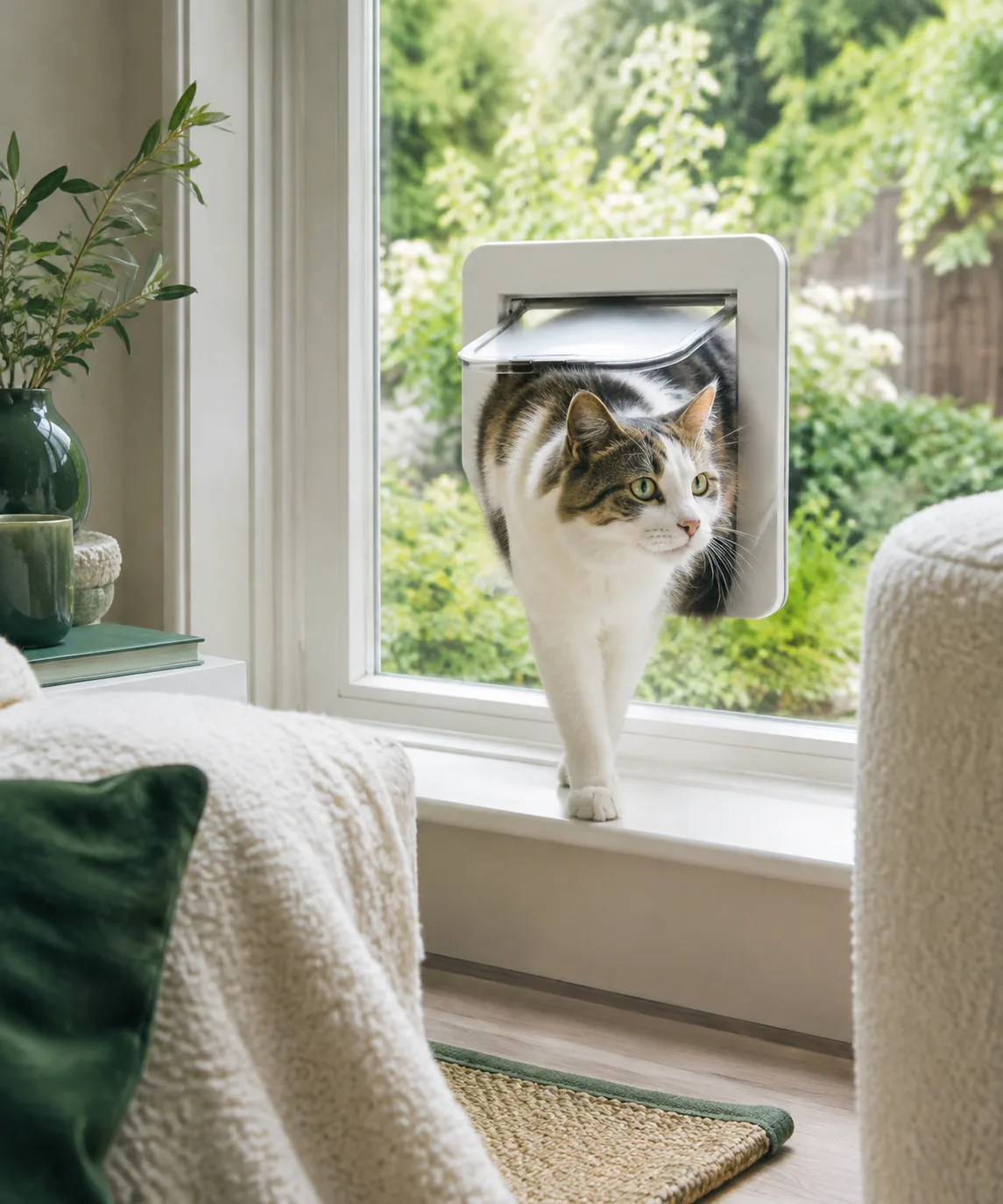
Choosing a window cat flap is an ideal solution for offering a feline a smooth transition to the outdoors or to a secured balcony. According to international veterinary recommendations, preserving an animal's territorial control significantly reduces daily environmental anxiety. Nevertheless, installing a pass-through panel on glazed joinery demands rigorous vigilance. Between frame compatibility, maintaining thermal insulation, and the absolute prevention of fall hazards, several technical criteria must be met. Discover how to select a suitable device without compromising the safety of your home.
Why Install a Window Cat Flap in Your Home?
Installing a window cat flap meets the fundamental behavioral needs described by feline welfare experts. A domestic cat naturally seeks to explore and patrol its territory with complete independence. When direct access through a hinged door proves impossible or too invasive, using a sliding window allows you to create a functional passageway without damaging the overall architecture of the home.
This approach offers a practical alternative for tenants or occupants wishing to preserve their window frames. However, a window cat flap must never lead to an unprotected area. If your home is located on an upper floor or has a ledge without an adequate safety barrier, the opening must imperatively lead to a fully secured space to eliminate any risk of injury or accidental falls.
Managing airflow and natural light is also among the decisive factors. Unlike opaque models, a frame incorporating a transparent opening preserves good visibility while reassuring the animal as it passes through. A thorough assessment of your living environment thus guarantees a smooth transition for your cat as well as for the thermal comfort of the room.
Technical Criteria for a Sliding Window Cat Flap
Choosing a sliding window cat flap relies on meticulous measurements. It is essential to measure the exact height of the available opening, the track thickness, and the depth of the frame profile. The width advertised by manufacturers of extendable inserts does not guarantee universal compatibility, as the sliding sash must not encounter any mechanical obstruction during its movement.
Furthermore, one should not assume that a drill-free installation is completely weatherproof without prior inspection. Integrating a vertical panel alters the junction between the frame profiles. You must systematically verify the presence and quality of sealing gaskets to prevent drafts of cold air, exterior moisture ingress, or energy loss within the living space.
The durability of the materials represents another critical checkpoint. A removable structure must withstand the daily pressure exerted by the repeated passage of your pet. Ensure that the rigidity of the chassis prevents any warping over time, thereby avoiding the risk of the swinging flap suddenly jamming during your companion's comings and goings.
Safety and Locking Features of a Window Cat Flap
In the context of veterinary recommendations to limit feline stress, predictable access is decisive. A window cat flap equipped with an advertised locking mechanism theoretically helps manage outdoor excursions, particularly at night or during adverse weather conditions. The multi-position system must nevertheless be thoroughly tested before allowing your animal to roam with complete autonomy.
It is essential to ensure that the locking positions operate smoothly without sticking and cannot be unlatched by a vigorous paw strike. Safety also involves avoiding overly complex systems that could startle the feline. A transparent flap that swings freely minimizes hesitation at the entryway and prevents partial blockages that could harm your pet's sense of security.
Finally, ongoing monitoring of the mountings remains indispensable over time. For any temporary or adjustable window cat flap, regular visual inspections are essential. If a fastener begins to loosen or if the panel experiences abnormal mechanical stress, stop using it immediately to prevent the panel from falling or your pet from escaping unexpectedly.
Proper Installation and Maintenance of a Window Cat Flap
Fitting a window cat flap always begins with a careful review of the supplied instructions. Never force an adjustable panel into a frame that is not dimensioned to receive it. During assembly, carefully inspect the weatherstripping seals and adjust the pressure points to ensure the entire unit remains perfectly stable without distorting your window frame.
Routine maintenance governs the durability and hygiene of the installation. Regularly clean the transparent surface of the swinging door with a mild, compatible cleaner free from harsh solvents that could alter clarity. Check that the hinge mechanism remains free of dust or debris that could hinder the smooth swinging movement of the flap.
Lastly, pay close attention to any thermal deformation caused by outdoor temperature swings. If the panel shows signs of wear or if a sealing component deteriorates, dismantle the assembly to readjust the fit. This regular upkeep ensures the physical safety of your feline and preserves the integrity of your windows across the seasons.
In the Veyrulis catalog, the SKT-04 white adjustable window cat flap (indicative target price: €163.98) features a 914 × 388 × 40 mm panel with an advertised adjustable width of 31 to 36 inches and an advertised four-position lock. Note that visuals and technical instructions remain non-contractual pending final European compliance validations.
Sources and further reading
This advice is for information only and does not replace your veterinarian's opinion.