
How many litter boxes per cat should you provide at home?
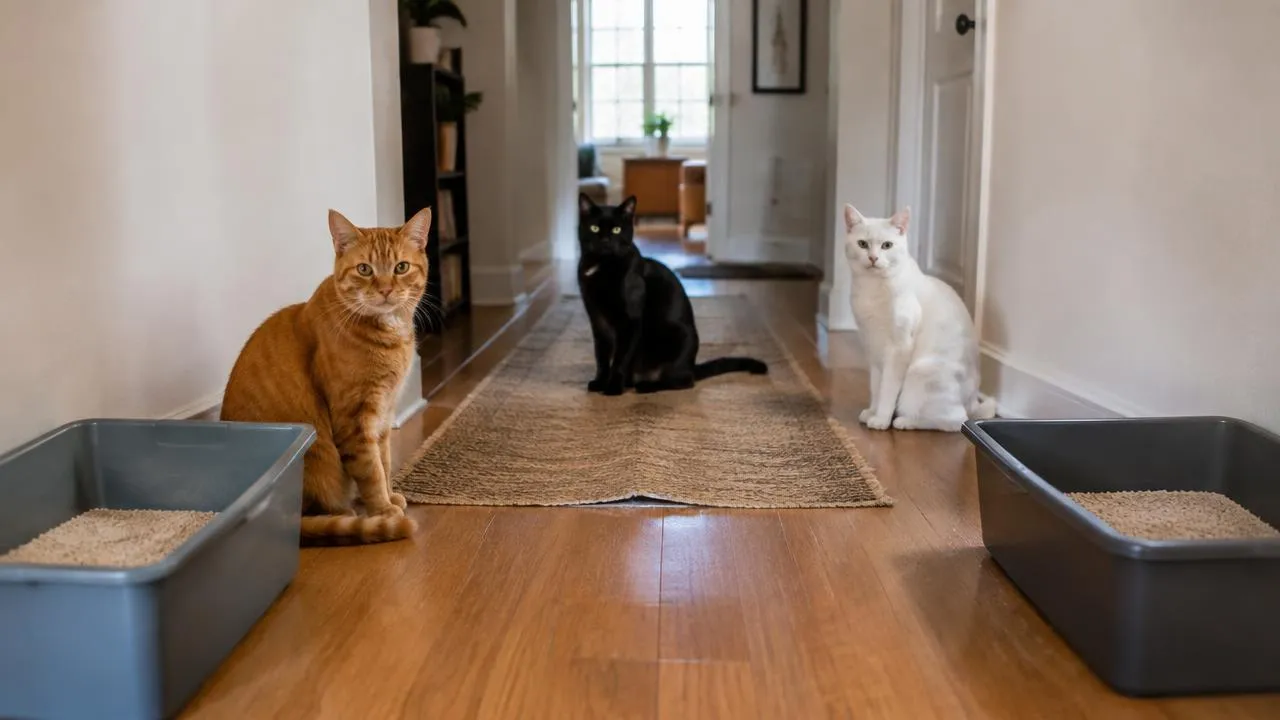
The question of 'how many litter boxes per cat?' requires a far more nuanced answer than a simple numerical ratio. Placing two containers in the same corner does not offer the same functional possibilities as providing two toilets distributed across different areas of the home. The 2014 AAFP/ISFM guidelines provide specific benchmarks regarding the quantity, but they also require owners to consider the social relationships between animals and their movement patterns within the property. Here is how to transform these professional recommendations into a clear organisational plan, without confusing a mere increase in equipment with truly available and accessible facilities for your feline companions.
A single cat: starting with two distinct locations
For a household comprising a single cat, the AAFP/ISFM guidelines recommend providing two litter boxes situated in two separate locations. This advice can often surprise owners when the first container appears to be used consistently without issue. It does not imply that your companion is experiencing a problem: rather, it offers them multiple options for their toileting needs. The text highlights that some cats may instinctively seek out different locations for urinating and defecating, a natural behaviour that multiple stations accommodate perfectly.
Before deciding exactly where to add an extra container, briefly sketch the layout of your rooms and the usual paths taken by your pet. The practical objective is to identify two usable, quiet locations rather than simply wedging a second box as close as possible to the first one. The official recommendations specify that trays placed side by side are perceived by the cat as a single, large tray. Their material count therefore does not accurately describe the total situation if they are not spatially separated.
Multiple cats: a benchmark that requires adjustments
In homes hosting several felines, the historical rule cited by the AAFP/ISFM consists of providing at least one box more than the total number of cats. This results, for example, in three boxes for two animals. The authors specify, however, that this formula is not an absolute, rigid requirement. It serves as a starting point and does not exempt the owner from carefully examining the social relationships within the group to ensure all needs are being met adequately.
Cats that are socially close may share their toilets more willingly. Conversely, those that do not constitute an affiliated group must have access to entirely separate stations. Depending on the number of distinct social groups and isolated individuals, additional installations may be necessary. Ask yourself who uses each specific location and who avoids going there when another animal is in the way: this observation usefuly completes the simple numerical count and ensures peace in the household.
Distributing toilets rather than forming an alignment
The guidelines suggest providing at least one litter tray on every level of a multi-storey house. They also advise against placing toilets close to food and water, as this proximity can discourage their use for hygiene reasons. To choose the best locations, start by identifying accessible levels and feeding areas, then look for several distinct, quiet spots. Do not automatically gather all the boxes in the single room that is most convenient for you as an owner.
Traffic flow counts particularly when several cats cohabit the same space. According to the same source, an animal must be able to reach its tray without being forced to encounter another cat. When containers remain close to one another, their openings should not face each other: the authors suggest an orientation at right angles or on either side of a corner. This specific layout allows a cat to exit while avoiding a approaching housemate, reducing potential conflict.
Checking the quality of existing litter trays
Adding an extra box does not necessarily correct a setup that is too small or neglected. The recommendations associate the quantity with the size: they propose a rectangular tray measuring approximately one and a half times the length of the cat, from the nose to the base of the tail. Therefore, look at the useful dimensions of each existing toilet before assuming that the problem is simply a matter of insufficient quantity rather than poor comfort.
Maintenance is part of the same overall assessment. The AAFP/ISFM text requires removing waste at least daily and topping up the substrate whenever necessary. It suggests a thorough wash with hot water and soap every one to four weeks, without using strong chemicals or ammonia-based products. These benchmarks remain pertinent even if several containers are offered: increasing their number does not allow you to leave the facilities dirty for longer periods.
An unused tray or accidents: interpret with caution
The authors indicate that a neglected tray may be removed if others remain available and are consistently used. This possibility is not an invitation to immediately remove every location that is infrequently visited. First, take stock of the overall situation: is there another option for each group of cats, on every level involved, without a conflict-prone passage? The guiding principle remains a sufficient supply of toilets distributed in different areas of the home.
Finally, urine outside the tray does not prove that you simply have too few boxes. The MSD Veterinary Manual describes this among the signs of lower urinary tract diseases, alongside blood in the urine, frequent urination and straining to urinate. Present these behavioral changes to your veterinarian rather than indefinitely increasing your purchases. The number of trays relates to the environment; it is not a tool for making a medical diagnosis.
At Accessoires Chat, a connected automatic litter box with a rounded format is currently in development. It is not yet available for sale and its final price has not been confirmed. The image presented is for illustrative purposes only and holds no technical confirmation value. Specifications must be verified in the manual of the model actually delivered; this project does not replace the fundamental guidelines regarding the distribution of trays.
Sources and further reading
- AAFP and ISFM Guidelines for diagnosing and solving house-soiling behavior in cats (Journal of Feline Medicine and Surgery, 2014)
- Manuel vétérinaire MSD — Lower Urinary Tract Disease in Cats
This advice is for information only and does not replace your veterinarian's opinion.