
Mealtime conflicts around the bowl: restoring calm
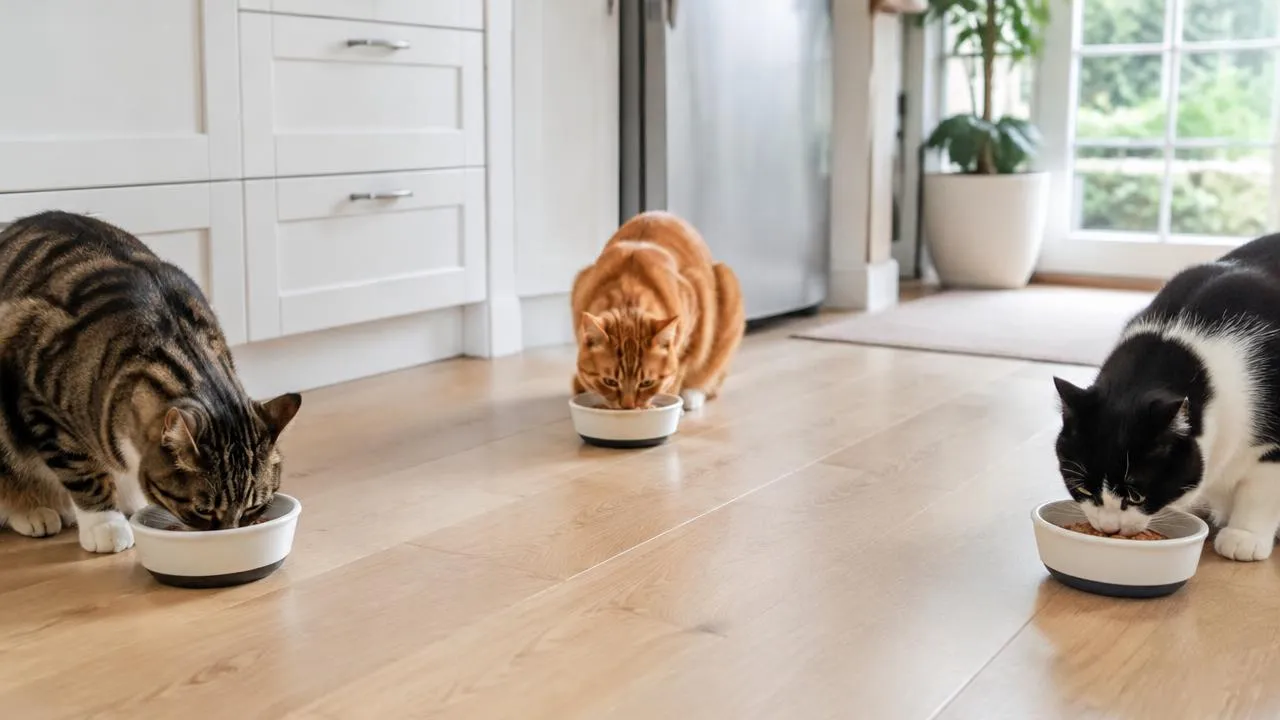
Growling or sudden paw swats are by no means the only indications of discomfort during mealtime. A cat that waits quietly at a distance or gives up on approaching the bowl entirely may also be experiencing genuine stress. The AAFP consensus statement highlights that tension between companion cats can often pass completely unnoticed. Observing daily habits and offering separated resources helps create a supportive environment where each cat can eat with greater confidence and peace.
Observing what happens during mealtimes
Begin by observing several mealtimes closely without immediately overhauling your entire household routine. Which cat approaches the food first? Does the other linger hesitantly, move away into another room, or eat with hurried urgency? Calm, repeated observation over time provides far more reliable information than a single isolated incident. Take note of feeding times and the quantities offered, without hastily interpreting every movement as a certain sign of conflict.
Cats sharing a household do not necessarily use different rooms in an identical manner. Some may actively avoid a housemate or restrict their daily movements to one particular part of the home. The AAFP consensus statement reminds caregivers that social friction can exist without any obvious, dramatic displays. A cat that makes no open protest is not automatically comfortable if another animal is quietly monopolising access to the food bowl.
In practice, a short period of attentive monitoring after every environmental change helps confirm that your new solution works well for everyone. Check whether each cat reaches their feeding station without making evasive detours, eats comfortably at their own pace, and walks away without being followed. If several feeding stations are necessary, distribute them across the areas genuinely frequented by your cats, rather than grouping them together simply to make serving easier. These concrete observations allow you to adjust the layout to suit your home and your individual pets.
Creating distinct and easily accessible feeding stations
In a multi-cat household, the AAFP recommends establishing multiple feeding stations that are visually separated from one another. These can be located in completely different rooms or areas, provided that each animal is able to reach them without any difficulty. You should always avoid forcing a cat to eat in close proximity to a companion that they would normally choose to steer clear of during the day.
Always take into account the physical agility and familiar routines of each individual pet. Placing food in an elevated position can be a useful option when a cat's physical condition and joints permit, but it is not automatically suitable for all felines. Feeding stations must always remain situated well away from litter trays and stay directly accessible to the designated cat. If an internal barrier or pet gate is used, ensure it never inadvertently blocks an animal trying to reach their meal.
Monitoring daily portions and food intake
The AAFP advises dividing a cat's total daily intake into several smaller meals distributed throughout the day. The precise quantity to serve should be discussed directly with your veterinary surgeon, who can help establish the exact caloric needs of each individual pet. Weighing out daily portions using kitchen scales or a dependable measuring cup makes it much easier to keep track of the nutrition actually being offered.
In households where cats regularly swap bowls or eat from each other's dishes, individual monitoring becomes especially vital. Make a note of the exact quantity served to each pet as well as any food remaining. The clinical recommendations also suggest comparing the food dispensed against what is left over after a full twenty-four hours. Although helpful, this routine tracking cannot replace professional veterinary assessment or careful observation of actual eating behaviour.
Evaluating bowls and adapting the feeding environment
When selecting a food bowl, the most important factors are ensuring that it is stable, clean, and positioned so your cat can access their meal without hindrance. The AAFP recommendations do not prescribe one universal bowl shape or width. If you are considering changing your cat's dish, make an adjustment that you can easily monitor, and confirm that your companion continues to feed normally and comfortably.
When cats have different dietary requirements, separating their feeding stations makes individual health tracking far clearer. Dedicated separate rooms or appropriate household barriers may be considered depending on your home's layout and the physical mobility of your animals. Selective-access microchip devices do exist on the market, but their features differ from one model to another: always check the instructions provided on the packaging carefully.
Establishing a practical and sustainable routine
An effective household arrangement is one that your cats actively use and that you can realistically sustain over time. Select meal schedules and feeding locations that fit comfortably into daily family life, then verify regularly that no animal is left without straightforward access. If social relationships evolve or a cat changes their familiar habits, re-examine the physical layout rather than regarding your initial plan as fixed and final.
You can enrich daily feeding times by providing appropriate foraging and problem-solving opportunities. The AAFP highlights food puzzle toys and scattering kibble across new locations as constructive ways to encourage healthy physical activity and mental stimulation. Introduce simple puzzles first, choosing an option well-suited to the type of food and your cat's abilities. Automatic dispensers can split meals into smaller portions, but they do not always substitute for natural foraging and predatory behaviours.
At Accessoires Chat, a black automatic kibble feeder equipped with Wi-Fi is currently in development and is not yet available for sale. Its price has not been finalised and any imagery is purely illustrative. Technical features and specifications will need to be confirmed directly in the instructions for the model actually delivered. Please do not assume any specific functions before this verification, and always seek professional advice when integrating any new device into your cat's feeding regime.
Sources and further reading
This advice is for information only and does not replace your veterinarian's opinion.