
Automatic Cat Feeder for Multiple Cats: Preventing Competition
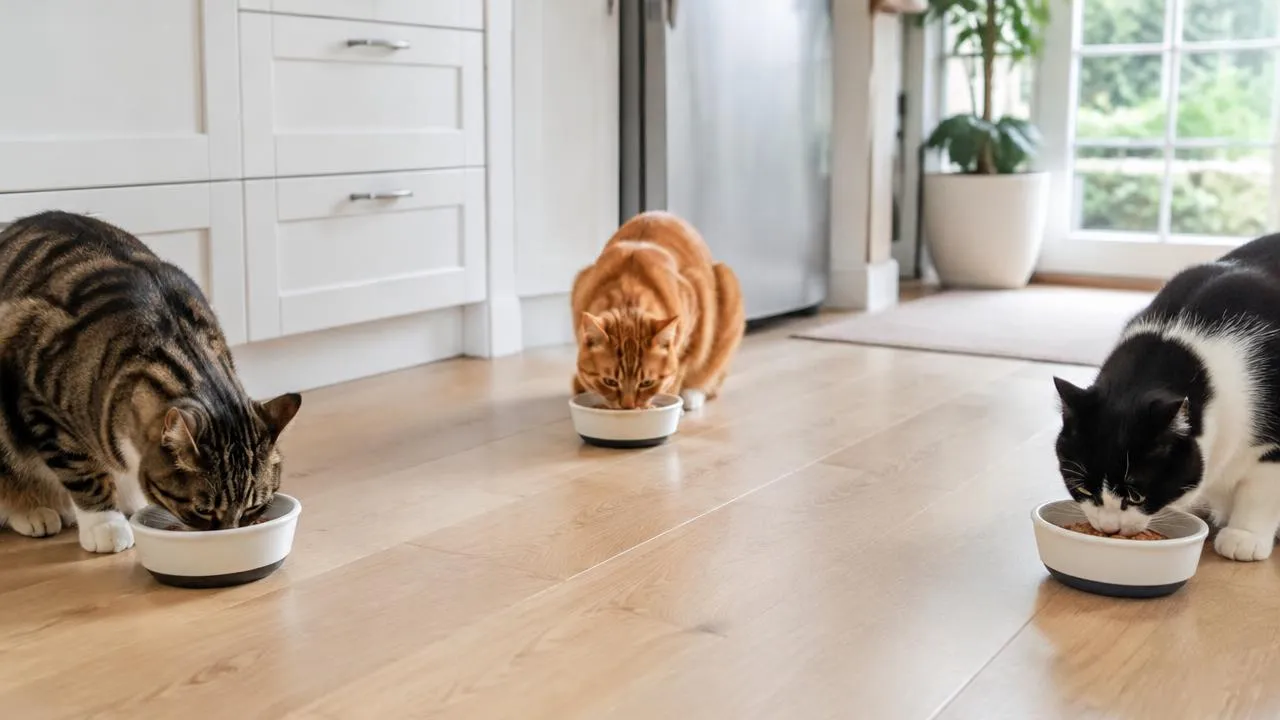
When several cats share a household, relying on a single dry food dispenser may initially seem convenient, but it does not guarantee that each individual gets to eat their portion peacefully. Cats do not always occupy living spaces in the exact same way, and some naturally prefer to avoid their peers. The AAFP consensus statement recommends providing multiple, separate feeding stations throughout the home. Structuring daily mealtimes must therefore take into account feline social relationships, daily habits, and specific individual needs.
Why a Single Station Can Cause Problems
Cats are solitary hunters by nature who tend to eat frequent, small meals alone. In a multi-cat household, competition over food resources can generate subtle tension well before mealtimes; these frictions are not always obvious to human owners. A cat may keep its distance, hesitate to approach, or struggle to access the bowl easily. Observe movement and behaviour carefully throughout the home, rather than assuming that living together means fair sharing.
The AAFP notes that domestic cats may affiliate with certain companions whilst actively avoiding others within the group. They do not necessarily share rooms equally: some confident individuals roam freely, whilst others keep to a much more restricted area. Positioning a feeder in a central communal space can therefore make access to food uncomfortable, stressful, or difficult for a less assertive member of the group.
Take time to record useful details in an accessible location: feeding schedules, set portion amounts, and veterinary clinic contact information. Keeping this clear written trace simplifies communication when a family member or pet sitter steps in, whilst making it easier to spot shifts in routine rather than relying solely on a saved electronic setting.
Setting Up Distinct Feeding Stations
The veterinary consensus statement recommends multiple feeding stations that are visually separated and placed where each cat feels thoroughly safe. Separation does not simply mean moving bowls a few steps apart: visual barriers, sightlines, and household traffic routes also matter. Using distinct spaces helps each individual eat calmly without having to remain in close physical proximity to a companion it prefers to avoid.
Consider physical agility and dietary needs when choosing locations. The AAFP highlights using elevated spaces when an animal's physical condition allows, alongside programmable feeders or suitable household barriers. Avoid creating obstacles that might prevent an older or less mobile cat from comfortably reaching its ration. Feeding stations should also never be placed in close proximity to litter trays.
The layout of the dining area deserves as much attention as the equipment. Select a stable, quiet, and easily accessible spot, then observe whether your cat settles there willingly. The animal's reaction remains a valuable indicator: adjust the arrangement if mealtimes seem hurried, interrupted, or avoided altogether.
Measuring and Monitoring Consumption
An automatic dispenser does not necessarily split a ration evenly between multiple cats, nor does it consistently identify who actually ate. Carefully measure what you provide and observe each cat's genuine access to the bowl. The AAFP recommends determining caloric needs with your vet and monitoring body weight and condition score regularly. Individual monitoring matters: a communal setting can mask overeating or underfeeding within the group.
Weighing portions with digital kitchen scales or using a dedicated measuring cup are practical methods cited by the AAFP, which highlights the limited precision of volume estimations. Note observed daily habits and report any changes to your veterinary team. An older, frail, or chronically ill cat may require close monitoring: do not alter their diet simply to suit the convenience of an appliance.
Remember that feline feeding behaviour should always be interpreted in context. The presence of other pets, resource placement, and household routines can all influence access to the bowl. Keep factual notes and seek professional advice from your vet if difficulties persist or if appetite noticeably changes.
Automation Does Not Replace Enrichment
Offering multiple small meals throughout the day aligns more closely with natural feline feeding preferences than serving a few large portions. A programmable dispenser can help manage this distribution, but it does not provide foraging or mental manipulation. The AAFP recommends puzzle feeders and foraging activities to encourage natural activity. Introduce a simple option whilst keeping a baseline ration reliably available at all times.
Take time to watch group dynamics at mealtimes: the absence of visible fighting does not mean one cat is not quietly avoiding another. If underlying tension persists, consult your vet and reorganise the feeding stations. Every cat must be able to eat in a safe, quiet place, receiving its intended portion. Good equipment supports this approach rather than enforcing an unsuitable single station.
Avoid introducing multiple environmental changes all at once, as this makes it much harder to understand what genuinely helps your cat. Introduce one adjustment at a time, maintain working routines and familiar landmarks, and consult your vet whenever your pet's situation, age, or nutritional requirements evolve over time.
At Accessoires Chat, a black automatic dry food dispenser with Wi-Fi connectivity is currently in preparation and is not yet available for sale. Its retail price has not been finalised, and the image shown is purely illustrative. Final technical specifications remain to be confirmed on the instruction leaflet of the delivered model; please check whether its everyday use suits the meal organisation of each cat in your household.
Sources and further reading
This advice is for information only and does not replace your veterinarian's opinion.