
Cat food and water: arranging resources in the home
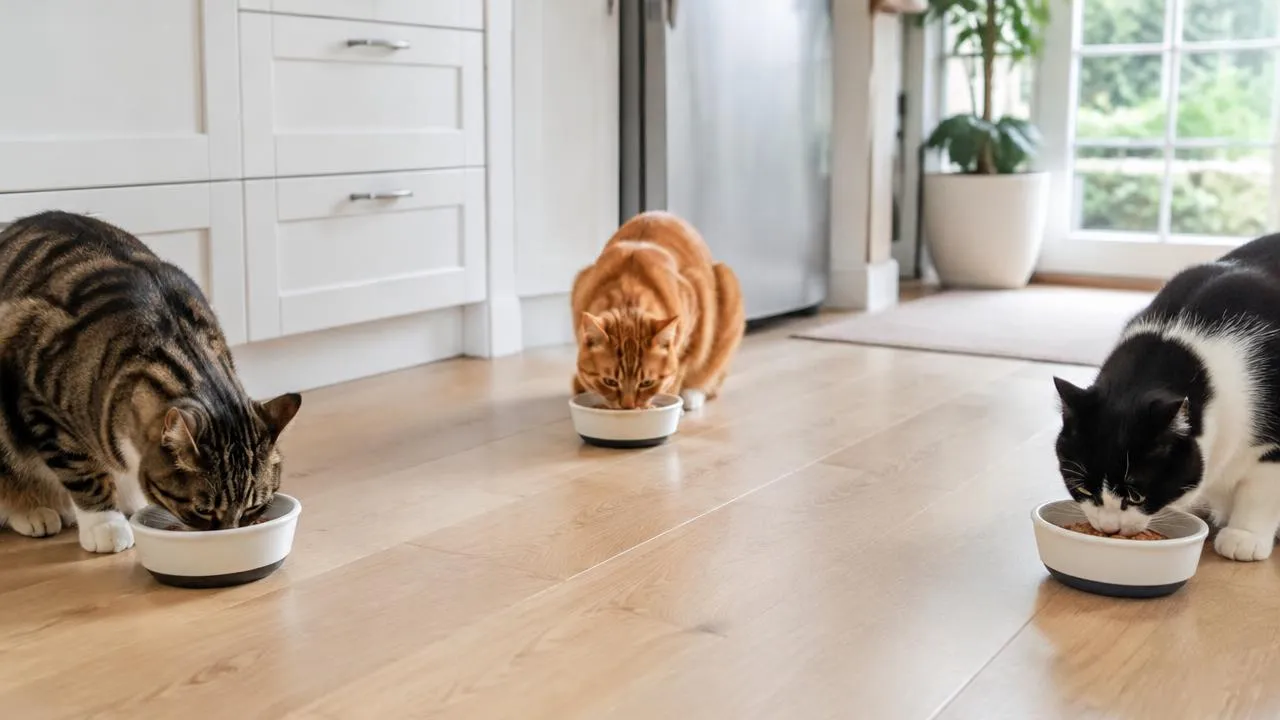
Water and food are essential daily resources whose placement directly influences how a household is organised. The AAFP consensus statement on feline feeding programmes recommends providing multiple food and water stations, as well as offering small, frequent meals throughout the day. It reminds us that domestic cats naturally prefer eating frequently and alone, and that cats in multi-cat households do not always share their living space equally. These general benchmarks provide helpful guidance for observing access to resources; however, they do not replace tailored professional advice from a veterinary surgeon for an individual cat.
Evaluating access to each resource
Observe where each cat eats and drinks, and whether their access remains completely unobstructed whenever they need it. In a multi-cat household, some animals roam confidently through every room, while others stay strictly within a few familiar core areas. The AAFP consensus statement indicates that cats may restrict their movements to spaces where they feel secure. A feeding or drinking station that appears accessible to you might not actually be used by every cat in the home. Note the travel routes and social interactions you witness rather than assuming that every pet shares resources equally.
Competition around food can often be subtle and go unnoticed. Watch carefully to see whether an animal waits at a distance, leaves the room, or retreats when another arrives. The consensus recommends ensuring that every cat can freely reach its food and consume an appropriate quantity. When it comes to water, providing several separate locations makes this vital resource available across different areas of the dwelling. There is no need to impose a rigid, universal layout: evaluate the options against your home's layout and seek veterinary advice if access or consumption worries you.
Distinguishing observations on water and food
A water bowl and a food dish provide information on quite different behaviours. Keep separate notes on the habits you observe, the specific locations involved, and any changes introduced over time. The AAFP consensus statement highlights the importance of multiple water stations in the design of a feeding programme; however, it does not provide a clinical rule for interpreting an individual cat’s fluid intake. If you have concerns about drinking or eating, describe them to your veterinary team and ask for personalised recommendations rather than applying a standard quantity found elsewhere.
In a multi-pet household, it can prove difficult to identify which animal has used a shared resource. A simple log of observed water levels or eating routines can be paired with an arrangement that clarifies individual access, where your home allows. Take care not to treat an isolated observation as a complete measure of daily consumption. For any clinical or medical question, your vet can advise on what is helpful to monitor and how to do so. Notes should support constructive discussions, not lead you to modify diet or care independently.
Providing meals that suit feline habits
Cats generally prefer eating alone and frequently, taking small quantities at each sitting. The AAFP suggests dividing daily food into smaller, frequent portions rather than relying strictly on one or two large meals, and highlights puzzle feeders and active foraging opportunities. The objective is to accommodate species-typical behaviours within the domestic environment. Even so, adapt your setup to your cat’s abilities and your capacity to monitor their ration. Do not increase the total daily food quantity simply because meals are being split across a greater number of servings.
Leaving food out ad libitum can obscure how much each cat consumes, especially when several pets share the same bowl. Measuring portions and noting leftovers helps clarify what was actually offered and eaten. The consensus recommends asking your vet for appropriate energy requirements and reliable measuring methods. A digital kitchen scale is often useful, as measuring cups can lead to significant inaccuracies. Discuss portions and their schedule with the veterinary professional who knows your cat, and record any changes to maintain clear, consistent tracking over time.
Choosing a practical household arrangement
Setting up multiple stations does not require complex or expensive equipment. It can simply mean providing distinct points that animals can easily reach, placed thoughtfully according to household foot traffic. Avoid automatically grouping all resources in one spot if that prevents a cat from eating or drinking in peace. Observe what works best in your home and record any adjustments you make. The AAFP consensus statement recommends taking feline preferences and behavioural needs into account, though placement decisions must always reflect the pets present and their physical environment.
An automatic food dispenser can assist with scheduling set portions, whereas a drinking fountain serves an entirely different purpose. Always check the specifications and maintenance instructions in the manual for your exact model, as different appliances are not interchangeable. Whatever equipment you choose, observe its actual use and ensure no cat is hindered from reaching the resource. If you notice any change that causes concern, consult your veterinary surgeon. An appliance helps organise the home, but it cannot evaluate individual needs or replace professional care.
At Accessoires Chat, a black automatic dry food dispenser with Wi-Fi is currently in preparation and is not yet available for sale. Its price has not been validated; any images presented are purely illustrative. Its technical specifications must be confirmed on the user manual of the delivered model. While it can help organise the scheduled distribution of dry food, it cannot replace accessible fresh water points or the attentive observation of each individual cat’s daily habits.
Sources and further reading
This advice is for information only and does not replace your veterinarian's opinion.