
Making a Homemade Kibble Puzzle for Your Cat
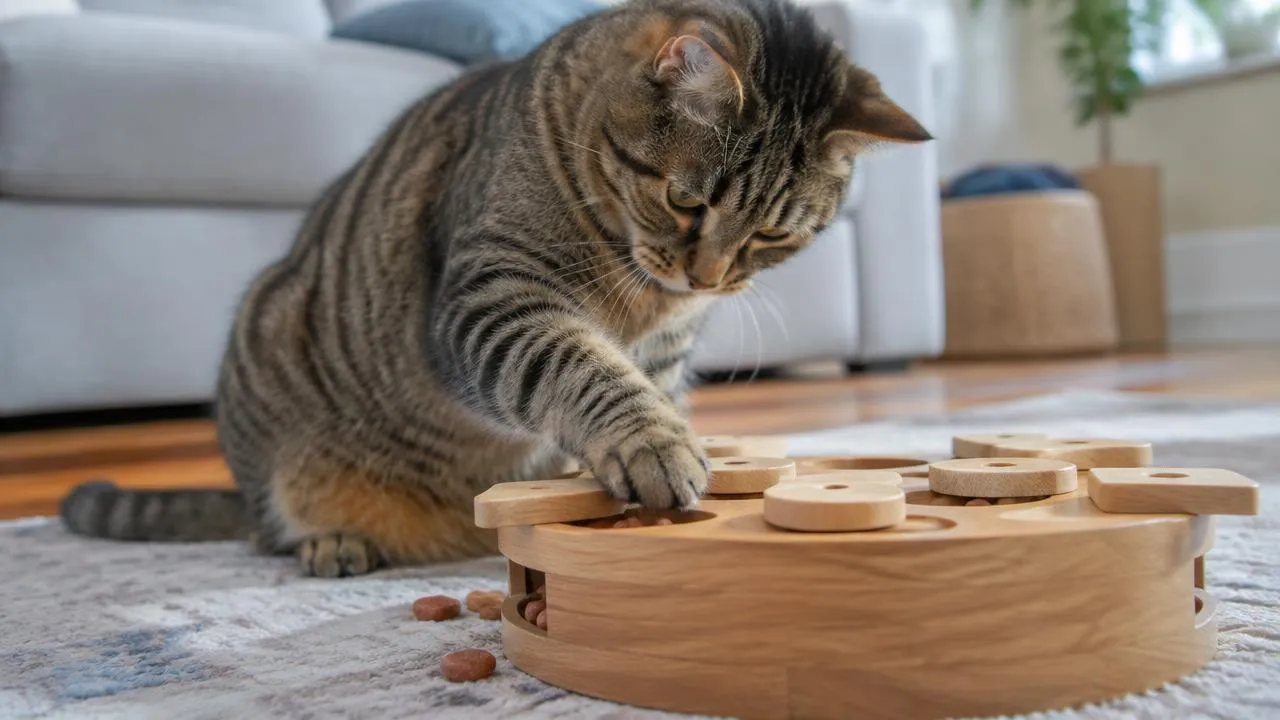
Making a homemade kibble puzzle allows you to offer your cat an alternative and engaging way to obtain part of their daily food ration. The AAFP consensus statement indicates that food puzzles can be assembled at home simply and inexpensively, without imposing any mandatory design or model. The underlying principle is to encourage the cat to manipulate an object to release kibble. Ease of access, attentive observation, and maintaining an accurately measured daily portion are far more important than the sophistication of any home craft.
Defining the Objective Before You Start Crafting
A food puzzle is essentially an object containing food that a cat must physically manipulate to retrieve their meal. It can engage the paws, mouth, or tongue depending on how it operates. Before assembling anything at home, determine the intended experience: whether you want a clearly visible portion that is easily reached or a slightly more active, investigative search for your cat.
The intention is never to replace the regular food ration with an arduous or frustrating ordeal. The device should simply provide a welcome opportunity to search, explore, and act during mealtime. Food puzzles can support mental and physical stimulation, which is particularly valuable when domestic indoor life offers relatively few natural opportunities for predatory foraging.
Select a simple, easily manipulated design for the very first attempt. This represents the starting point recommended by the AAFP when introducing puzzles in general. A clear, straightforward mechanism helps the cat achieve early success and allows the caregiver to observe their genuine interest and physical interaction.
Preparing an Accessible and Safe Experience
While the consensus statement explicitly endorses the idea of puzzles made at home, it does not provide detailed recipes or specify compulsory materials. Caregivers should therefore avoid assuming that any homemade creation carries a guaranteed level of safety simply because the reference document mentions the broad concept.
Present a modest portion drawn directly from the measured daily food allocation, then allow the cat to approach and explore at their own pace. Carefully observe whether they manipulate the object, retrieve the kibbles, and remain calmly interested throughout the interaction.
If your cat begins biting, chewing, or pulling at the structure itself rather than concentrating on the kibbles, end the trial immediately and reconsider the design. Any cat that fails to retrieve their portion must be given prompt, direct access to their food to prevent unnecessary frustration or hunger.
Measuring Daily Portions and Varying Feedings
Foraging games must have an established place within the overall daily feeding plan rather than being treated as unmonitored extras. Measure the total daily quantity in advance and reserve a specific portion for the puzzle. The AAFP highlights digital kitchen scales and volumetric measuring cups as viable methods, whilst pointing out the notable precision limitations associated with measuring by volume.
Cats frequently prefer eating small meals on a regular basis and in solitary conditions; the AAFP advises dividing their daily allowance into multiple small meals distributed throughout the day and night. A puzzle device can comfortably house a portion dedicated to one of these meals.
An automatic dispenser can also help schedule multiple timed meals across the day, yet it generally does not provide the physical quest and predatory behaviour associated with a puzzle or hidden kibbles. Consequently, these feeding tools do not fulfil precisely the same behavioural function.
Taking Other Household Animals into Account
In a home where multiple cats live together, placing a puzzle toy in the centre of a shared communal space can inadvertently trigger competition or social tension. Cats do not necessarily share territory equally, and some individuals actively prefer avoiding certain feline companions during feeding times.
The consensus statement recommends providing multiple, visually separated feeding stations in multi-cat households. The chosen location must suit the agility and physical mobility of each cat; an elevated surface is only appropriate if the cat can access it comfortably and safely.
A cat may eat abnormally quickly if attempting to escape an uncomfortable or exposed situation. If a foraging puzzle is placed in a busy or contested area, it risks exacerbating anxiety instead of enriching the mealtime routine.
Evaluating and Developing the Activity Over Time
Following each trial, check that the kibbles were actually retrieved and that the cat did not simply give up and abandon the toy. Any portion left behind or forgotten in a corner must not be counted as consumed food.
The AAFP recommends regular monitoring of body weight and body condition score, especially for older cats, frail animals, or those with specific nutritional requirements. Consult your veterinary team to determine an appropriate daily caloric allowance and to help assess your feeding plan.
A successful activity is one that sparks natural foraging curiosity without unnecessarily complicating access to proper nutrition. The puzzle should remain just one option among several: multiple small bowls, varied feeding locations, or a simple commercial toy. Crafting at home does not need to be elaborate to be effective.
After the trial, store the puzzle away and verify whether the cat retrieved all the food. This check prevents confusing an offered activity with a ration that was actually eaten. If some food remains inaccessible, adapt the device or serve the remainder directly, noting a better configuration for next time.
Encourage everyone in the household to adhere to the exact same measuring and distribution routine. A shared protocol prevents a portion from being given twice or a puzzle being refilled without being accounted for. Daily consistency also makes it much easier to compare habits from one day to the next.
The black Wi-Fi kibble dispenser from Accessoires Chat is currently in preparation and is not yet available for sale. Its retail price has not been validated; the accompanying image is purely illustrative. Specific product features and technical details will need to be confirmed directly from the instruction manual corresponding to the specific model that is actually delivered.
Sources and further reading
This advice is for information only and does not replace your veterinarian's opinion.