
USB or Battery-Powered Cat Fountains: What Are the Everyday Differences?
When choosing a pet fountain, owners often look at water capacity or bowl material, paying far less attention to how the pump is powered. Yet whether you pick a model connected via USB cable or one with a rechargeable battery significantly changes daily life: where you can put it, how you clean it, and what precautions you must take with your cat. Here are the genuine practical differences, without exaggerated battery life claims or figures we cannot independently verify.
How the pump is powered
An electric cat fountain relies on a small pump to circulate water, and its exact setup depends on the model. On a USB fountain, electrical power is delivered constantly through a lead plugged into a mains adapter or USB port. On a battery-operated design, the motor draws from an integrated rechargeable battery that requires regular charging from a wall socket.
Some battery-powered models can continue running while plugged in for a top-up, whereas others cannot: only the manufacturer’s instruction manual is authoritative here. Likewise, the correct voltage and recommended adapter specifications are set by the maker, and it is far safer to follow them closely rather than plugging in an arbitrary spare charger.
The power supply changes neither the water circulation principle nor the quality of the filtered water. It mainly affects three things: where you can position the fountain, the tasks you must fit into your daily routine, and the precautions needed if your cat is curious. Your home layout and your pet's drinking habits should therefore guide your choice, well before you consider design or water capacity.
USB fountains: no recharging, but tethered to a socket
Depending on the operating mode designed by the manufacturer, water flow can be continuous or triggered as needed; a USB supply avoids having to recharge a battery when the unit stays plugged in. This is very practical if your cat’s designated drinking spot is already near a wall socket, such as on a kitchen worktop or along a utility wall.
The main drawback is the cable itself. It restricts where the fountain can go and must be shielded from inquisitive teeth. Some cats, especially younger ones, chew or play with loose wires. Run the cable flush along the wall, behind furniture, or inside protective trunking, and inspect it regularly for damage. A frayed or damaged lead must always be replaced, never taped over near water.
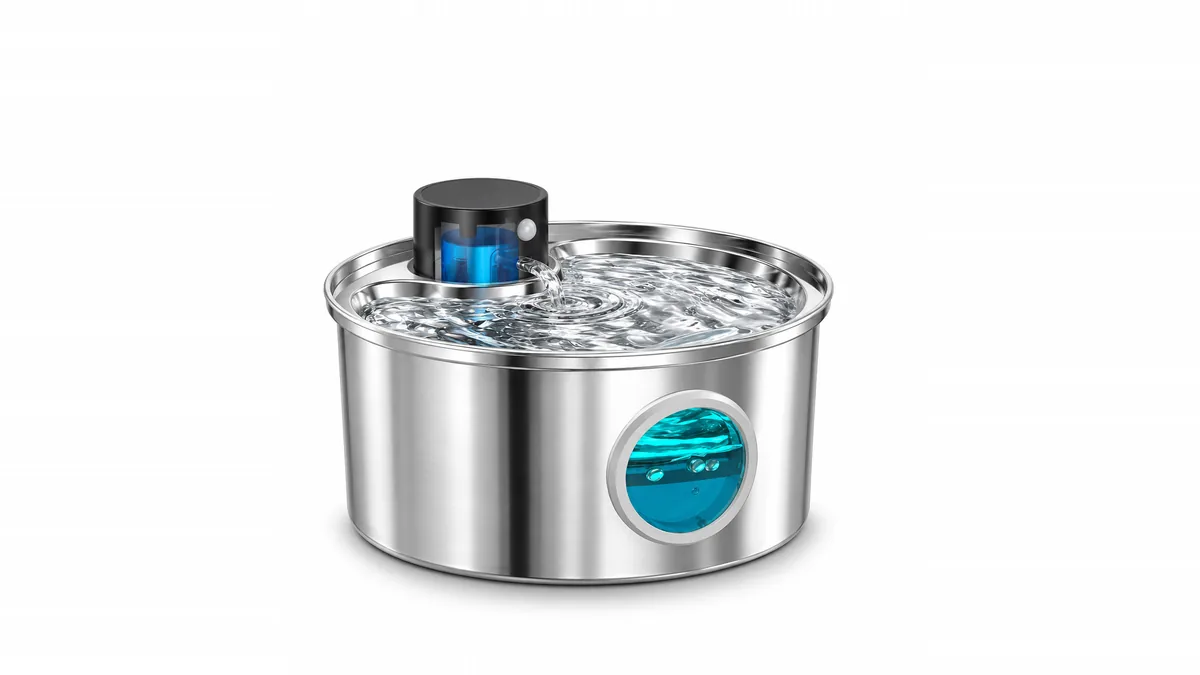
In our catalogue, the stainless steel fountain with a round viewing window is powered via 5V USB; this is the only power specification we have for this design. The vertical-window model also plugs directly into a compatible low-voltage power supply.
Battery-powered fountains: placement flexibility, but charging required
Without a permanent mains lead, a battery-powered fountain can sit wherever your cat prefers to drink, even far from a plug: in a quiet hallway, a bedroom, or near their favourite resting spot. For a cat that shies away from a poorly positioned drinking station, this freedom of placement can make all the difference.
In exchange, you must remember to recharge it. Battery lifespan depends on the model, chosen operating mode, and frequency of use; we quote no specific runtime figures, as we have no verified measurements. A sensor that triggers water flow only when the cat approaches can reduce power consumption, although certain cats much prefer continuously running water.
In our catalogue, both the stainless steel fountain with an angular window and the black fountain run on battery power according to supplier details, the latter featuring an infrared sensor and an advertised 2,600 mAh battery.
Safety and maintenance: what stays the same
Regardless of the power source, the pump must never run dry: monitor the water level daily and top it up before it dips below the minimum line. Always unplug or switch off the fountain before taking it apart, and never submerge electrical parts in water unless the user manual explicitly allows it.
Cleaning remains identical: empty the bowl, wash the reservoir, rinse the filter, and clean the pump following the manufacturer's instructions. International Cat Care stresses the importance of clean, fresh water served in a clean container: the power method does not alter this advice. Replace filters and foam sponges according to the manual and their actual condition, without relying on generalised lifespan estimates.
How to choose between the two
Ask yourself three simple questions. Where does your cat drink most readily, and is there a safe plug socket nearby? Are you happy to add regular recharging to your domestic routine, just like charging your phone? Does your cat play with cables? If a socket is handy and your cat ignores wires, USB is usually the simplest choice. If the ideal drinking spot is far from an outlet, battery power becomes much more appealing.
In either case, keep a standard water bowl alongside the fountain during the transition period, and observe how much your cat actually drinks. A fountain is not a medical treatment: any marked shift in water consumption should be discussed with your vet.
The 3.2-litre stainless steel fountain, our original model at €95, is currently the only product listing configured for ordering on Accessoires Chat. The other four models are shown as exclusive previews: orders are not yet open, packages do not yet have confirmed prices, and images are illustrative and unverified against physical production samples. The links below lead to the full catalogue and individual product pages.
Sources and further reading
- International Cat Care — Encouraging your cat to drink: a guide for caregivers (PDF)
- Cornell Feline Health Center — Hydration (besoins en eau, signes et causes de déshydratation)
This advice is for information only and does not replace your veterinarian's opinion.