
Automatic litter boxes for multiple cats: planning access and tray placement
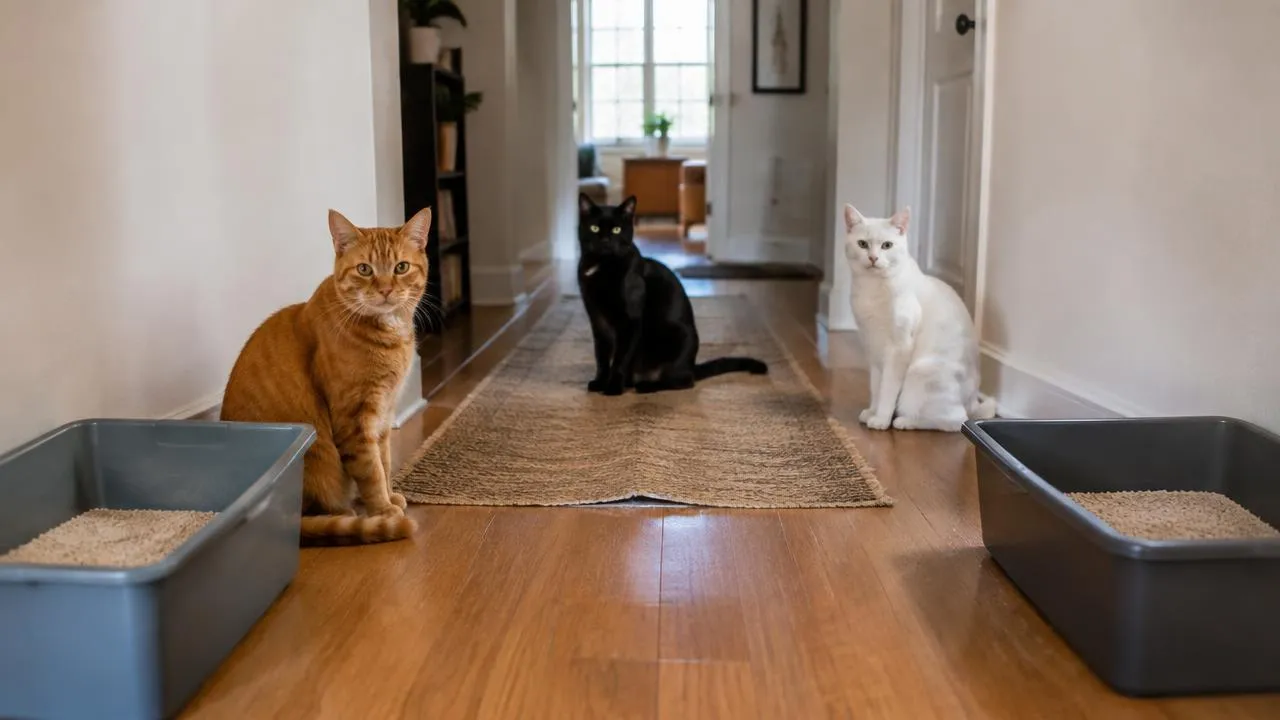
Choosing an automatic litter box for multiple cats is not simply a matter of finding equipment they can share. Veterinary guidelines emphasise the distribution of toilet facilities and the relationships between the animals. They do not specify a universal capacity that would allow one machine to replace every litter tray. Before considering a particular model, look at which cats use which spaces, how each cat reaches them and what resources remain available throughout the different areas of your home.
Understanding the guideline on litter tray numbers
The AAFP/ISFM guidelines describe the traditional rule of providing at least one more tray than the number of cats, while explaining that this is not an absolute requirement. Socially bonded cats may be more willing to share. Conversely, cats that are not bonded need separate toilet stations. The aim is therefore to provide enough locations for the different groups, rather than following a calculation without considering the relationships within your household.
These guidelines do not say that a cleaning function changes social needs or makes this distribution unnecessary. Do not assume a device can replace more trays than the sources support. Check the instructions for the exact model to establish its conditions for use by multiple animals. Then keep two assessments separate: what the manufacturer documents technically, and what the layout of your home actually makes possible for each of your cats.
Spread out locations rather than lining trays up
According to the AAFP/ISFM recommendations, trays placed side by side are perceived as one large tray. The authors emphasise the importance of several locations and recommend at least one toilet facility on every level of a multistorey home. Gathering equipment in a single corner does not necessarily meet the need for separate locations. Consider the animals’ daily routes, not just where storage and cleaning seem most convenient for you.
The same recommendations advise against placing water and food near toilet facilities, as this arrangement may discourage cats from eliminating there. They also explain that busy areas may be avoided. Your installation plan should therefore accommodate several resources without clustering them indiscriminately. A list of features cannot choose the location for you; take time to identify the spaces and routes used, without assuming that every cat willingly visits the same areas.
Identify social obstacles to entering and leaving
The AAFP/ISFM document describes situations where one cat monopolises toilet resources and a less confident animal eliminates elsewhere. It states that cats must be able to reach a tray without encountering another cat. Access therefore means more than the width of the opening: it includes the route and possible encounters along it. Observe what happens around the toilet facilities, not just how they are used once an animal is already inside.
The authors also mention that one cat may prevent another from entering or leaving a tray. Clean equipment alone does not resolve this difficulty. Before interpreting avoidance as a problem with the litter or the technology, examine the interactions you can observe. Request the device’s documentation for its dimensions and particular characteristics; for tensions between animals and their consequences, the recommendations call for consideration of all the social and environmental factors involved.
Respect individual preferences and maintenance needs
The AAFP/ISFM guidelines report that preferences vary between open and covered litter trays. They recommend open trays where possible to make monitoring and waste removal easier. Individual cats may also differ in their acceptance of the litter itself. Do not assume that a shared purchase will suit the whole group equally well. One cat using it does not demonstrate that the others have access to a solution that suits them.
The authors recommend removing waste at least daily and remind readers that no product eliminates regular maintenance. For a particular machine, check its instructions for the required tasks, permitted materials and cleaning procedures. Without this information, do not claim an emptying interval or an allowable number of users. Compare the documented requirements with your own routine, while keeping observation of each individual animal separate from the question of overall cleanliness.
Prepare a useful history if a cat urinates elsewhere
For house-soiling, the AAFP/ISFM recommendations call for a timeline and a floor plan showing toilet facilities, soiling locations and possible conflicts. In a shared household, gather individual observations wherever possible rather than a general impression of ‘the cats’. Record what you know and what you have not witnessed. Do not assume that a possible connected function identifies animals: that capability could only be discussed on the basis of the relevant instructions.
The MSD Veterinary Manual includes relationships between cats and management of toilet facilities among treatment considerations for idiopathic cystitis. It also describes urinary signs such as straining, increased frequency, blood and urination outside the tray. These signs must be reported to a vet, rather than automatically attributed to sharing. Considering resources and assessing health are complementary approaches; buying a device is not a substitute for either of these steps.
At Accessoires Chat, the round connected automatic litter box project is still in preparation and is not currently available for sale. Its price has not been confirmed, and the image is for illustrative purposes only. Specifications will need to be checked against the instructions for the model supplied. Neither a permitted number of cats nor any individual identification function can be inferred from this presentation of the project.
Sources and further reading
- AAFP and ISFM Guidelines for diagnosing and solving house-soiling behavior in cats (Journal of Feline Medicine and Surgery, 2014)
- Manuel vétérinaire MSD — Lower Urinary Tract Disease in Cats
This advice is for information only and does not replace your veterinarian's opinion.