
Automatic litter boxes during holidays: organising cat monitoring
Preparing an automatic litter box for holidays is not about calculating how long the cat can be forgotten. Veterinary sources remind us that toilets require regular maintenance and that urinary changes can signal illness. To organise your absence, separate the technical instructions for the device, concrete tasks, and animal observation. No multi-day autonomy or remote monitoring capability can be claimed without documentation for the exact model.
Establishing usable transmission for another person
Prepare a short document indicating tray locations, the manual, and details for the usual veterinarian. For technical operations, refer to pages corresponding to the installed version. Check the manual of the exact model for emptying procedures, intervention restrictions, and planned responses to anomalies. It is not about writing a universal procedure based on advertising memories, but providing factual guidance for the specific equipment being used daily.
Clearly distinguish what you know about the model from questions still open. A directive like check the tray remains too vague if no one knows which observations to note or which manipulations are authorised. Describe documented tasks with simple words, then ensure the person involved knows how to find the information. Do not present familiarity with another device as an equivalence, as specifications vary between brands.
Maintaining a genuine cleanliness routine
The AAFP/ISFM guidelines recommend removing waste at least daily and adding substrate as needed. They emphasise that no product replaces regular toilet cleaning. These recommendations justify explicitly planning maintenance during your absence. They do not define a universal storage duration for a machine's collector, nor a technical frequency valid for all references. Routine care remains essential for feline comfort and hygiene, regardless of the automation level.
For ordinary trays, authors advise soap and hot water, avoiding ammonia and strong chemicals. For a machine, washable parts and methods must be verified in its documentation. In your holiday instructions, avoid general formulas that could be applied to the entire device. Specify the document to be consulted before each technical intervention. Safety precautions for electrical components must always be respected according to the manufacturer's specific guidelines.
Also ask for a description of toilet usage rather than a simple confirmation that the object appears clean. Which cat was seen at this location? Have eliminations been found elsewhere? Has any difficulty in access been observed? These questions relate to concrete facts and do not assume any capacity of the device to identify the animal or interpret its state. Human observation provides context that sensors cannot.
Describing the available toilet areas
The AAFP/ISFM guide recommends two separate trays for a single cat. In multi-cat households, it invites consideration of the number of individuals and their social groups. On your sheet, locate all truly accessible areas. Do not reduce instructions only to the automatic device because it occupies a central place in your usual organisation. Ensure every cat has an unobstructed path to their preferred elimination site throughout the period.
The same recommendations explain that adjacent trays are perceived as a single unit. They also signal that one cat can block access or exit for another. The person looking after the home must be able to describe these interactions. This allows for discussion regarding the resources available for each individual, rather than being satisfied with a global count of trays or a common log provided by a machine.
Knowing which changes to report to the vet
The MSD Veterinary Manual lists frequent urination, straining to urinate, urinary blood, and urination outside the tray among manifestations of lower urinary tract diseases. Include these elements in the transmission using everyday language. When observed, request that the facts be communicated to the veterinarian, without waiting for a device to provide an explanation or a potential message. Direct human reporting is the safest way to ensure prompt veterinary intervention.
The manual specifies that several diseases can cause these signs. The person present should not have to choose between infection, stones, or cystitis based on behaviour. Their role consists of describing what they see and contacting the professional. On your side, avoid giving improvised therapeutic instructions to treat a problem that no one has yet evaluated. Diagnosis must remain the responsibility of a qualified vet following a clinical exam.
Performing a factual debrief upon return
AAFP/ISFM recommendations approach inappropriate eliminations through research associating health and environment. If accidents occurred, gather dates, locations, and reported changes. The fact they happened during holidays is not enough to conclude an emotional reaction. A medical cause and social or material factors can also enter the evaluation. A comprehensive review helps determine if the current setup meets the cats' needs during changes in household routine.
Then address technical questions left unanswered with the supplier, separately from clinical follow-up. A manual difficulty calls for model clarification; a urinary sign calls for a veterinary exchange. This distinction makes your organisation clearer for a future absence. It especially avoids presenting an automatic litter box as a complete delegation of maintenance, attention to the cat, or health decisions, which always require responsible and active human supervision.
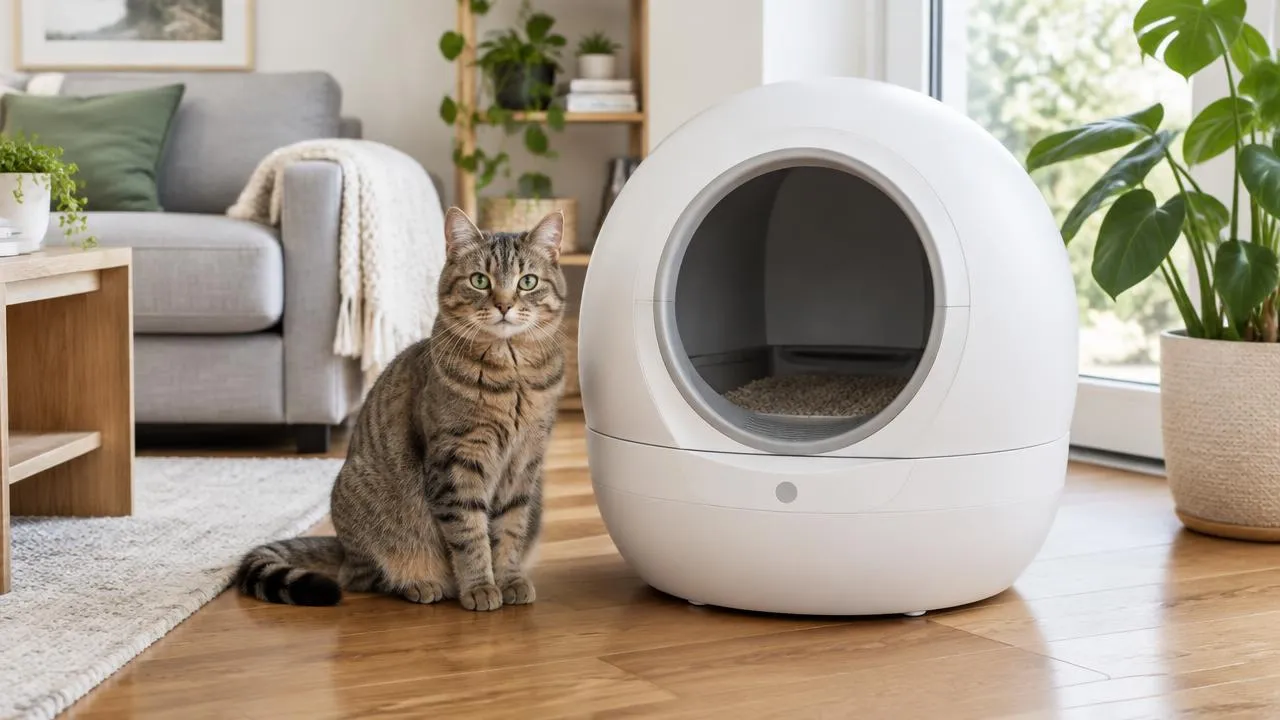
A connected automatic litter box in a round format is currently in preparation at Accessoires Chat, though not yet for sale. The price is not validated and the visual presented is illustrative. Specifications are to be confirmed on the manual of the delivered model. No holiday autonomy or monitoring function should be inferred from this provisional presentation of the project, which remains a draft for now.
Sources and further reading
- AAFP and ISFM Guidelines for diagnosing and solving house-soiling behavior in cats (Journal of Feline Medicine and Surgery, 2014)
- Manuel vétérinaire MSD — Lower Urinary Tract Disease in Cats
This advice is for information only and does not replace your veterinarian's opinion.