
Litter away from bowls and water: organising distinct spaces
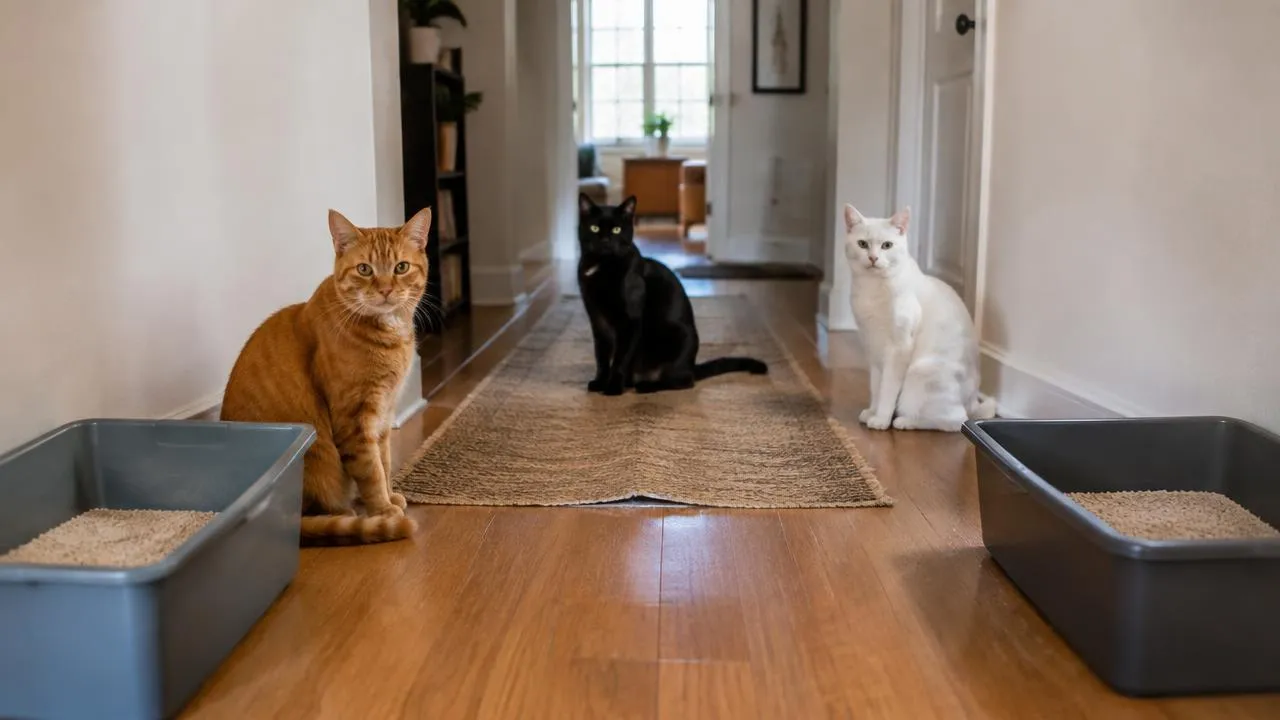
Grouping cat accessories in one corner sometimes seems logical for small homes. However, keeping the litter box away from bowls and water matches AAFP/ISFM recommendations on the elimination environment. This principle does not require inventing an ideal number of metres. It invites examining resources separately, then verifying that their organisation truly allows the cat to eat, drink and eliminate in adapted spaces, respecting their natural ethological needs within the household.
Understanding the recommendation without adding invented explanations
The AAFP/ISFM guidelines indicate that placing food and water near the tray can discourage elimination at that spot. The advice for separation is based here on this effect regarding toilet usage. The sources used do not set a universal distance for all dwellings. It would therefore be misleading to turn this recommendation into a mandatory threshold or to claim that a specific gap guarantees the comfort of every cat regardless of their personality.
This distinction also avoids excessive promises: moving the tray away from bowls is not presented as a urinary treatment, nor as a guarantee the cat will drink more. The layout meets a toilet management criterion. If your question concerns a health or consumption change, describe what you observe to the veterinarian. A choice of furniture is not sufficient to establish the cause of a change in habits or to diagnose an underlying condition.
Make a plan before moving all the resources
The AAFP/ISFM document uses the home floor plan to analyse resources and soiling sites. Draw the bowls, water points, toilets, doors and frequently used sectors. The interest is not architectural precision, but the overview. An apparent separation might be of little use if it sends all movements towards a passage where the cat regularly encounters a housemate or significant activity. Visibility and safety are essential components of feline environmental management.
Next, look for quiet and accessible locations for the trays, two qualities highlighted in the recommendations. Do not relegate the toilets to a difficult-to-access area solely to keep them away from the meal. Separating functions does not exempt you from checking the path. A site must be evaluated according to its neighbourhood, but also according to the animal's ability to get there and leave under good conditions, without feeling trapped or observed.
Preserve the number and distribution of toilets
For a single cat, the AAFP/ISFM recommends two trays in different locations. Seeking a corner separate from the bowls must not result in keeping only a single site for the sake of tidiness. Two adjacent containers are perceived as one large tray, the text specifies. You must think in terms of available locations rather than the quantity of items purchased and placed on the same surface area within the house for convenience.
In multi-cat households, social affinities modulate needs beyond the usual benchmark of one extra tray relative to the number of cats. Those who do not belong to the same social group need separate stations. Multi-level houses must also have at least one toilet per level. These criteria complement the separation from food: they prevent resolving a bothersome neighbourhood by creating a new obstacle elsewhere, ensuring consistent access to all necessary resources.
Do not neglect the container and its maintenance
A better-chosen location does not necessarily correct a tray that is too small or a poorly accepted substrate. The AAFP/ISFM generally recommends a large container, easy entry and fine unscented material, while recognising individual preferences. The available space must allow for the use of the tray, not just its storage. Check if the choice of furniture imposes a toilet whose shape or opening does not suit the cat's size or mobility.
The same recommendations remind us that no product removes the need for regular maintenance. They specifically advise against seeking to satisfy humans with fragrances that may displease the cat. Separating water, meals and toilets does not replace cleaning. If several criteria change, note the modifications to be able to explain later what was done, rather than attributing an improvement or a refusal solely to the distance from the bowls or water source.
Evaluate results without forgetting medical signs
Observe the toilets actually frequented and any accidents after the reorganisation. The guidelines place particular importance on the history of the problem and its follow-up. A plan annotated with the places used allows for a concrete discussion with professionals. If the cat continues to eliminate elsewhere, do not consider the separation useless: it may meet a need without explaining all the present difficulties on its own, especially in chronic or complex cases.
The MSD Veterinary Manual describes urine outside the tray, frequent urges, blood and straining to urinate among the signs of lower urinary tract diseases. These manifestations require a veterinary evaluation rather than a simple new location trial. MSD mentions toilet management in the care of idiopathic cystitis, along with other measures. Keeping distinct spaces is thus a matter of attentive organisation, not a promise of prevention or a guaranteed clinical cure.
At Accessoires Chat, the project currently under preparation concerns a round-format connected automatic litter box. This product is not yet for sale and no price has been validated. Its image is illustrative, without technical confirmation value. For any specifications, the reference will be the manual of the delivered model, whose indications will remain to be confirmed before planning a suitable location for the device in your specific domestic environment.
Sources and further reading
- AAFP and ISFM Guidelines for diagnosing and solving house-soiling behavior in cats (Journal of Feline Medicine and Surgery, 2014)
- Manuel vétérinaire MSD — Lower Urinary Tract Disease in Cats
This advice is for information only and does not replace your veterinarian's opinion.