
Litter in multi-storey homes: distributing trays by access
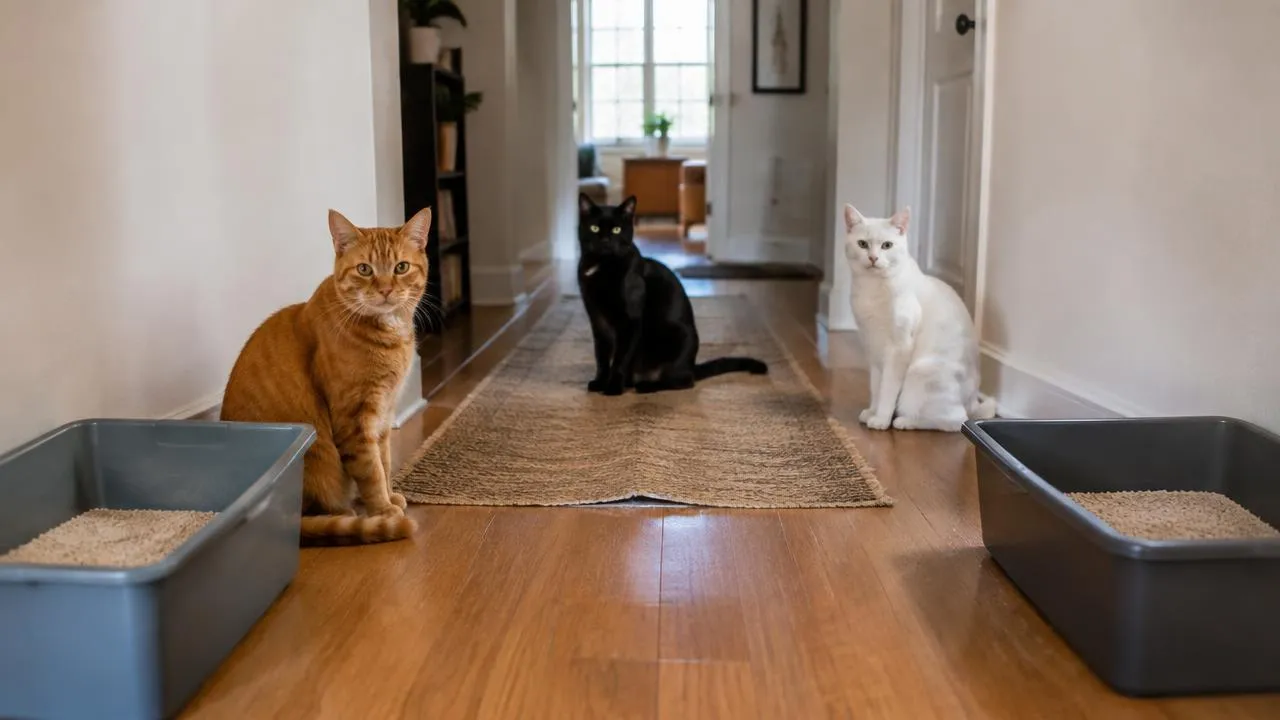
A large house alone does not guarantee comfortable toilet access. If trays are grouped together, the cat does not necessarily have useful choices within its living spaces. Organising litter in a multi-storey home requires reasoning by levels, pathways, and users. AAFP/ISFM guidelines provide an explicit benchmark for this distribution, to be supplemented by observing habits and potential health issues. Logical placement ensures resources remain available wherever the cat spends its time.
Starting with the benchmark of one tray on each level
AAFP/ISFM recommendations indicate that at least one toilet must be placed on each level of a multi-storey home. This is not a proposal reserved solely for households already experiencing accidents. This principle is part of designing a suitable toileting environment. Before looking for a particular model, check which levels actually have a tray and which depend on a toilet installed elsewhere in the dwelling. Proper vertical distribution is a fundamental requirement for feline welfare.
The text also recommends two trays in distinct locations for a cat living alone. These benchmarks must be considered together: the objective is a sufficient quantity of sites distributed throughout the home. A global total does not indicate where resources are located. A large collection of containers on a single level does not meet the same organisational needs as a distribution offering several truly usable toileting areas. Accessibility remains the primary concern for every resident cat.
Mapping pathways between rooms and resources
The AAFP/ISFM proposes a home floor plan as a tool to analyse inappropriate soiling problems. In a multi-storey house, represent each level and the links between them, including doors, toilets, and potential accident sites. Add water points and feeding areas. This view allows for discussing complete pathways, instead of assuming that the presence of a tray somewhere in the house is sufficient to resolve the issue. Visualising routes helps identify potential barriers to access.
Search for quiet locations away from heavy traffic, in accordance with recommendations. Food and water must remain far from toilets, as proximity can discourage elimination. Choosing a level does not waive these local criteria. A tray correctly distributed between floors might still be in an unsuitable area: examine both the general map and conditions around each selected site. Privacy and separation from resources are essential for maintaining good elimination habits in all domestic cats.
Adapting distribution to relationships between cats
In multi-cat households, guidelines use the benchmark of one more tray than the number of animals, while noting its non-absolute nature. Social groups can modify needs; unaffiliated cats must have separate stations. One tray per level therefore constitutes a minimum vertical distribution, not necessarily a sufficient response to all social relationships present in a large shared house. Additional sites may be required to prevent conflict over territory and resources in complex feline groups.
The text also specifies that each cat must be able to access toilets without having to encounter another animal. Therefore, observe the passages connecting utilised spaces to the trays. If a housemate monopolises a pathway, a resource can become inaccessible despite its presence on the correct level. Distributing sites further can be part of adjustments to discuss, but their usage must then be observed by individual as much as possible to ensure everyone's needs.
Checking the trays themselves, not just their floor
Easy opening and a sufficiently spacious container are among the AAFP/ISFM criteria. The document illustrates the benefit of a low entry for elderly cats or those with degenerative joint disease. If an animal hesitates to use a toilet, do not interpret this behaviour solely as a preference for a floor. Access to the container and potential physical difficulty also deserve an evaluation, especially if habits change. Physical comfort is just as important as location.
Monitoring and cleaning remain necessary on all levels. Recommendations state that open trays facilitate observation and waste removal, and no product removes the need for maintenance. As adjacent toilets are perceived as one large tray, grouping them does not multiply independent sites. Evaluate each location according to its actual usage, ease of access, and the cat's preferences, rather than solely for storage convenience. Consistency in hygiene across all floors ensures the system functions effectively.
Tracking changes and searching for medical causes
After reorganising, note the levels frequented, toilets used, and the location of any incidents. Guidelines recommend a chronological history and follow-up to adjust measures. Observations plotted on the plan make exchanges with the vet more precise. They allow showing that a problem remains concentrated in one area or concerns one user, without quickly concluding that an entire floor has become undesirable for all cats. Data collection helps differentiate between behavioural and environmental issues.
The MSD Veterinary Manual reminds us that straining, frequent urges, blood, and urine outside the litter box are signs of lower urinary tract diseases. If these manifestations appear, have them evaluated rather than just adding a tray to another floor. Toilet management plays a role in managing idiopathic cystitis, but it does not establish the diagnosis. A well-organised house remains complementary to medical attention adapted to the symptoms. Health must always be the priority.
The connected automatic litter box in a round format announced by Accessoires Chat remains in preparation. It is not yet for sale, and its price has not been validated. The image is illustrative: no specifications should be deduced from it. Characteristics will remain to be confirmed in the manual of the delivered model before considering its eventual place among the toilets in your home. This draft product is not available for purchase currently.
Sources and further reading
- AAFP and ISFM Guidelines for diagnosing and solving house-soiling behavior in cats (Journal of Feline Medicine and Surgery, 2014)
- Manuel vétérinaire MSD — Lower Urinary Tract Disease in Cats
This advice is for information only and does not replace your veterinarian's opinion.