
Cat urine marking: recognising clues and identifying triggers
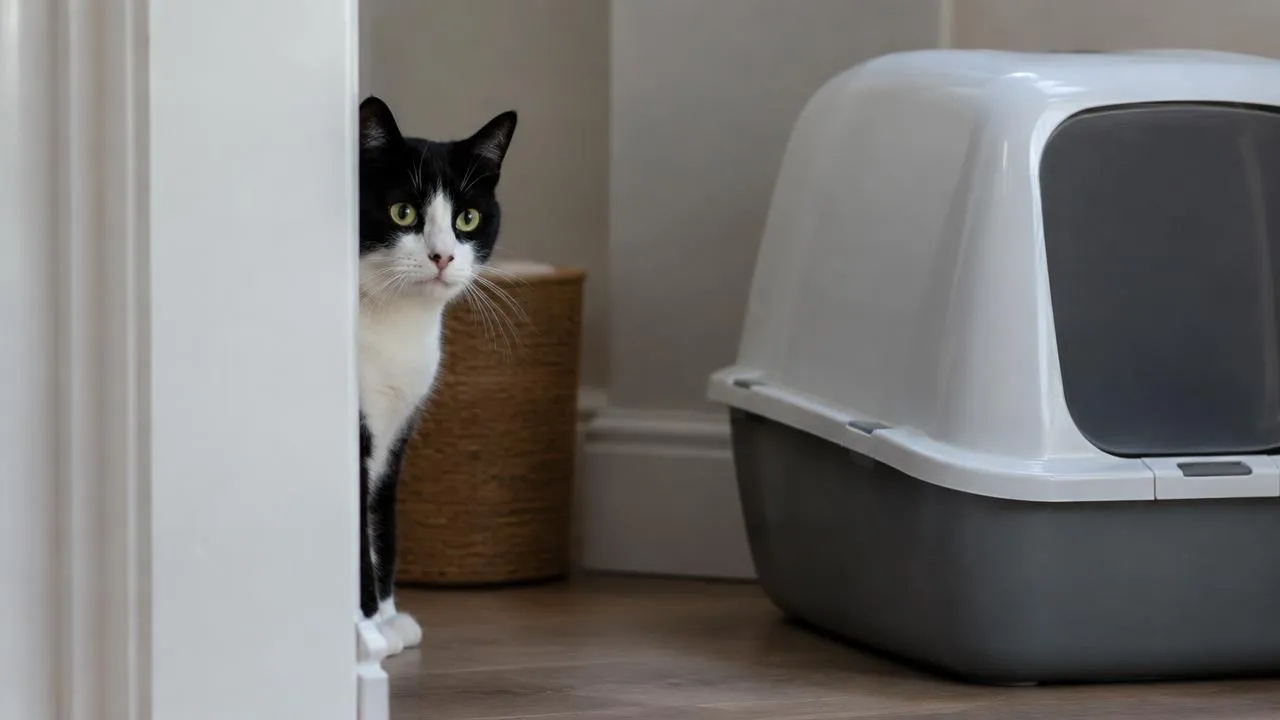
A mark on a door, suitcase or furniture never tells the full story. Feline urine marking often differs from ordinary bladder emptying, but it never excuses skipping a health check. AAFP/ISFM guidelines describe its forms and triggers. They specifically encourage looking at what motivates that individual cat. This approach avoids two shortcuts: viewing every mark as definite illness, or treating all spraying as a simple discipline problem.
Recognising a cluster of clues, not a single proof
The classic presentation described by AAFP/ISFM combines a standing position, an upright quivering tail and a small amount of urine deposited on a vertical surface. Frequency does not necessarily follow ordinary urination intervals. The cat may continue to empty its bladder normally in its tray while leaving marks elsewhere in the home. It is essential to monitor these patterns closely to distinguish marking from standard house-soiling issues.
However, the same authors report marks produced while crouching, including on horizontal surfaces. One must therefore observe posture, quantity and context together. Note successive sites rather than relying solely on a photo of the stain. A nuanced description will be more useful to the vet than a certainty based only on the height of the trace. Detailed observations help practitioners differentiate between social signalling and potential medical distress.
Do not artificially separate behaviour and medicine
The MSD Veterinary Manual notes that urination outside the box, frequent urges, straining and the presence of blood characterise lower urinary tract diseases. Such signs require clinical assessment. If attempts seem unproductive, seek immediate veterinary advice without waiting to see if changing the decor resolves the situation. Delayed intervention can lead to complications. Urinary health must always be the first consideration when these specific physical symptoms are observed.
AAFP/ISFM guidelines also specify that a cat with idiopathic cystitis may mark. Observing a spray does not close the medical case. According to the MSD, this cystitis remains a diagnosis of exclusion. The choice of examinations belongs to the practitioner, who compares household observations with clinical results instead of systematically opposing illness and behaviour. A holistic view ensures that physical pain is not mistaken for a purely social reaction.
Identifying changes in the cat's landmarks
The AAFP/ISFM text distinguishes between sexual marking and reactive marking, notably associated with environmental changes. A piece of furniture, a person or a new animal can change the collective household scents. Objects bringing foreign smells, such as luggage or shoes, are also reported targets. This provides leads, not an automatic explanation. Owners should reflect on any recent modifications to the home layout that might have unsettled the cat.
Initial location helps guide the investigation. Traces near windows or entrances may suggest an external trigger; those in interior corridors and passages might lead to examining relationships within the house. Reconstruct events around the first episode: arrival, absence, return or circulation changes. The goal is to reduce identifiable triggers, not to create a list of culprits. Understanding these spatial cues is vital for managing the cat's perceived security.
Reducing tension and making resources available
AAFP/ISFM recommends strengthening perceived security and considering social relationships. Check if every cat can reach its toilet without crossing a point controlled by another. Multiplying trays in the same place does not necessarily solve this difficulty. Distinct stations adapted to the social groups actually present in the home are required. Proper resource distribution prevents competition and reduces the cat's need to signal its presence through urine marking.
A sexual component can be discussed with the vet: neutering greatly reduces reproductive marking without guaranteeing its total disappearance. For reactive marking, analysing the living environment remains crucial. Recommendations combine researching stimuli, reducing the need to mark and positive behavioural modification; they do not promise a single solution valid for every animal. Professional guidance is necessary to tailor these environmental adjustments to the specific needs of the resident cats.
Cleaning and monitoring without increasing pressure
Marked areas must be cleaned regularly, as per recommendations, because cats may return to maintain these olfactory traces. Ammonia-based products are discouraged. The document also warns that deterrent devices may displace marking or trigger other signs of stress. Avoiding one spot does not mean the need to mark has been resolved. Effective cleaning should neutralise odours without adding harsh scents that could provoke further marking from the cat.
Physically punishing during or after spraying increases stress and may encourage more discreet marks, according to AAFP/ISFM. Prefer a calm record of episodes and a re-evaluation of triggers with the practitioner. Any complementary aids, including treatments, are discussed within global management; they replace neither household adaptations nor attention paid to the toilets. Maintaining a neutral reaction prevents the cat from becoming more anxious about its environment or interactions.
To evaluate progress, distinguish sprays from ordinary urination and record the locations involved. Partial improvement does not prove all factors have disappeared. Finally, changing the tray type alone does not address marking motivations. If considering an automatic toilet, check the exact model's manual rather than assuming an unestablished behavioural effect. Consistency in monitoring is key to understanding if the environmental modifications are actually reducing the cat's marking frequency.
An automatic connected litter box, featuring a round design, is currently in development at Accessoires Chat. Its commercialisation has not yet started and the price remains unconfirmed. The illustration does not constitute a contractual description: specifications must be confirmed in the manual of the delivered model. This is a project presentation and not a device already available for sale. It remains a draft product for illustrative purposes only.
Sources and further reading
- AAFP and ISFM Guidelines for diagnosing and solving house-soiling behavior in cats (Journal of Feline Medicine and Surgery, 2014)
- Manuel vétérinaire MSD — Lower Urinary Tract Disease in Cats
This advice is for information only and does not replace your veterinarian's opinion.