
Cat litter enclosure: maintaining access and feline preferences
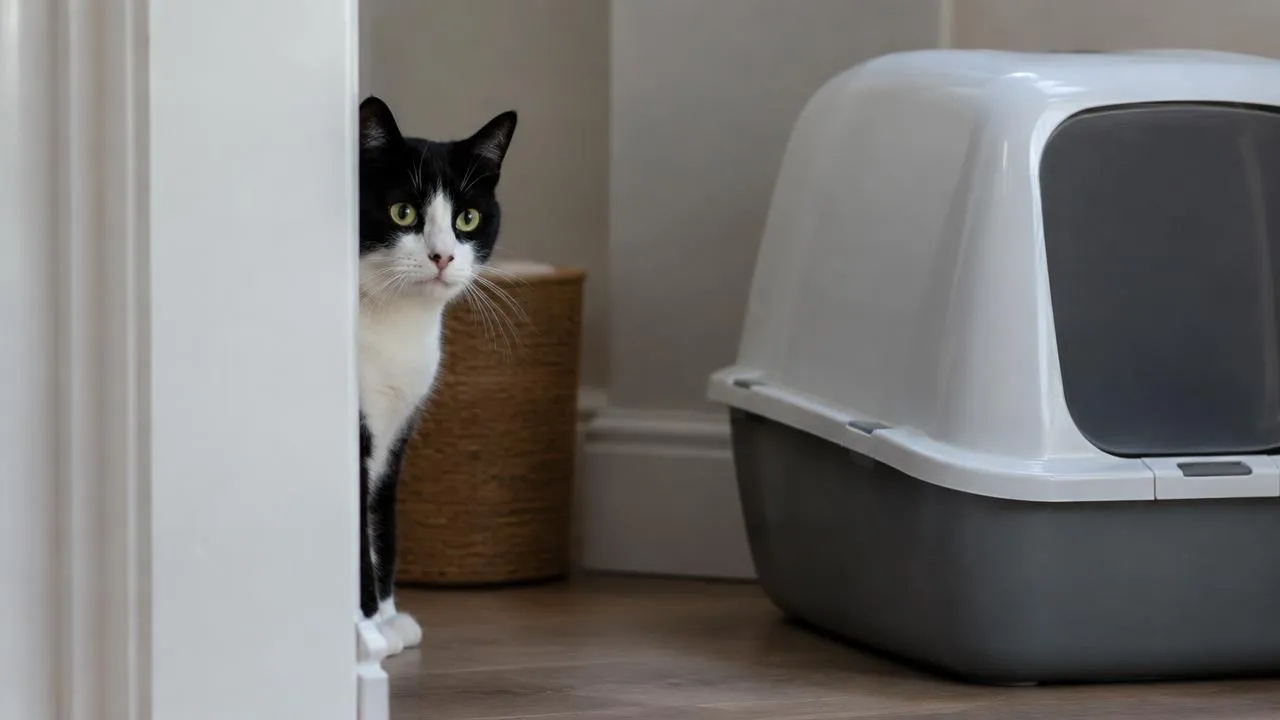
A litter enclosure meets a desire for home integration. For cats, the question differs: does the toilet area remain easy to reach and pleasant to use? AAFP/ISFM guidelines discuss open or covered boxes, size and management, but do not validate specific furniture. They provide benchmarks to examine your project. If considering an automatic device, check the exact model manual for permitted configurations and specific required conditions.
Do not confuse visual discretion with feline preference
AAFP/ISFM guidelines report that cats are divided between preferring large covered boxes and preferring open ones. They highlight that cleaning regularity may matter more than the presence of a lid. It would therefore be excessive to claim that a concealed space pleases all cats, or that they systematically dislike it. The individual cat and concrete environmental conditions remain the determining factors for success.
The authors favour open boxes when possible to facilitate monitoring and waste removal. This advice invites you to consider what the furniture changes for you too: can you observe the box and ensure maintenance easily? Successful decorative integration is not proof of feline adaptation. The project must maintain its primary function as a toilet area, rather than merely making an object disappear from view.
Evaluating internal space and possible posture
The AAFP/ISFM guide generally recommends a rectangular box 1.5 times the length from the cat’s nose to its tail base. It notes that small covered boxes can hinder the posture of large cats. Before choosing furniture, examine the actually usable box size and the space left around its entrance, rather than focusing solely on the external dimensions of the furniture itself.
Ease of entry is an explicit requirement in these recommendations. Animals with joint disorders may specifically require a very low opening. Ask yourself if your installation maintains this possibility for the cat concerned. It is irrelevant to judge only the furniture's opening if the box opening, or the path between the two, poses an additional difficulty for the user during their daily routine.
For motorised equipment, no universal clearance dimensions stem from veterinary sources. Check the exact model manual for installation conditions, component access and maintenance operations. If use within furniture is not clearly addressed, request a response from the manufacturer. Do not present the absence of a quickly found prohibition as a confirmation of compatibility. Safety must remain the priority when choosing any enclosure.
Anticipating maintenance rather than masking odours
AAFP/ISFM recommendations indicate that odours can deter a cat from a covered box, but usage may resume after cleaning restores a neutral scent. They also specify that an open box avoids trapping odours inside. These observations concern boxes; they do not allow for quantifying a furniture item's properties. However, they invite you not to overlook this essential question within your overall project design.
Deodorising powders are discouraged in the guide, which recalls that scented products can displease cats. Seeking to make the area less perceptible to humans must not replace its cleaning. Waste removal is recommended at least once daily. Reflect on how to perform this task before choosing an arrangement that would make it difficult to organise or maintain regularly for the animal's comfort.
Keeping paths and resources truly distinct
The AAFP/ISFM document notes that some cats prevent housemates from entering or exiting a box. In multi-cat households, examine encounters near the furniture and how each animal approaches. A facade matching the living room says nothing about these relationships. Observing interactions complements measurements and allows for discussing the layout without assuming that all cats will willingly share the same space or enclosed resource.
For a single cat, authors recommend two boxes in separate locations. For several, they adapt reflection to social groups and unaffiliated individuals. They also specify that neighbouring boxes are perceived as a single set. Furniture containing several containers must therefore not be immediately equated to multiple distinct stations distributed throughout the home. Real separation is key to reducing potential conflict between cohabiting feline individuals.
Reacting to refusal without blaming the cat
The MSD Veterinary Manual mentions urinating outside the box among signs of lower urinary tract disease. It associates this with straining, frequent attempts and blood in the urine. If behaviour changes after adding furniture, describe this chronology to the vet. It is useful, but insufficient to rule out a medical cause in favour of a decorative explanation. Always prioritise health over aesthetic preferences.
The AAFP/ISFM approach invites considering illnesses, toilet preferences and social or environmental factors together. Rather than forcing the use of the new arrangement, prepare observations on chosen locations, access and habits. The decision can then be built around the animal's real needs. No furniture, even designed to hide a box, constitutes a universal answer to inappropriate elimination. Respecting feline nature ensures long-term harmony.
Accessoires Chat is preparing a connected automatic litter box in a round format. It is not currently available for sale and its price remains to be validated; the image is illustrative. Specifications must be confirmed on the delivered model's manual. It is therefore impossible to announce its compatibility with a litter enclosure here, nor the specific conditions required for such an installation in your home.
Sources and further reading
- AAFP and ISFM Guidelines for diagnosing and solving house-soiling behavior in cats (Journal of Feline Medicine and Surgery, 2014)
- Manuel vétérinaire MSD — Lower Urinary Tract Disease in Cats
This advice is for information only and does not replace your veterinarian's opinion.