
Cleaning a Cat Kibble Feeder: Essential Best Practice
Cleaning a cat kibble feeder may seem simple, but appliances do not all share the same components or maintenance precautions. Consulting the user manual for your exact model is essential before dismantling or washing any single element. The overarching aim is also to preserve a quiet, predictable, and accessible dining space for your cat. According to the AAFP consensus statement, the way food is presented contributes directly to feline wellbeing: careful maintenance therefore forms an integral part of a broader feeding routine.
Start by identifying the different components
Locate within the user manual which parts are detachable, which elements can be washed safely, and which internal components must never be exposed to water. Avoid improvising disassembly and never submerge an electrical section based on mere assumption. Material specifications and cleaning guidance vary significantly from one model to another; the manufacturer’s documentation must always take precedence over generic advice found elsewhere.
Before carrying out any maintenance, ensure that the device cannot dispense or trigger during cleaning by following the manufacturer’s safety instructions. Empty the remaining dry food according to the recommended procedure and store the kibble in an appropriate, clean container. Once the parts are clean, wait until they are completely dry if the manual specifies this step, before reassembling the unit and serving food again.
Always bear in mind that feeding behaviour should be interpreted within its wider household context. The presence of other animals, the spatial placement of resources, and daily household movements can all influence access to the food bowl. Keep note of concrete daily observations and consult a veterinary professional if any difficulty persists or if your cat’s appetite changes noticeably.
Maintain a practical and realistic cleaning routine
The ideal cleaning frequency depends on actual usage, device design, and specific manufacturer recommendations. Rather than adhering rigidly to an arbitrary calendar, inspect the food bowl and all surfaces in contact with kibble on a regular basis, then clean them as instructed. If you notice oily residues or dirt, adapt your routine without using unapproved cleaning products. When in doubt, check the instructions for your specific model.
Take advantage of routine cleaning sessions to verify that the feeder sits securely and that your cat can reach their food with ease. The AAFP statement places strong emphasis on ensuring that cats can genuinely and comfortably access their meals. A spotlessly clean feeder that is unstable, awkward to reach, or situated in an uncomfortable, busy walkway does not satisfy this essential behavioural need.
Avoid introducing multiple changes at the very same time, as this makes it much harder to understand what is truly helping your cat. Introduce one modification at a time, retain familiar reference points that are already working well, and review the situation with your veterinary team whenever your pet’s physical condition, age, or daily nutritional needs begin to evolve.
Combine hygiene with accurate portion monitoring
Whenever you refill the hopper, measure the intended ration carefully rather than pouring by eye. The AAFP recommends determining your cat's daily food allowance with your vet, explaining that portions can be measured using kitchen scales or a measuring scoop. It notes that measuring dry food purely by volume can lack precision. Regular cleaning and refilling thus provide valuable opportunities to check settings and monitor dispensed amounts.
An automated feeder will not necessarily confirm how much your cat has actually consumed throughout the day. Regularly inspect the bowl itself and observe your pet, taking into account whether other household cats have access to the area. The consensus statement advises monitoring body weight and condition score, particularly for senior or vulnerable cats or those with special needs. If their appetite shifts, seek veterinary advice.
Take the time to keep practical details in an easily accessible place: dispensing times, agreed portion weights, and your veterinary clinic's contact details. Keeping an up-to-date record simplifies communication with relatives or pet sitters and helps you spot gradual changes in routine, rather than placing complete reliance solely upon a pre-programmed electronic setting.
Consider the wider organisation of mealtimes
While an automatic feeder can help provide several small meals throughout the day, it does not fully replicate natural feline foraging. The AAFP also suggests food puzzles and the deliberate, measured scattering of kibble to stimulate search behaviours. These enrichment options must always match your cat’s physical abilities and remain part of their overall daily food allowance; introduce them gradually and check that they eat normally.
In a multi-cat household, keeping the feeding station clean is only part of the task; separating resources is equally vital. Cohabiting cats often prefer distinct dining spaces, and some individuals will actively avoid others around food. Several visually separated feeding points, placed away from tense thoroughfares and accessible to each cat, can reduce competition. Regular cleaning therefore does not replace observing social interactions around meals.
The layout of the dining area deserves just as much attention as the feeding equipment itself. Choose a stable, quiet, and easily reached location, then observe whether your cat settles there comfortably to eat. Your pet’s reaction remains a valuable indicator: adapt the arrangement thoughtfully if meals appear rushed, frequently interrupted, or avoided altogether.
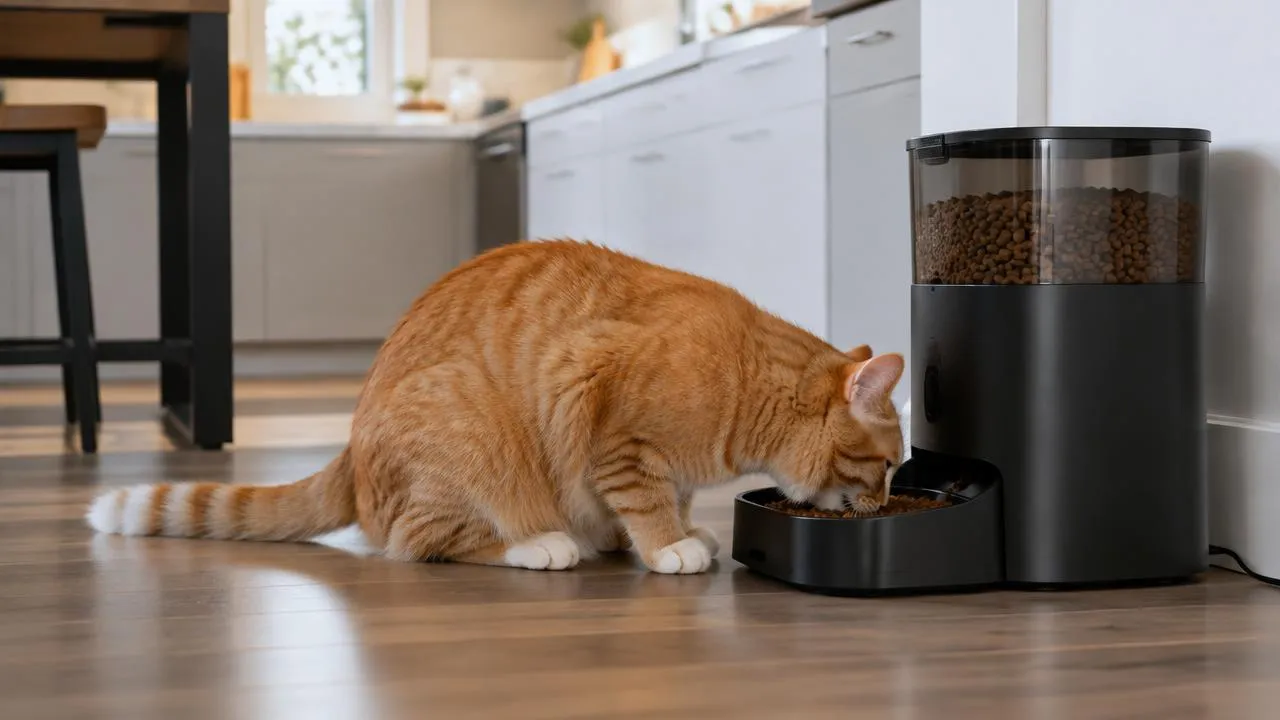
At Accessoires Chat, a black automatic kibble feeder with Wi-Fi is currently in development and is not yet available for purchase. Its price has not been finalised and the image shown is purely illustrative. Final technical specifications must be confirmed against the user manual supplied with the delivered model; please consult this manual to identify washable components and specific cleaning precautions.
Sources and further reading
This advice is for information only and does not replace your veterinarian's opinion.