
Feeding multiple cats: organising peaceful mealtimes
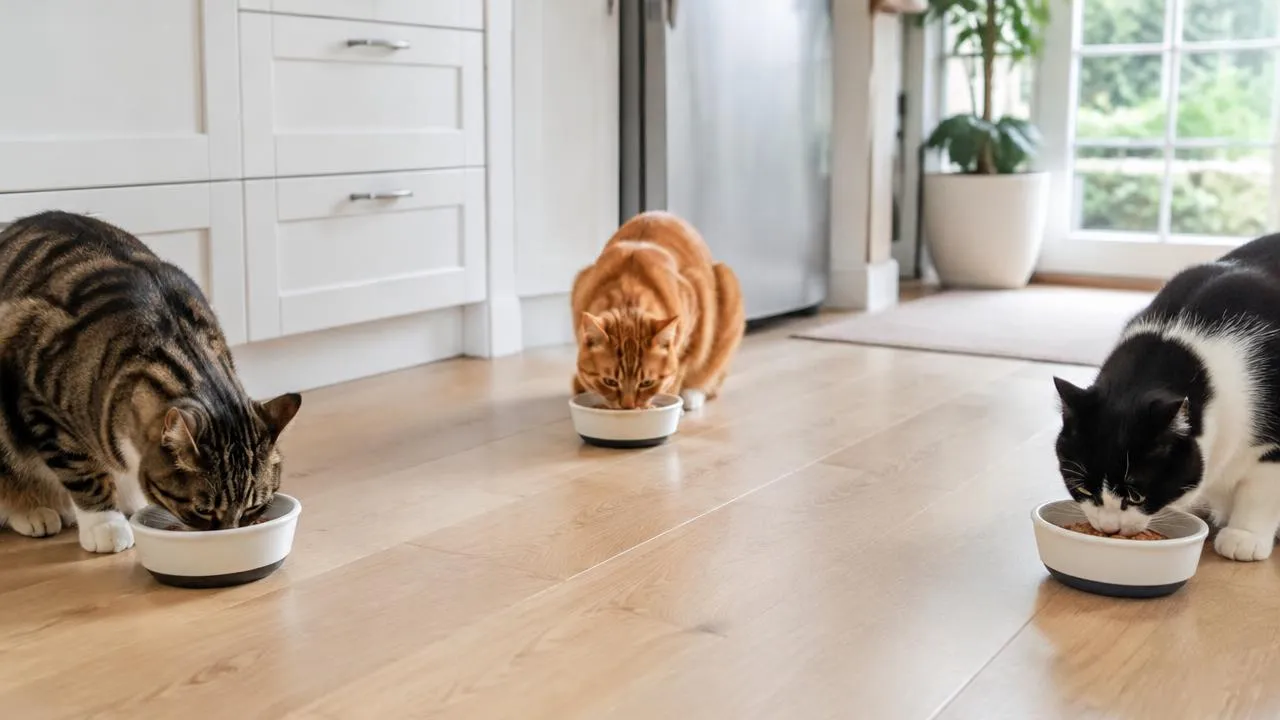
In a home where several cats live together, placing food bowls side by side can seem convenient. Yet sharing a room or feeding station does not guarantee that every pet feels at ease or receives their fair share. The AAFP consensus statement on feline feeding programmes reminds us that how meals are offered matters just as much as what is in the bowl. Observing social bonds, avoidance behaviours, and individual routines helps guardians create a far more suitable arrangement.
Why communal dining does not always suit cats
Cats are solitary predators that feed on small prey and prefer to eat frequently and alone, according to the AAFP consensus statement. While this tendency does not prevent some companions from eating in the same room, it reminds us not to assume that physical proximity is welcomed by all. An affectionate bond at other times does not necessarily mean that cats wish to share mealtimes.
Within a single group, relationships are rarely uniform. Some cats actively seek out the company of another, whereas others keep their distance. The AAFP also notes that cats do not always share domestic space equally. One companion may stay within a few rooms where they feel completely secure, while another moves freely throughout the home.
Competition around food can foster tension or subtle aggression before meals. These signs are not always obvious: a cat might simply wait until another moves away, hesitate to approach the bowl, or eat remarkably quickly. Looking at the wider picture, rather than relying solely on the absence of fighting, makes it easier to spot access difficulties.
In practice, a short period of observation after each change helps confirm that the arrangement works for everyone. Check whether each cat reaches their station without detours, eats at an unhurried pace, and departs without being followed. When multiple resources are needed, distribute them across the areas genuinely used by the cats, rather than clustering them together to simplify serving. These practical benchmarks allow you to adjust the layout to your home and your pets.
Mapping individual habits and household spaces
Before moving food bowls, observe where each cat spends their time and which animals approach one another or keep their distance. Note who arrives first, who waits, and whether one cat blocks a passageway. The aim is not to label a cat as dominant or timid, but to understand the practical conditions each individual needs to eat in peace.
Choose feeding spots where cats feel secure and can access their food with ease. The AAFP recommends several feeding stations that are visually separated. A partition, an existing piece of furniture, or separate rooms can limit direct sightlines between stations, provided these adjustments remain practical for the cats involved.
Placement must also reflect individual mobility and physical needs. An elevated spot might suit an agile cat, but will be unsuitable for an older or less mobile pet. Feeding stations should never be set up near litter trays. Ensure each companion can reach their food without having to cross an area they normally avoid.
Providing multiple meals and monitoring intake
The general recommendation from the AAFP is to divide daily food intake into multiple small meals throughout the day. The ideal frequency and portion size depend on each cat: ask your vet to help establish daily caloric needs and a reliable way to measure food. A kitchen scale or measuring cup can be used, keeping in mind that volumetric measures often lack accuracy.
In a multi-cat household, measure what is offered to each animal and observe what remains behind. The AAFP suggests comparing the amount presented with what is left after 24 hours to monitor consumption accurately. This benchmark does not replace veterinary care, but it helps make subtle changes in appetite much clearer.
A programmable feeder can help space out meals across the day. However, it does not replace natural foraging opportunities, nor does it guarantee that the intended cat ate the ration. Devices and functions vary: consult the manual for the exact model and monitor food intake, especially when pets have distinct dietary requirements.
Adjusting your setup over time
Introduce changes gradually and make sure each cat continues to access their food reliably. If a new feeding station is neglected, consider whether its location, access route, or the presence of another cat might explain this hesitation. Never force a cat to stay close to a companion they would normally choose to avoid.
The AAFP consensus statement recommends regularly checking body weight and body condition score, paying particular attention to older, frail, or medically vulnerable cats. Keeping notes on feeding times, portions, leftovers, and observed behaviours will also make discussions with your veterinary team much easier.
At Accessoires Chat, a black automatic kibble feeder with Wi-Fi connectivity is currently in development and is not yet available for sale. Its retail price has not been validated and the image is illustrative. Technical specifications remain subject to confirmation on the manual of the model delivered. It may eventually serve as an organisational tool, without presuming features that have not yet been confirmed.
Sources and further reading
This advice is for information only and does not replace your veterinarian's opinion.