
Where to Place Cat Bowls in a Multi-Cat Household?
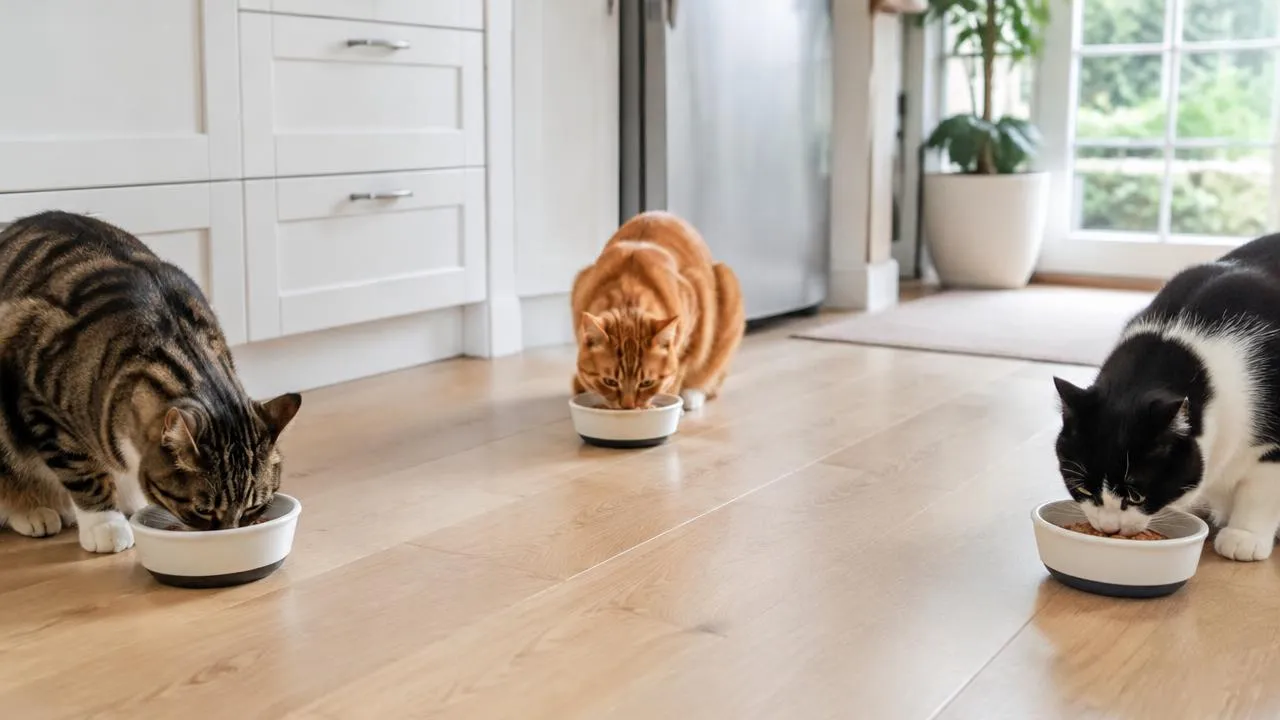
The placement of the feeding bowl significantly influences the conditions under which a cat accesses its meals. In a home with multiple pets, a corner that seems practical for humans is not automatically reassuring for every animal. The AAFP consensus statement advises taking into account the social dynamics of the group, frequented spaces, and zones that certain cats avoid. A few thoughtful observations will help you select a much more suitable location.
Observing What Happens at Mealtimes
Begin by observing several meals without immediately modifying your entire household routine. Which cat steps forward first? Does the other linger, move to another room, or eat with noticeable haste? Calm, repeated observation provides far more reliable information than an isolated incident. Note the times and the quantities offered, without interpreting every single gesture as a definite sign of conflict.
Cats in the same home do not necessarily use living spaces in an identical manner. Some avoid a companion or restrict their movements to one part of the house. The AAFP consensus statement reminds us that tensions can exist without overt physical displays. A cat that does not protest is not necessarily comfortable if another animal monopolises direct access to the bowl.
In practice, a short period of supervision after each modification helps verify that the solution works for all pets. Check whether each cat reaches their feeding station without making detours, eats at their own pace, and can leave without being followed. If multiple resources are required, distribute them across the areas genuinely used by the cats, rather than clustering them together to simplify serving. These practical benchmarks allow you to adjust the organisation according to your accommodation and your individual animals.
Creating Distinct and Accessible Stations
In a multi-cat household, the AAFP recommends establishing multiple feeding stations that are visually separated. These can be located in different rooms, provided each animal can reach them without encountering difficulty. Avoid forcing any cat to eat in close proximity to a companion that it routinely seeks to avoid in daily domestic life.
Take into account the agility and established habits of each individual. Using an elevated space may be considered when a cat’s physical condition comfortably allows it, but it is not automatically suitable for all pets. Stations must remain well away from litter trays and be readily accessible to the intended animal. If a pet barrier is used, check that it does not inadvertently block a cat from reaching its meal.
Monitoring Portions and Actual Intake
The AAFP advises offering daily food intake in the form of several small meals spread throughout the day. The precise amount to give should be discussed with your vet, who can help determine the caloric needs of each cat. Measuring out portions using kitchen scales or a measuring scoop allows you to monitor what is being offered far more reliably.
In a home where cats swap bowls, individual monitoring is particularly important. Record the quantity served to each pet and note what remains. The recommendation also mentions the possibility of comparing the food offered with what is left after twenty-four hours. While this record can be helpful, it does not replace a professional veterinary evaluation or direct observation of actual food consumption.
Evaluating Bowls and Adapting the Environment
For any feeding bowl, verify above all that it is stable, clean, and positioned so that the cat can reach its food comfortably. AAFP recommendations do not prescribe a universal shape or rim width. If you consider introducing a different bowl, make a gradual change that you can observe, and ensure that your cat continues to feed normally without hesitation.
When cats have differing needs, separating feeding stations makes daily monitoring much clearer. Separate rooms or suitable pet barriers can be considered depending on your home layout and the physical abilities of the animals. Selective-access devices exist, but features vary considerably from one product to another: always check the operational instructions and details in the user manual.
Building a Sustainable and Realistic Routine
A successful arrangement is one that the cats genuinely use and that human caregivers can reliably maintain. Choose schedules and feeding stations that are compatible with household life, then confirm that no animal is left without safe access. If group relationships evolve or a cat alters its habits, re-examine the layout rather than regarding the initial plan as definitive.
You can enrich mealtimes by introducing appropriate foraging opportunities. The AAFP mentions puzzle feeders and scattering kibble across novel locations to encourage exploratory physical activity. Introduce simple puzzles first, choosing an option suited to the food type and the cat’s individual abilities. Automatic feeders can help divide daily rations into smaller portions, but they do not always substitute for the predatory sequences and active search of foraging.
At Accessoires Chat, a black automatic kibble dispenser with Wi-Fi is in preparation and is not yet available for sale. Its price has not been validated and the image is illustrative. Technical specifications must be confirmed on the user manual of the model actually delivered. Do not assume any particular functions prior to this verification, and seek professional advice when integrating any new device into your cat's feeding plan.
Sources and further reading
This advice is for information only and does not replace your veterinarian's opinion.