
Where to place the cat's litter box for peaceful access?
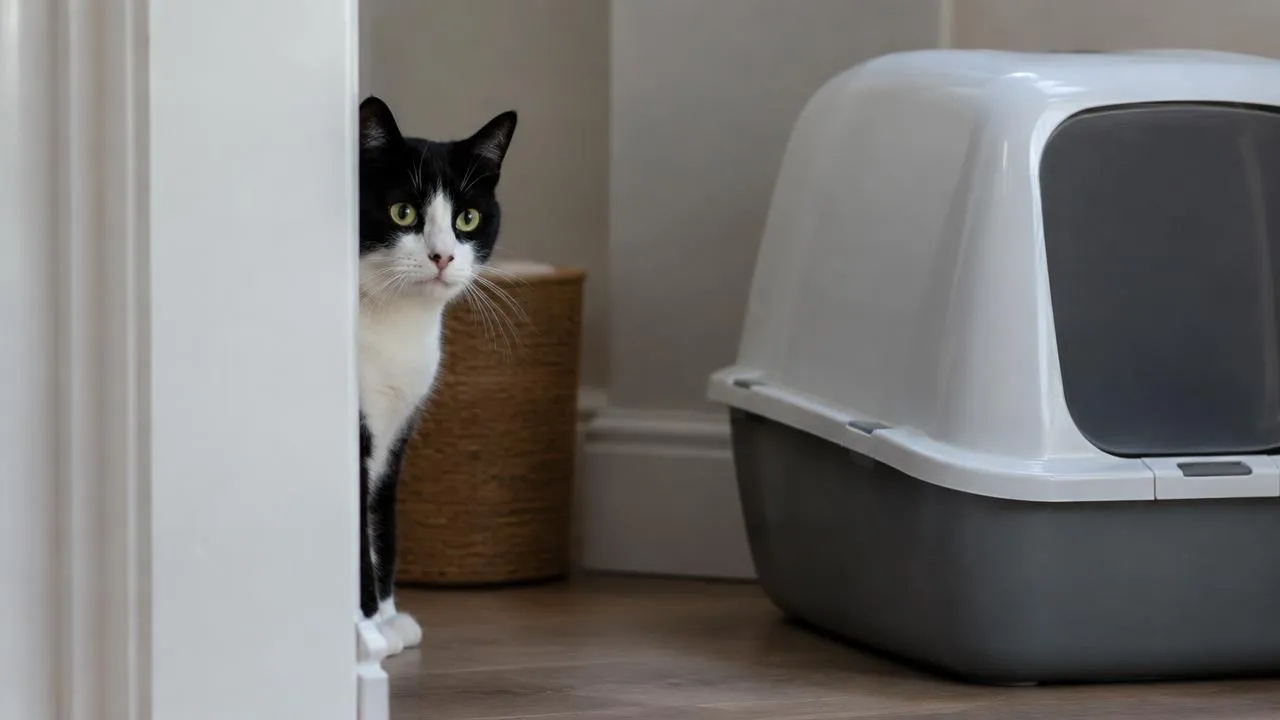
You have found a suitable tray, but its location remains difficult to choose. Where should you place the cat's litter box when rooms are already used for eating, sleeping or moving? The AAFP/ISFM guidelines invite looking at the home from the animal's perspective: peace, availability and absence of forced encounters. It is not about designating an ideal room for every household, but verifying the chosen spot allows needs to be met without unpleasant experiences.
Prioritise a quiet location, not just a discreet one
The AAFP/ISFM guidelines indicate that most cats prefer a private space over high-traffic areas for elimination. They also report that some avoid trays installed near doors or cat flaps used by other cats. A corner that is not very visible to you is therefore not necessarily peaceful for them. Examine what happens around the tray when animals and inhabitants move about. A location that seems hidden might actually be a busy corridor for pets.
Noisy appliances are among the unfavourable situations mentioned in this text. An installation chosen solely because it disappears behind household equipment thus deserves to be re-evaluated. Without imposing a specific distance absent from the recommendations, ask yourself if this spot associates the toilet with a noise or an unpleasant event. Decorative discretion must not become the sole decision criterion. Ensure that the feline does not feel startled by sudden mechanical sounds while using the box.
Separate the toilet from the feeding points
The AAFP/ISFM advises against placing food and water near the tray, as this proximity could discourage elimination in that spot. The document does not provide a universal number of metres to respect. Avoid arbitrary rules: it is about organising separate zones, rather than believing that a specific gap guarantees acceptance. First identify where your cat eats and drinks before selecting the toilet location. This separation respects natural feline hygiene behaviours and prevents unnecessary stress.
In a small dwelling, begin by mapping usages instead of grouping everything into a "cat corner". This way of thinking helps distinguish possible locations without inventing a minimum surface standard. If you hesitate between two configurations, compare each against the text's criteria: meal separation, calm and ease of access. The chosen location must be evaluated as a whole, not just on its footprint. Strategic placement ensures the cat feels safe while performing its basic daily needs.
Preserve movement between cats and between floors
For a multi-level house, the authors recommend at least one tray on each floor. They also suggest two toilets in distinct locations when only one cat lives in the household. These indications show why a single dedicated room does not always meet all situations. Reflect on the possibilities offered in different parts of the dwelling, even if a central location seems more convenient to you. Having multiple options reduces the risk of inappropriate elimination issues.
In the presence of housemates, access must not force one animal to confront another. The recommendations describe difficulties caused by a cat that monopolises the toilet or blocks entries and exits. Therefore, look at the surroundings as much as the container itself. Several trays side by side are treated as a single large box; when their openings are close, avoid facing them directly towards each other. This prevents a cat from being trapped inside by another.
Do not turn this spot into a place of constraint
A suitable location may become avoided if painful experiences are repeated there. The AAFP/ISFM cites administering medication in the tray and children holding the cat there among counterproductive interventions. The toilet area is thus not a practical station for catching the animal. Inform the people living with you: when the cat uses this resource, it must be able to leave freely. Safety and trust are essential for maintaining good litter box habits over time.
To examine a refusal, note what has changed around the installation rather than immediately attributing the behaviour to ill will. The document links avoidance to unpleasant associations, but also to a soiled tray. Location and maintenance must be examined together. You can thus distinguish the questions to discuss: has the passage become more frequent, is another cat waiting nearby, are waste clumps removed regularly? Consistency in cleanliness is as vital as the physical placement of the box.
Move progressively, without forgetting medical evaluation
If a cat eliminates elsewhere, the guidelines suggest trying a new location for its tray. When it starts using it again, they advise maintaining this spot for at least two weeks, even if it inconveniences the inhabitants. Once usage has become regular, a progressive move can be considered. This approach differs from repeatedly moving the box based on human preferences. Gradual changes allow the cat to adjust its mental map of safe elimination zones without stress.
However, changing the place does not dispense with searching for an illness. In the MSD Veterinary Manual, urinating outside the toilet is among the manifestations of lower urinary tract diseases. Blood, frequent visits or straining to urinate constitute other described signs. If you observe these changes, talk to your veterinarian: a new home organisation is not enough to explain or manage all possible causes. Medical issues often masquerade as simple behavioural problems in domestic felines.
Accessoires Chat is preparing a connected automatic litter box in a round format, which is not yet for sale. At this stage, the price remains unvalidated and the image serves solely as an illustration. Specifications remain to be confirmed by consulting the manual of the model actually delivered. For any advice specific to an automatic device, check the manual of the exact model before selecting a location for it.
Sources and further reading
- AAFP and ISFM Guidelines for diagnosing and solving house-soiling behavior in cats (Journal of Feline Medicine and Surgery, 2014)
- Manuel vétérinaire MSD — Lower Urinary Tract Disease in Cats
This advice is for information only and does not replace your veterinarian's opinion.