
Separating Meals for Cats on Different Diets
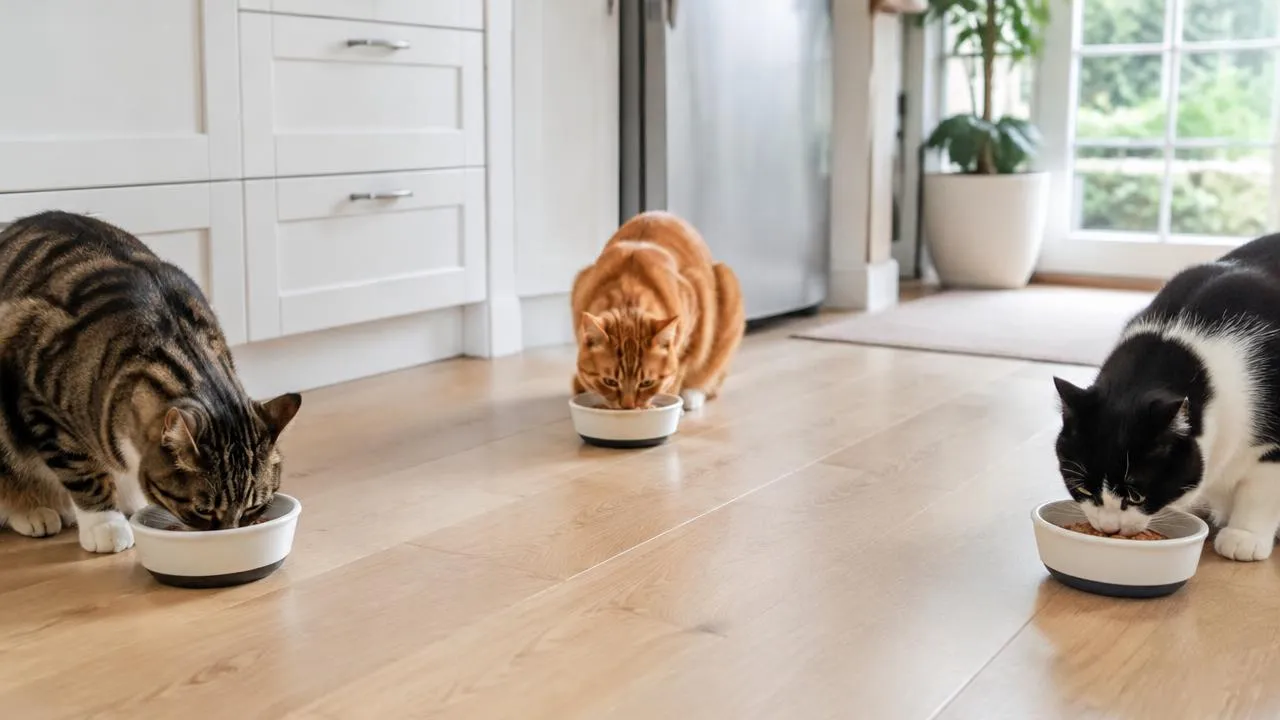
When cats in the same household have distinct dietary requirements, a shared feeding station makes it difficult to monitor what each individual consumes. The AAFP consensus statement recommends taking individual dietary needs into account when placing essential resources around the home. Your veterinary team can guide you on suitable diets and appropriate portion sizes. Setting up separate feeding zones and maintaining attentive observation helps make daily mealtime management clearer and more reliable.
Observing What Happens During Meals
Begin by watching several meals without immediately overhauling your entire household routine. Which cat approaches the food first? Does the other cat hesitate, leave the room, or eat hurriedly? Calm and repeated observation provides far more dependable information than an isolated incident. It is equally sensible to note feeding times and quantities offered, without assuming that every subtle gesture represents a definitive sign of conflict.
Cats sharing a home do not always use living spaces in the same way. Some actively avoid a housemate or restrict their movements to a specific area of the property. The AAFP consensus statement notes that social tension can exist without obvious outward signs. A cat that does not openly protest is not necessarily at ease if another animal is quietly monopolising access to the food.
In practice, a brief period of observation after every adjustment helps verify that the setup suits everyone. Check whether each cat reaches their feeding station directly, eats at their own pace, and leaves without being followed. When multiple resources are required, distribute them across areas the cats genuinely use, rather than grouping them together for convenience. These practical benchmarks allow you to adapt routines to your home and your pets.
Creating Separate and Accessible Feeding Stations
In multi-cat homes, the AAFP advocates providing multiple feeding stations that are separated visually from one another. These stations can be located in different rooms, provided each animal can reach their food easily and without stress. Avoid obliging a cat to eat in close proximity to a companion animal whom they would normally prefer to avoid during the day.
Take the agility, age, and established habits of each cat into careful consideration. Using an elevated area can be explored when a cat's physical condition permits, but it is not automatically suitable for all felines. Feeding stations must always be kept well away from litter trays and remain easily accessible to the intended pet. If barriers are used, ensure they do not accidentally block access for a cat needing their meal.
Monitoring Portions and Actual Intake
The AAFP recommends offering daily food allowances as multiple small meals spaced throughout the day. The exact quantity to provide should be discussed with your veterinary surgeon, who can help determine each cat's individual energy requirements. Accurately weighing portions using kitchen scales or a reliable measuring scoop makes it far simpler to keep track of what is actually being offered.
In households where cats tend to swap bowls, monitoring individual intake becomes especially important for their wellbeing. Record the quantity served to each pet as well as any food remaining. Recommendations also mention comparing food offered with leftovers after twenty-four hours. This record-keeping can be useful, but it does not replace a veterinary assessment or direct observation of what is consumed.
Assessing Bowls and Adjusting the Setup
When choosing a bowl, the main priority is ensuring it is stable, clean, and positioned so the cat can reach their food comfortably. The AAFP guidelines do not mandate a single universal shape or width. If you decide to introduce an alternative dish, make changes you can observe directly, confirming that the cat continues to eat normally and comfortably.
Where cats have differing nutritional needs, separating their stations makes tracking daily intake far clearer. Separate rooms or suitable interior barriers can be considered according to your living space and the abilities of your animals. Individualised microchip-access feeders are available, but their features differ between models; always check the manufacturer's manual carefully before relying on them.
Building a Practical Daily Routine
A successful feeding arrangement is one that cats use comfortably and owners can realistically sustain over time. Select meal times and feeding locations that fit smoothly into household life, then verify that no pet is left without access. If social dynamics change or a cat alters their habits, review the layout rather than treating your plan as permanently fixed.
You can enrich mealtimes by incorporating appropriate foraging opportunities. The AAFP highlights food puzzles and scattering kibble in novel locations to encourage activity and mental engagement. Introduce basic puzzles first, choosing designs suited to the food type and the cat's capabilities. Automatic dispensers can divide meals into smaller servings, though they do not fully replicate natural hunting and foraging behaviours.
At Accessoires Chat, a black automatic kibble feeder with Wi-Fi is currently in development and is not yet available for purchase. Its price has not been finalised, and the image is purely illustrative. Technical specifications and features must be verified on the instructions provided with the model that is physically delivered. Please do not assume specific capabilities prior to this check, and seek professional advice when integrating any device into your cat's feeding programme.
Sources and further reading
This advice is for information only and does not replace your veterinarian's opinion.