
Monitoring your cat's urine in the litter box: useful benchmarks
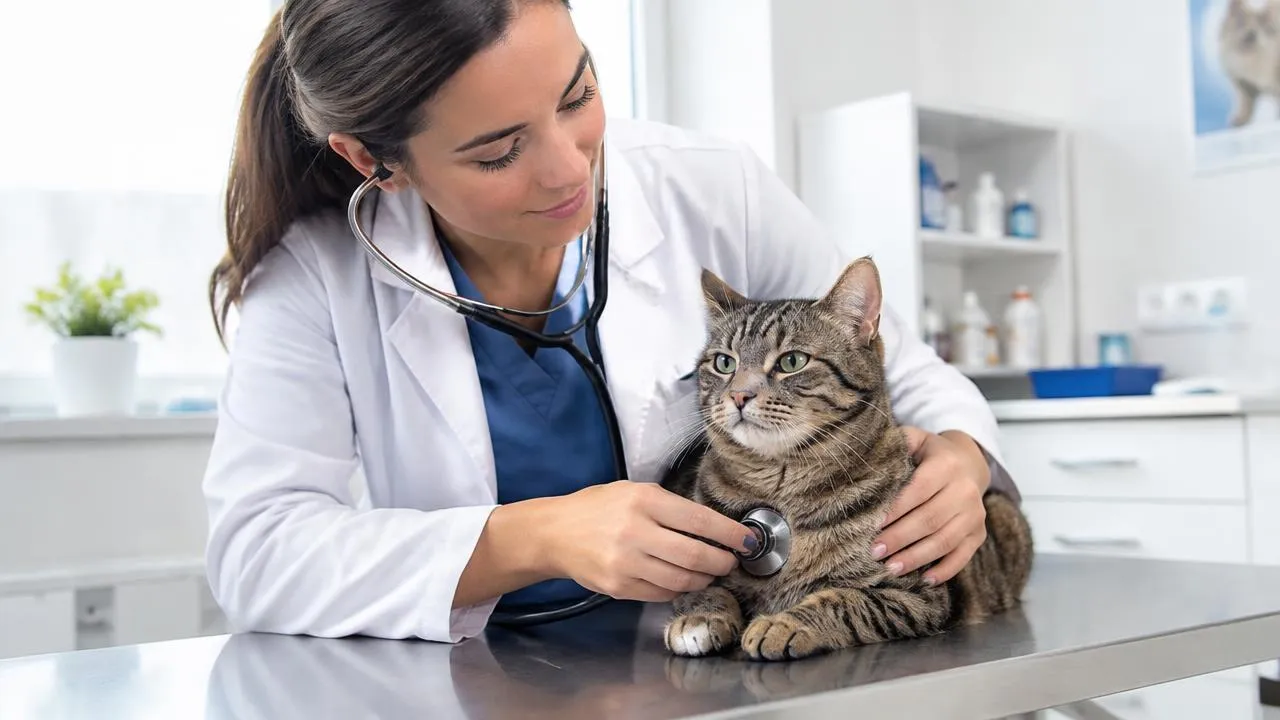
To monitor your cat’s urine in the litter box, it is most helpful to watch for changes without turning every visit into an exam. Your observations help the veterinarian reconstruct a history, but they do not determine the cause of the problem. A clean box is not a certificate of good health. Here is how to link visible traces, feline behaviour, and access conditions, while keeping a clear place for clinical consultation.
Watch the cat before looking at the traces
The MSD Veterinary Manual lists four characteristic manifestations of lower urinary tract diseases: blood presence, frequent urination, straining to urinate, and urine deposited outside the box. These are clues to describe, not elements of a diagnosis you could establish alone. Several diseases can produce a similar picture; an explanation found on the internet is therefore not sufficient to choose a treatment. Professional medical advice remains mandatory for any suspected health issue or discomfort.
Observe specifically if your companion returns quickly to their toilet and if you actually see urine after their attempt. Note what you have observed rather than concluding they have 'cystitis'. If straining produces no urine, contact a veterinarian immediately: domestic monitoring must then give way to an urgent evaluation, without waiting to complete your notes. Straining without production is a medical emergency that requires swift intervention to ensure your cat's vital safety.
Build a chronology rather than a score
AAFP/ISFM guidelines place great importance on the onset of the problem and its evolution. In a notebook, separate your dated observations from hypotheses: observed visits, traces found outside the box, changes in toilet location, or conflict between cats. This presentation allows for recounting events in their proper order, instead of providing a global impression that is difficult to specify during the appointment. Clear timelines help the clinical staff identify patterns and potential triggers.
You can also prepare a small floor plan of the home. Locate the boxes and the spots where you found urine, then indicate noisy passages or meeting zones between animals. This type of description aligns with the approach proposed by the AAFP/ISFM. It does not prove that an environmental factor explains the problem, but it helps to ask the right questions after the medical exam. Environmental mapping provides context that subjective descriptions often lack during visits.
Make observations possible without disturbing the animal
To facilitate monitoring and waste removal, AAFP/ISFM recommendations favour an open box when possible. They specify, however, that individual preferences matter and that cleanliness may carry more weight than the presence of a lid. The goal is not to impose a new installation on a cat who willingly uses their current one, solely to observe them better. Sudden changes in the environment can cause stress, which might complicate the existing urinary issues.
The same document recommends removing waste at least daily and washing the box with soap and hot water, avoiding strong chemicals or ammonia-based products. Use this maintenance time to note any anomalies you see. Do not deliberately leave the toilet dirty to accumulate evidence: its condition can itself contribute to box avoidance. A clean environment ensures that the signs you observe are related to health rather than a reaction to poor hygiene standards.
Separate observations in a shared household
When several felines live together, clearly indicate what you know about the user's identity and what remains uncertain. Write, for example, that a trace was discovered in a shared box, rather than automatically attributing it to the cat already known to be ill. Unknown information has its place in the report; it avoids building the entire discussion on an unverified association. Accurate attribution is vital for selecting the correct patient for treatment.
The AAFP/ISFM describes situations where one animal monopolises resources and prevents another from reaching the toilet or leaving it. Therefore, watch the paths and encounters too. An absence of observed visits does not, by itself, tell what is happening in the bladder: the veterinarian must be able to distinguish access difficulties, elimination elsewhere, and actual urinary signs. Monitoring social dynamics is just as important as checking the litter box contents for traces.
Know the boundary between monitoring and medical assessment
According to the MSD, stones, urinary infections, urethral plugs, and tumours are among the possible causes of urinary signs; idiopathic cystitis is also frequent. Exams serve to differentiate these possibilities. No colour observed in the granules nor any history of visits replaces a urinalysis, a culture, or imaging when the practitioner deems them necessary for your animal. These diagnostic tools provide the objective data required to formulate a safe and effective medical plan.
If you use automatic equipment, check the manual for the exact model to see how to consult available information and perform maintenance. Do not attribute a diagnostic capacity to a counter that has not been established. When calling, start with the concerning facts and specify uncertainties; the notebook then serves as support. The good result of monitoring is clear transmission, not a certainty manufactured at home. Always rely on professional veterinary expertise for diagnosis.
Accessoires Chat is developing a connected automatic litter box with a round format. This project is in preparation and not yet for sale; no price is validated and the image remains illustrative. Characteristics must be confirmed in the manual of the delivered model. This presentation does not allow for deducing monitoring functions or retaining performance metrics for your daily tracking. This product remains a draft not for sale with illustrative imagery.
Sources and further reading
- AAFP and ISFM Guidelines for diagnosing and solving house-soiling behavior in cats (Journal of Feline Medicine and Surgery, 2014)
- Manuel vétérinaire MSD — Lower Urinary Tract Disease in Cats
This advice is for information only and does not replace your veterinarian's opinion.