
Cat kibble feeder and owner absence
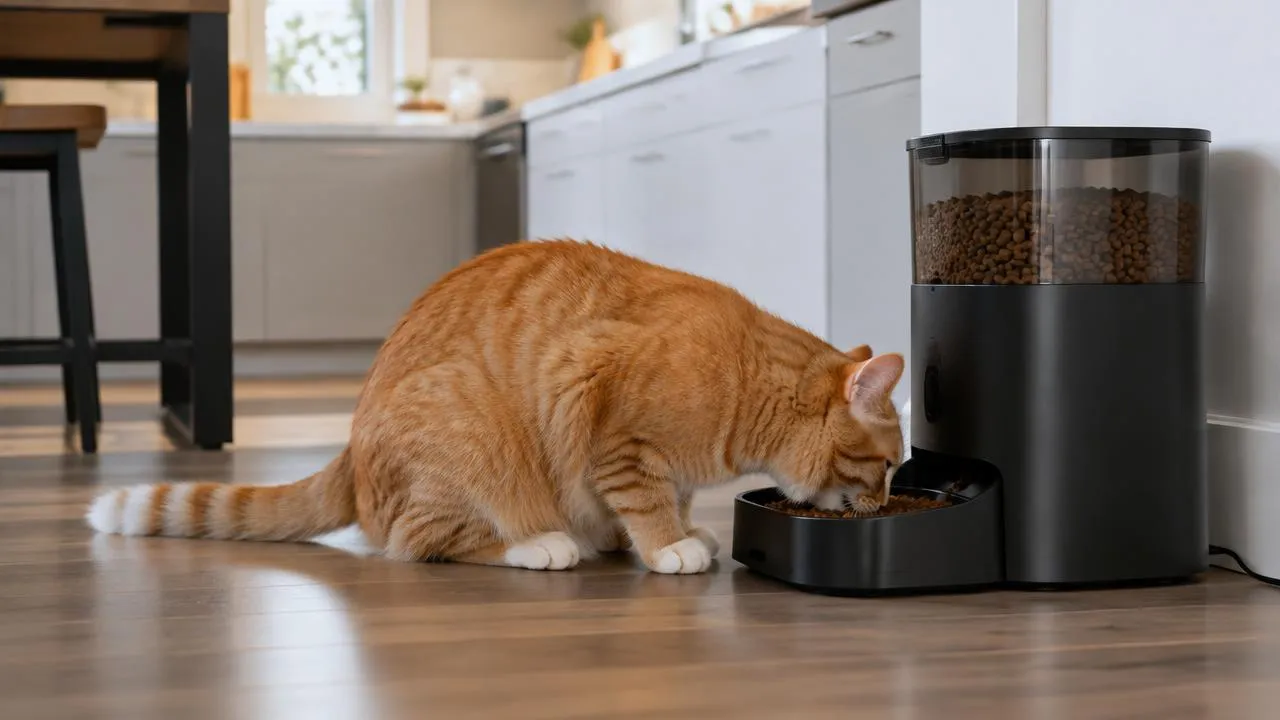
Before comparing devices, examine your cat's daily routine: where they eat, whether they are alone, and whether their access to food remains peaceful. The AAFP recommends offering several small meals spread throughout the day and ensuring that the animal consumes an appropriate amount. The precise daily dietary ration requires tailored advice, particularly from a veterinary surgeon. In this guide, our practical advice focuses on overall organisation and the checks you need to make; technical capabilities remain specific to each individual model.
What an automatic device can provide
The general principle is to release dry kibble according to a schedule or command set by the device. Dispensing mechanisms, portion settings, and operational methods differ significantly between models: always check the manual for your exact unit. Do not assume from appearance alone that a machine measures accurately or identifies an animal. If multiple pets live together, observe their habits at various times. A station accessible to one cat may be avoided by another. Separating feeding points and managing access individually helps create an arrangement reflecting each pet's relationships and preferred spaces.
Dividing daily food into several smaller portions fits well into an organised routine of small meals. The AAFP consensus statement notes that automatic feeders can be useful, whilst pointing out that they generally do not provide opportunities for foraging and predation. An appliance is therefore simply a distribution tool, rather than a complete answer to behavioural needs.
Choosing according to the cat and their environment
Begin by identifying where your companion feels safe to eat. In multi-cat homes, animals do not always share available space equally, and some will actively avoid their housemates. The AAFP recommends multiple feeding stations, visually separated, to provide distinct areas and reduce competition. When considering a cat kibble feeder and owner absence, prioritise your pet's needs rather than mere convenience. A well-chosen device should fit into a routine you can supervise, without preventing the cat from eating in a quiet spot.
Consider the natural agility and specific physical requirements of each cat when choosing an installation site. An elevated spot may suit some pets if their physical condition allows, but it must not become a barrier. Stations should not be positioned near litter trays, in accordance with AAFP recommendations.
Schedules and quantities: starting from a consistent baseline
Before programming anything, establish the daily allowance with your veterinary team if necessary. The AAFP recommends that a professional advise on calorie requirements and portion measurement. Kitchen scales or volumetric measures can be used; ongoing monitoring confirms what is actually eaten. If multiple pets live together, observe their habits at various times. A station accessible to one cat may be avoided by another. Separating feeding points and managing access individually helps create an arrangement reflecting each pet's relationships and preferred spaces.
Dividing an intended daily allowance into multiple meals does not mean increasing the daily total without careful thought. Measure portions when filling the hopper and compare this with leftovers or consumed food. Monitor weight and body condition regularly, paying close attention to older, frail, or unwell cats, or those with special requirements.
Programming and verifying correct operation
Carefully read the manufacturer's instructions before setting meal times, portion sizes, and associated features. Units and controls vary: no dispensed amount can be assumed identical from one machine to another. Run a test whilst present, watch the kibbles drop, and confirm your cat reaches the food comfortably. When considering a cat kibble feeder and owner absence, prioritise your pet's needs rather than mere convenience. A well-chosen device should fit into a routine you can supervise, without preventing the cat from eating in a quiet spot.
Note down the chosen settings and expected meals, then inspect leftovers and your cat's behaviour. A device alone cannot tell you which pet ate in a shared home. If appetite changes or access proves difficult, do not simply adjust the timer: seek advice from your vet.
Maintaining foraging behaviour and ongoing observation
Food puzzles and hunting games can stimulate physical and mental activity. The AAFP suggests starting with an easy-to-use puzzle and matching its difficulty to the cat's abilities. You can consider these activities alongside normal meals, ensuring food remains accessible and the animal successfully obtains it. If multiple pets live together, observe their habits at various times. A station accessible to one cat may be avoided by another. Separating feeding points and managing access individually helps create an arrangement reflecting each pet's relationships and preferred spaces.
The appliance alone cannot show whether mealtimes are genuinely peaceful. Watch whether your cat approaches, eats, and walks away undisturbed, and check if a housemate monopolises the area. The consensus statement stresses that tension between cats is not always obvious. Regular observation helps you spot changes to discuss with a professional.
At Accessoires Chat, a black automatic kibble feeder with Wi-Fi is currently in preparation and is not yet available for sale. Its price has not been confirmed; the accompanying image is illustrative. The exact features must be verified in the user manual of the model actually delivered. Do not assume any functionality prior to checking this documentation.
Sources and further reading
This advice is for information only and does not replace your veterinarian's opinion.