
Programmable dry food dispenser: schedules and portions
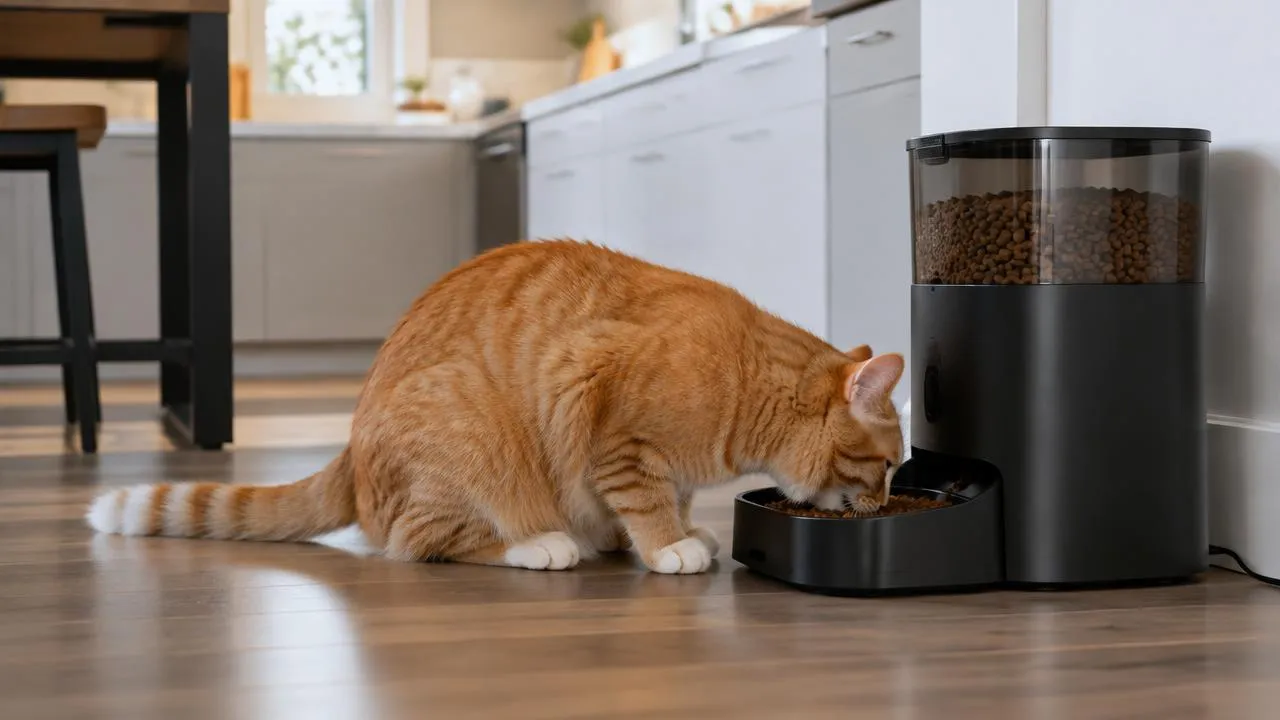
The AAFP consensus statement on feline feeding programmes reminds us that feeding a cat is not merely about choosing its food. The way meals are presented matters just as much. Cats generally prefer to eat frequently and alone, whereas an automatic dispenser does not necessarily meet all their foraging and predatory needs. In this guide, our advice focuses on organisation and the checks to carry out; technical capabilities remain specific to each individual model.
What an automatic device can provide
The general principle is to release dry food according to a schedule or a command intended by the device. Mechanisms, settings, and procedures differ across models: check the manual for your exact model. Do not deduce from appearance alone that a device measures accurately or recognises an animal. For the subject 'programmable dry food dispenser: schedules and portions', keep your pet's needs as your priority rather than the mere convenience of the device. A properly chosen device should fit into a routine you can monitor, without preventing the cat from feeding in a quiet place.
Splitting food intake can fit into an arrangement of small meals. The AAFP statement indicates that automatic feeders can be useful, whilst specifying that they generally do not provide opportunities for foraging and predation. A device is therefore a dispensing tool, rather than a complete response to behavioural needs.
Choosing according to the cat and its environment
Start by identifying the spot where your companion feels safe to eat. In multi-cat homes, animals do not necessarily share spaces equally, and some avoid their fellow cats. The AAFP recommends several feeding stations, visually separated, in order to offer distinct areas and limit competition. If several animals live together, observe their habits at different times. A station accessible to one may be avoided by another. Separating feeding points and individually controlling access facilitates an arrangement that matches each cat's relationships and preferred spaces.
Take into account the agility and special needs of each cat when choosing the location. Elevated access may suit certain animals if their physical condition permits, but it must not become an obstacle. Feeding stations should not be placed near litter trays, in line with AAFP recommendations.
Schedules and quantities: starting from a coherent baseline
Before programming anything, establish the daily quantity to offer, with the help of your veterinary team if necessary. The AAFP recommends that the professional advise on the number of calories and how to measure portions. Kitchen scales or a volumetric measure may be used; practical monitoring makes it possible to verify what is actually consumed. For the subject 'programmable dry food dispenser: schedules and portions', keep your pet's needs as your priority rather than the mere convenience of the device. A properly chosen device should fit into a routine you can monitor, without preventing the cat from feeding in a quiet place.
Dividing a planned quantity into several meals does not authorise increasing the daily total without careful consideration. Measure portions upon filling and compare them with leftovers or food consumed. Regularly monitor weight and body condition, paying special attention to older, weakened, or ill cats, or those with specific needs.
Programming and verifying operation
Read the instruction manual before setting schedules, portions, and any associated features. Units and controls vary: no dispensed quantity can be assumed to be identical from one device to another. Carry out a trial run in your presence, observe how the dry food is released, and confirm that the cat can reach the food without hindrance. If several animals live together, observe their habits at different times. A station accessible to one may be avoided by another. Separating feeding points and individually controlling access facilitates an arrangement that matches each cat's relationships and preferred spaces.
Note down the chosen settings and expected meals, then check any leftovers and the cat's behaviour. A device alone does not allow you to know which animal ate in a shared household. If there is a change in appetite or difficulty accessing food, do not merely modify the programme: seek advice from your vet.
Maintaining a dimension of foraging and observation
Food puzzles and foraging for kibble can stimulate physical and mental activity. The AAFP suggests starting with an easy-to-manipulate puzzle and tailoring its difficulty to the cat's capabilities. You can consider these activities as a supplement, ensuring that food remains accessible and that the animal succeeds in obtaining some. For the subject 'programmable dry food dispenser: schedules and portions', keep your pet's needs as your priority rather than the mere convenience of the device. A properly chosen device should fit into a routine you can monitor, without preventing the cat from feeding in a quiet place.
The device does not indicate on its own whether the meal is taking place peacefully. Watch whether the cat approaches, eats, and leaves without being disturbed, and whether a companion animal is monopolising the area. The consensus document underlines that tension between cats is not always obvious. Regular observation helps identify changes to discuss with a professional.
At Accessoires Chat, a black automatic dry food dispenser with Wi-Fi is currently in preparation and is not yet available for sale. Its price has not been confirmed; the image is illustrative. Features will need to be confirmed in the manual for the model actually delivered. Do not assume any function prior to this verification.
Sources and further reading
This advice is for information only and does not replace your veterinarian's opinion.